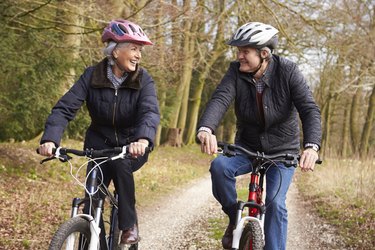
If you're one of the 14 million people in the U.S. who have knee osteoarthritis, exercising is a must. Not only can physical activity help ease joint pain and preserve joint function, it can also help stave off arthritis-related disabilities, according to the Centers for Disease Control and Prevention (CDC).
"There's a popular idea that 'motion is lotion," says Joseph Garry, MD, a visiting professor of clinical family medicine at the University of Illinois College of Medicine Rockford.
Video of the Day
Video of the Day
As you exercise, your muscles get stronger, which allows them to better support your bones and surrounding tissue, according to the Mayo Clinic. This, in turn, helps ease the stress that's placed on your knee joint, helping your knees to feel better.
The best exercises for knee osteoarthritis will help strengthen the muscles above the knee — in particular, the quadriceps (the front of the thigh) and those of the gluteus (the muscles in the buttocks). That's where cycling comes in.
Is Bike Riding Good for Knee Osteoarthritis?
Cycling is a great activity for people with knee osteoarthritis because it strengthens the gluteal and quadriceps muscles, says Dr. Garry. Plus, many people find that it's one of the easier exercises to stick with.
"The compressive forces that go through your knee during cycling are far less than those during walking," says Brian Andonian, MD, a rheumatologist and assistant professor of medicine at Duke University School of Medicine. "It tends to be more comfortable for people."
Most people with knee osteoarthritis will be able to cycle without a problem, says Dr. Garry. One possible exception, however, is people with osteoarthritis of the kneecap — i.e., patellofemoral arthritis, which affects the area of the joint where the kneecap (patella) meets the thighbone (femur).
For people with this form of knee osteoarthritis, cycling — which requires you to bend the knee often — can be painful, says Dr. Garry. "They're usually better off doing something like walking, where they can really minimize how much that knee has to bend," he says.
Still, even people with osteoarthritis of kneecap might be able to cycle successfully if they position their seat as high as they can — this way, their foot will do more work to push the pedal around in a circle as opposed to their knee, says Dr. Garry. "The higher the seat, the less the knee has to bend," he says.
How to Cycle with Knee Arthritis
There are two types of bicycles you can use to cycle if you have knee osteoarthritis: a traditional bicycle or a stationary bicycle. Traditional bicycles are usually used outdoors, but you can buy a piece of equipment called a bike trainer (think of it like a stand for your bicycle) that allows you to use the bike indoors. Stationary bikes are used indoors, and are often found in gyms.
People who are severely impaired or have obesity may want to use a stationary bike rather than a traditional bike, at least at first, says Dr. Andonian. "If stability and balance are issues, a stationary bike often gets rid of that problem," he says.
You can also use a recumbent bicycle, which has a reclined (as opposed to an upright) seat; these also tend to be good options for people who have limited mobility or who are new to exercise, he says.
"Recumbent bikes are usually lower to the ground and can be more comfortable for people to get onto," says Dr. Andonian. "An upright bike requires a little bit of mobility and balance."
Related Reading
How to Get Started With Biking When You Have Arthritis
If you're new to exercise, try limiting yourself to "easy riding" for the first two to three weeks — for example, about 20 minutes of cycling a day on a flat surface, says Dr. Garry. He recommends avoiding power work (increased levels of resistance), speed work (for example, varying your speeds from fast sprints to slower bouts of cycling) and high-intensity interval training until you build up your strength.
"People shouldn't get off the bike and say, 'All my muscles are absolutely beat,'" Dr. Garry says. The goal, he says, is to pick up the pace gradually, first by increasing speed (RPMs), then by increasing resistance.
For the first three weeks of your cycling regimen, you'll probably feel escalating knee pain, in part because you may be irritating parts of the joint with little-to-no cartilage, says Dr. Garry. But around the third week, the pain tends to peak, and around the sixth week, the pain de-escalates so much that you'll have little — if any — pain compared to when you first started working out.
It's important to be aware of this timeline, says Dr. Garry. Many people with knee osteoarthritis will exercise for a week or so, then stop because they're in pain and think they're "ruining" their joint, he says. "They don't realize that this is a phase they have to work through to strengthen their muscles," he says.
While there's never a bad time to go for a bike ride, many people with knee osteoarthritis say there's a benefit to exercising in the a.m. "Lots of my patients say they like exercising in the morning because their knee feels better all day long," says Dr. Garry.
Another benefit of cycling during the day? The sun is shining. "Heat feels good on the joint," says Dr. Garry. "It warms up the muscle and makes it feel stronger."
You should call your doctor if your knee pain and swelling has prevented you from exercising for three days in a row. If that's the case, you might need a more aggressive therapy, such as a shot, he says.
"Once someone has missed three days, I find that it's unpredictable as to when they're going to go back [to exercising]," says Dr. Garry. "Some go back on day four or five, but a lot of them aren't going back for three weeks."
You should also stop exercising and give your doctor a call if you feel sharp, stabbing pain or if your joints feel "hot" or are red, according to the CDC.
Related Reading
Is this an emergency? If you are experiencing serious medical symptoms, please see the National Library of Medicine’s list of signs you need emergency medical attention or call 911.