Fun fact: Cashews are technically seeds, not nuts. They grow on small, pumpkin-shaped fruits called cashew apples in a number of subtropical and tropical regions around the world, including Brazil and India, and boast a rich, buttery taste.
They're commonly referred to as tree nuts because their nutrition and culinary profiles resemble that of nuts.
Video of the Day
Video of the Day
Cashews provide a rich array of nutrients that can support your heart health, regulate blood sugar and benefit your eyes and skin. They're often enjoyed alone as a snack or used as an ingredient in stir-fry dishes or vegan staples like cashew "cheese," and make for a nutritious, sweet addition to a healthy diet.
Cashew Nutrition Facts
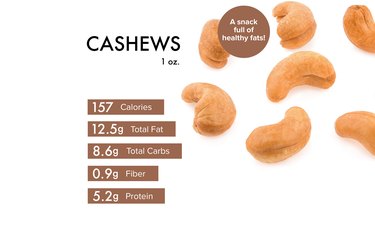
One ounce of cashews (about 18 whole cashews) is equal to a single serving. One ounce of raw cashews contains:
- Calories: 157
- Total fat: 12.5 g
- Cholesterol: 0 mg
- Sodium: 3.4 mg
- Total carbs: 8.6 g
- Dietary fiber: 0.9 g
- Sugar: 1.7 g
- Added sugar: 0 g
- Protein: 5.2 g
Cashew Macros
- Total fat: One ounce of cashews has 12.5 grams of total fat, which includes 2.2 grams of polyunsaturated fat, 6.7 grams of monounsaturated fat, 2.2 grams of saturated fat and 0 grams of trans fat.
- Carbohydrates: One ounce of cashews has 8.6 grams of carbs, which includes 0.9 grams of fiber and 1.7 grams of naturally occurring sugars.
- Protein: One ounce of cashews has 5.2 grams of protein.
Vitamins, Minerals and Other Micronutrients
- Copper: 69% of your Daily Value (DV)
- Magnesium: 20% DV
- Manganese: 20% DV
- Zinc: 15% DV
- Phosphorus: 13% DV
- One ounce of cashews is not a good source of vitamin B6 (7% DV), potassium (4% DV) or calcium (1% DV).
How Do Cashews Compare to Other Tree Nuts?
Based on a 1-oz. serving, raw | Cashews | Pistachios | Walnuts | Almonds |
|---|---|---|---|---|
Calories | 157 | 159 | 186 | 164 |
Total Fat | 12.5 g | 12.9 g | 18.5 g | 14.2 g |
Carbohydrates | 8.6 g | 7.7 g | 3.9 g | 6.1 g |
Dietary Fiber | 0.9 g | 3 g | 1.9 g | 3.6 g |
Protein | 5.2 g | 5.7 g | 4.3 g | 6 g |
Health Benefits of Cashews
Cashews provide a myriad of nutrients that are linked to lowering your risk of disease. Like other nuts, cashews may also help with weight loss or maintenance.
1. Cashews Are Heart-Healthy
Cashews offer a rich blend of heart-healthy polyunsaturated and monounsaturated fats. "These good fats may help prevent heart disease and stroke, especially when you use them to replace saturated fats in your diet," says Mia Syn, RDN.
Saturated fats are made of tightly-packed bonds and found in foods like butter, shortening and lard. Unsaturated fats are made of looser bonds and found in foods such as nuts, vegetable oils, avocado and tuna fish, according to the USDA.
Cashews also provide 20 percent of the Daily Value of magnesium. Higher intake of magnesium was associated with a 58-percent lower chance of coronary artery calcification and a 34-percent lower chance of abdominal aortic calcification — two markers of advanced atherosclerosis that can predict heart disease morbidity and mortality — than in people with the lowest magnesium intake, per a January 2014 study published in the journal JACC: Cardiovascular Imaging.
Atherosclerosis is the accumulation of cholesterol, fats and other substances in and on artery walls that can limit blood flow, according to the Mayo Clinic. The inverse association between magnesium intake and arterial calcification may be a reason magnesium appears to have protective effects against stroke and fatal coronary heart disease, according to the study researchers.
Cashews are also a source of phytosterols, plant-derived compounds that are linked to lower "bad" LDL cholesterol levels, per the Oregon State University.
Overall, many of the largest cohort studies (such as the Nurses' Health Study and the Adventist Study) found that eating nuts several times a week is associated with a 30- to 50-percent lower risk of heart disease, sudden cardiac death or heart attack, according to the Harvard T.H. Chan School of Public Health.
In addition to healthy fats, nuts like cashews also provide an amino acid called arginine, which helps produce nitric acid — a molecule that relaxes constricted blood vessels and eases blood flow, per the university.
2. Cashews Are Linked to Regulating Blood Sugar Levels
Because cashews contain fiber, protein and healthy fats, they can help keep your blood sugar steady when you eat them as a snack or as part of a meal.
"By keeping your blood sugar stable, cashews can help you feel satiated for longer and may even help with weight management," Syn says. "They likely won't spike your blood sugar as much as the simple carbohydrates in some snack foods might."
Researchers observed that eating cashews daily helped reduce blood insulin levels in a small January 2019 study of 50 patients with type 2 diabetes published in the International Journal of Endocrinology and Metabolism. The unsaturated fatty acids in cashews may play an important role in insulin control, and their fiber and polyphenols (plant compounds) might also have anti-diabetic effects, according to the researchers.
Low consumption of nuts and seeds was associated with 8.5 percent of diet-related adult deaths caused by type 2 diabetes, stroke and heart disease in a March 2017 study published in JAMA, which analyzed the CDC's National Health and Nutrition Examination Survey (NHANES) and national disease-specific mortality data.
Is It Healthy to Eat Cashews Every Day?
Yes, but stick to the one-ounce portion size.
Eating nuts may help to control hunger while promoting an overall higher-quality diet, due to their unsaturated fats, protein, fiber, vitamins and minerals, according to a December 2017 review published in the journal Nutrients.
“That said, even though cashews are a nutrient-dense food, they’re also calorically dense, so you want to watch portion sizes,” Syn says.
3. They Pack Nutrients That Can Benefit Eye and Skin Health
Cashews provide antioxidants and minerals that can help protect your skin and eyes.
"They're one of the best sources of copper, which is an essential mineral mostly located in the skeleton and muscles," Syn says. "Copper plays a role in the maintenance of collagen, a major structural component that our body produces less of over time."
A reduction in collagen can contribute to wrinkles and health issues like weakening muscles or joint pain, according to the Cleveland Clinic. Collagen production requires copper, zinc, vitamin C and amino acids you get from protein-rich foods. Besides aging, the leading cause of low collagen levels is an unhealthy diet.
"Cashews also contain vitamin E, which acts as an antioxidant to help protect cells from the damaging effects of free radicals, and therefore may help slow the aging process," Syn says. While research on the best foods for healthy skin is still limited, antioxidant-rich foods like nuts, vegetables and fruits appear to have the most protective effects on skin, according to the Mayo Clinic.
Cashews also offer lutein and zeaxanthin, two carotenoids (a type of plant compound) that can filter out harmful blue wavelengths of light. They are the only carotenoids found in large amounts in the retina of the eye, according to the American Optometric Association.
"These antioxidants are important for vision and eye health," Syn says. Getting enough lutein and zeaxanthin was linked to a lower risk of late age-related macular degeneration (but not early age-related macular degeneration) in a February 2012 review in the Journal of British Nutrition.
Cashew Health Risks
Raw Cashews
Truly raw cashews are not safe to eat because they contain urushiol, a resin that is toxic if consumed and can result in burns or rashes if it comes in contact with your skin, according to the UC Davis School of Medicine. (This is the same substance that makes poison ivy poisonous.)
The "raw" cashews available at grocery stores have typically gone through an extensive steaming or roasting process to remove urushiol.
Allergies
Allergy to tree nuts such as cashews affects approximately 0.5 to 1 percent of the U.S. population, and is one of the eight most common types of food allergies, according to the American Academy of Allergy, Asthma & Immunology (AAAAI).
Although being allergic to one tree nut doesn't guarantee you'll be allergic to all of them, cashews are closely related to pistachios and they may trigger similar reactions, per the AAAAI. Keep in mind that a peanut allergy is not the same as a tree nut allergy, but 30 percent of peanut-allergic people also have an allergy to tree nuts.
Speak to an allergist to assess your risk. Tree nut allergies can cause severe reactions — including life-threatening anaphylaxis — and if you have one, you should have epinephrine nearby at all times.
Calorie Intake
Because cashews are calorically dense, they can cause weight gain if eaten in excess. Enjoy the health benefits without over-consuming calories by sticking to the serving size of 1 ounce, or about 18 cashews.
Drug interactions
There are currently no known drug interactions. Be sure to discuss any medication and food interactions with your health professional.
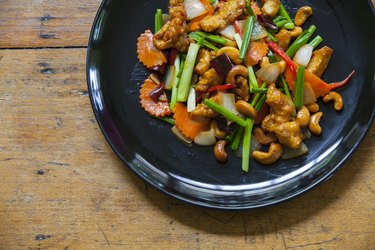
Cashew Recipes
Cashew Preparation and Helpful Tips
Harvesting times depend on where cashews are grown, but they are generally available year-round in supermarkets. Follow these tips to store and prepare them as a healthy part of your diet.
Opt for unsalted varieties. Although some cashews are sold salted or seasoned, it's best to look for those with no added sodium and oil. Because cashews have a naturally sweet, buttery taste, they can add their own unique flavor to your meals or snacks.
To fit more nuts like cashews into your diet, sprinkle them on cereal or yogurt, toss them into a stir-fry or try a nut-crusted fish or chicken, recommends Harvard Health Publishing.
Tip
Add cashews to your salad for an extra nutrient boost. “Not only are they a crunchy, nutrient-dense replacement for croutons, but the vitamin C in vegetables and fruits will help your body absorb the iron in cashews,” Syn says. Iron transports oxygen throughout your body to enable the production of energy, per the Academy of Nutrition and Dietetics.
Store them in the refrigerator. The unsaturated fats in nuts can go rancid quickly (leading to an unfavorable flavor), so it's best to keep them in a cool spot. Store them in a sealed plastic or glass container and keep in the refrigerator for four to six months, recommends the Academy of Nutrition and Dietetics.
Alternatives to Cashews
Cashews are filled with heart-healthy monounsaturated and polyunsaturated fats, along with other nutrients that can lower your risk of heart disease. They also contain a rich array of antioxidants that may benefit your skin and eye health, and can be a satiating part of a weight loss or weight maintenance plan.
Many nuts share similar nutrient profiles. You can replace cashews with other tree nuts such as:
- Almonds
- Walnuts
- Brazil nuts
- Pecans
- Chestnuts
- Pistachios
- My Food Data: "Cashews (Raw)"
- My Food Data: "Pistachio Nuts"
- My Food Data: "Walnuts"
- My Food Data: "Almonds"
- U.S. Department of Agriculture: "Saturated, Unsaturated, and Trans Fats"
- JACC: Cardiovascular Imaging: "Magnesium Intake Is Inversely Associated With Coronary Artery Calcification"
- Mayo Clinic: "Arteriosclerosis / atherosclerosis"
- Oregon State University Linus Pauling Institute Micronutrient Information Center: "Phytosterols"
- Nurses' Health Study: "The Nurses’ Health Study and Nurses’ Health Study II are among the largest investigations into the risk factors for major chronic diseases in women."
- Loma Linda University Health: "Adventist Health Study"
- Harvard T.H. Chan School of Public Health: "Nuts for the Heart"
- National Heart, Lung, and Blood Institute: "DASH Eating Plan"
- International Journal of Endocrinology and Metabolism: "Effects of Daily Consumption of Cashews on Oxidative Stress and Atherogenic Indices in Patients with Type 2 Diabetes: A Randomized, Controlled-Feeding Trial"
- JAMA: The Journal of the American Medical Association: "Association Between Dietary Factors and Mortality From Heart Disease, Stroke, and Type 2 Diabetes in the United States."
- Cleveland Clinic: "The Best Way You Can Get More Collagen"
- Mayo Clinic: "What are the best foods for healthy skin?"
- American Optometric Association: "Lutein & Zeaxanthin"
- Journal of British Nutrition: "Lutein and zeaxanthin intake and the risk of age-related macular degeneration: a systematic review and meta-analysis"
- Nutrients: "Nuts and Human Health Outcomes: A Systematic Review"
- UC Davis School of Medicine: "Cashew: The Nut That Is Not a Nut"
- American Academy of Allergy, Asthma & Immunology: "Everything You Need to Know About Tree Nut Allergy"
- Harvard Health Publishing: "Get cracking: Why you should eat more nuts"
- Academy of Nutrition and Dietetics: "Iron"
- Academy of Nutrition and Dietetics: "10 Surprising Foods That Benefit from Refrigeration"