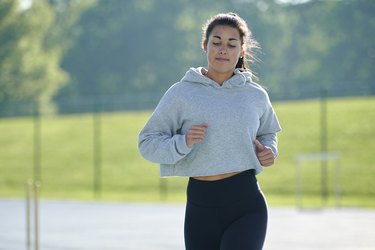
You're never too young to invest in the health of your bones. That's because healthy bones at an early age help prevent bone loss in old age. Nutrition and exercise can help prevent bone loss at any age.
According to the American Academy of Orthopaedic Surgeons (AAOS), 50 percent of Americans over age 50 have weak bones, and 2 million of them suffer fractures each year.
Video of the Day
Video of the Day
The National Institutes of Health's Osteoporosis and Related Bone Diseases National Resource Center explains that bone mass is the key to healthy bones. Your bone mass is the amount of bone tissue in your skeleton. Bone mass is like a bone bank. Because bone mass is living tissue, bone cells are constantly being deposited and withdrawn.
"Loss of bone mass is a disease of old people that starts in youth. That's because your peak bone mass occurs in early life. The better your bones are at ages 25 to 30, the better they will be at 65 to 70," says Donald Ford, MD, a family medicine physician at the Cleveland Clinic, Mayfield Heights, Ohio.
Bone Mass, Density and Bone Weight
"Bone weight is about 15 percent of your body weight, but determining bone weight is complicated and it does not give us useful information. It is much more important to know about bone density, which is the best way to measure bone mass and bone health," says Dr. Ford.
The National Institutes of Health (NIH) explains that the most common way to test your bone mass is with a bone imaging study called a central dual-energy X-ray absorptiometry (DXA) test.
"The DXA test is the gold standard. Guidelines say that all women should have this test after age 65. There are no guidelines for other testing, but anyone with an unexplained fracture or other evidence of weak bones may have the test ordered," says Dr. Ford.
Older women should be tested because they are at highest risk for osteoporosis due to the loss of the female hormone estrogen that occurs after menopause, says the NIH. Estrogen helps women maintain bone mass.
The DXA test measures your bone density compared to the bone density of a healthy young adult. Your score on the test is called your T-score. The normal healthy adult gets a T-Score of 0. If your T-score is more than one point (called a standard deviation) below 0, you may have weak bones, explains NIH. If your T score is between -1 and -2.5, you have low bone mass. If your score is -2.5 or lower, you have osteoporosis.
Investing in Your Bone Health
AAOS says that bone health nutrition includes calcium and vitamin D. Calcium is the mineral that builds strong bones. Vitamin D is the vitamin you need to absorb calcium from your diet. Because calcium is important for many body functions, if you don't have enough, your body will take calcium out of your bone bank.
"You can usually get enough calcium from your diet, dairy foods are high in calcium and vegetables supply a considerable amount," Dr. Ford says. "The jury is out on calcium supplements for most people, but everyone agrees that the most efficient way to get calcium is through your diet. Weight-bearing exercise that exercises your hips and spine is the best for bone health, because hips and spine are at the highest risk for fractures from osteoporosis."
Here are the other bone health tips from all the experts:
- Get at least 30 minutes of weight-bearing exercise every day, like running, walking or hiking.
- Get plenty of calcium and vitamin D from dairy foods, fortified cereals, leafy green vegetables and other sources.
- Maintain a healthy weight.
- Don't smoke.
- Limit alcohol.
- Ask your doctor if you need calcium or vitamin D supplements.
AAOS says that as we get older it gets harder to replace normal bone loss. We may not be able to control some of the factors that lead to bone loss like our genes and hormones, but we can fight bone loss with exercise and nutrition at any age.
Read more: The One Vitamin Deficiency You're More Likely to Have in the Winter — and 5 Recipes to Help Avoid It
- American Academy of Orthopaedic Surgeons: “Bone Health Basics”
- NIH Osteoporosis and Related Bone Diseases National Resource Center: “Osteoporosis: Peak Bone Mass in Women”
- Donald Ford, MD, Family Medicine, Cleveland Clinic, Mayfield Heights, Ohio
- NIH Osteoporosis and Related Bone Diseases National Resource Center: “Mass Measurement: What the Numbers Mean”
Is this an emergency? If you are experiencing serious medical symptoms, please see the National Library of Medicine’s list of signs you need emergency medical attention or call 911.