There isn't anything more frustrating than an injury that sidetracks your fitness goals. Regardless of whether aerobics was the ticket to weight loss or insurance against serious health issues down the road — being forced to stop because of a bad ankle could mean losing all that hard-won progress.
But, does having a sprained ankle mean the end of aerobic exercise until it gets better? Maybe not. Consider a sprained ankle workout to minimize the impact that a leg injury can have on your aerobic exercise routine.
Video of the Day
Video of the Day
Tip
Don't allow an injury to completely sideline your training. You can still improve aerobic conditioning with a sprained ankle workout.
Speeding the Healing Process
Although rest is an important part of the healing process, there are still ways to training aerobically while preventing further injury. According to the American Orthopaedic Foot & Ankle Society, the typical recovery time for a sprained ankle is about two to six weeks, and it's a good idea to practice RICE often:
- Rest the ankle as much as possible
- Ice the area for about 10 minutes at a time every hour
- Compression with an ace bandage or ankle support sleeve
- Elevation; keep the ankle above
chest level whenever possible
The only other thing that can be done is to wait. Time will bring about a gradual return to full ankle strength.
But it's not necessary to wait until the sprained ankle heals to enjoy productive aerobic exercise. There are several forms of aerobic training that can be done without doing sprained ankle exercise.
1. Swimming
Swimming is a famously low-impact activity that can be easily modified to eliminate strain on the sprained ankle. The use of a flotation device or pool buoy held between the legs permits the use of swim strokes such as backstroke, freestyle and breast stroke.
2. Arm Bicycle
The arm bicycle is a piece of equipment that has handles instead of pedals and offers aerobic exercise using only the arms. Since the arm bicycle is used in a seated position, there's no strain placed on the ankle while it heals. A research study in November 2014 issue of the Open Access Journal of Sports Medicine discovered that 16 weeks of arm bicycle training significantly improved V02 max in 12 healthy male subjects.
3. Endless Rope Machine
The endless rope machine is a long loop of climbing rope fed through the machine at variable levels of resistance to replicate rope climbing. By adjusting the resistance to a light level, it's possible to pull rope long enough to raise the heart rate into the aerobic training zone to get the benefits of cardiovascular training.
4. Seated Zumba
It's not too hard to modify the leg moves of Zumba to be done with the arms. Try it while watching a Zumba video at home or seated on the periphery of a Zumba class (to stay out of everyone's way). One hour of waving your arms around should provide a decent aerobic workout.
Read more: The Best Cardio Exercise for a Food Injury
5. Rowing Ergometer
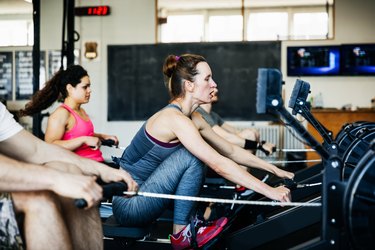
It's possible to modify the rowing movement to avoid using the legs, and a more mildly injured ankle may be able to handle the back and forth leg movement without discomfort.
Indoor rowing, as demonstrated by ExRx.net, is a form of aerobic exercise that can safely and effectively increase cardiovascular levels, even in the elderly population.
The rowing ergometer — like the arm bicycle — does a great job of keeping the heart rate in the aerobic training range long enough to maintain a decent fitness level until the ankle is fully healed.
- American Orthopaedic Foot & Ankle Society: "How to Care for a Sprained Ankle"
- Open Access Journal of Sports Medicine: "Effects of 16-Week High-Intensity Interval Training Using Upper and Lower Body Ergometers on Aerobic Fitness and Morphological Changes in Healthy Men: A Preliminary Study"
- ExRx.net: "Row Ergometer"
Is this an emergency? If you are experiencing serious medical symptoms, please see the National Library of Medicine’s list of signs you need emergency medical attention or call 911.