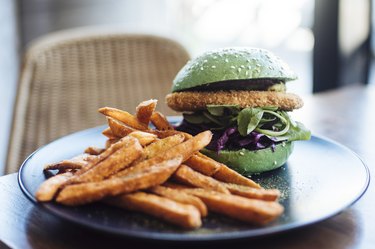
The health, environmental and social benefits of plant-based eating have been getting a significant amount of attention these days, which could leave you wondering if a vegetarian or vegan diet is right for you.
If you are, you're in good company: In January 2023, over 700,000 people signed up for the Veganuary challenge, where people follow a vegan diet for the month of January, per the official Veganuary website.
Video of the Day
Video of the Day
With interest in these diets at an all-time high, we dove into the statistics of vegetarians versus meat eaters, so you can see how vegetarianism is showing up in the world today and what the effects may be compared to a more meat-heavy diet.
Variations of a Vegetarian Diet
Diet | Meaning |
|---|---|
Vegan | Avoids all ingredients derived from animals. Many also avoid materials and goods created with the use of animals, like leather or beeswax. |
Lacto-vegetarian | Avoids meat, poultry, eggs and seafood but includes dairy. |
Ovo-vegetarian | Avoids meat, poultry, seafood and dairy but includes eggs. |
Lacto-ovo-vegetarian | Avoids meat, poultry and seafood but includes eggs and dairy. |
Pescatarian | Avoids meat and poultry but eats fish. Many pescatarians also eat eggs and/or dairy, but not all. |
Flexitarian | Combines "flexible" and "vegetarian." Avoids animal products most of the time. |
Whole food plant-based | Avoids animal products as well as vegetarian processed foods, oils and sugars in favor of whole, unprocessed, plant-based foods. |
Global Vegetarian Stats
There are 1.5 billion vegetarians worldwide, but only 75 million exclude meat by choice, according to an older but frequently cited January 2010 estimate from the Economic and Social Research Institute.
The other 1.4 billion are vegetarians out of necessity but would eat meat if they could afford it. Many vegetarians also avoid meat because it's part of their religion.
- Up to 35.7% of India's population is vegetarian, making it the country with the most vegetarians, according to a May 2017 article in the Journal of Medical Research and Innovation. That's because two of the largest religions in India encourage abstaining from specific meats.
- 79% of India's population is Hindu and 14% is Muslim, according to the Pew Research Center. Hinduism encourages vegetarianism and followers traditionally avoid beef; followers of Islam traditionally avoid pork.
- Here is the percentage of people who are vegetarian by country, according to the World Population Review:
- India: 24%
- Mexico: 19%
- Brazil: 14%
- Finland: 12%
- Denmark: 10%
- Philippines: 5%
- China: 5%
- Russia: 1%
- People spent $28 billion globally on plant-based meat, seafood, milk, yogurt and cheese in 2022, according to the Good Food Institute (GFI) 's 2022 State of the Industry Report.
- Global sales for plant-based milk, cheese and yogurt hit $21.6 billion — up 7% from 2021, per the 2022 GFI report.
- Plant-based food is expected to make up 7.7% of the global protein market by 2030, according to Bloomberg Intelligence.
- About 20% of the food and drink products launched in 2020 in Germany had a vegan claim, according to the Mintel Group.
- The top vegetarian-friendly countries to vacation to, according to Wanderlust, a top travel website, are:
- India
- Sri Lanka
- Italy
- Lebanon
- Indonesia
- Taiwan
- U.K.
Vegetarians in the U.S.
The percentage of people following a vegetarian diet in the United States is low compared to the percentage of people who regularly eat meat. Approximately 6 percent or 15.48 million adults in the U.S. are vegetarian, according to a 2022 YouGov poll published by the Vegetarian Resource Group.
This number may sound surprising, as so many plant-based alternatives have hit store shelves over the past several years. Plant-based milk, cheese and meat aren't just for vegans or vegetarians — many meat eaters are now experimenting with at least a small amount of plant-based eating.
- Up to 65% of Americans ate plant-based meat alternatives in 2021, and 42% eat meat alternatives at least once a week, according to a June 2022 National Consumers League report.
- Total U.S. retail plant-based food dollar sales reached $8 billion in 2022, while plant-based meat dollar sales decreased 1% from the previous year, per the GFI's 2022 State of the Industry Report.
- An estimated 86% of households that purchased meat alternatives also purchased conventional meat in 2022, per the GFI's 2022 State of the Industry Report.
- 39% of consumers choose plant-based options because they believe they're healthier than animal-based products.
- About half of vegetarians are also vegans — approximately 7.74 million U.S. adults.
Vegetarians in the U.S. by Age
Veganism and vegetarianism have become more popular among younger people: Millennials and Generation Z have the highest rates of plant-based eating. Here is a breakdown of vegan and vegetarian diets by age in the U.S., according to the Vegetarian Resource Group:
- 5% of Americans between the ages of 18 to 34 are vegan.
- 5% of Americans between the ages of 18 to 34 are vegetarian.
- 3% of Americans between the ages of 35 and 54 are vegan.
- 2% of Americans between the ages of 35 and 54 are vegetarian.
- 1% of Americans over 55 are vegan.
- 1% of Americans over 55 are vegetarian.
A Note on Language
We make deliberate choices about the language we use here at LIVESTRONG.com. For accuracy, we have used the terms for race, ethnicity, sex and gender used by the primary sources throughout this article.
Vegetarian Statistics in the U.S. by Race and Ethnicity
According to the Vegetarian Resource Group, about 6 percent of Latino, Asian and Black Americans follow a vegetarian diet, including vegan. The same survey found going meat-free was largely driven by the motivation to improve health and reduce costs.
- 5% of Black Americans are vegan.
- 1% of Black Americans are vegetarian.
- 3% of Latino Americans are vegan.
- 3% of Latino Americans are vegetarian.
- 1% of Asian Americans are vegan.
- 6% of Asian Americans are vegetarian.
- 56% of Hispanic/Latino Americans and 51% of Black/African Americans believe there is a stigma in their culture around people who eat plant-based foods, according to a Danone North America study.
- More Americans are interested in following a vegetarian diet, according to a December 2021 report in the International Journal of Environmental Research and Public Health. Of the 14,680 people surveyed, 352 (2.4 percent) identified as vegetarian. Here is the ethnicity breakdown among vegetarians in the U.S.:
- 7.4% are Mexican American.
- 5.8% are other-Hispanic.
- 56.2% are non-Hispanic white.
- 7.6% are non-Hispanic Black.
- 23% are other ethnicities.
U.S. Vegetarians by Sex
The number of female and male vegans and vegetarians in the U.S. is still quite small compared to those who are meat eaters. Here is the sex and gender breakdown of vegetarians, including vegans, in the U.S., according to the Vegetarian Resource Group.
- 67.3% identify as female.
- 32.7% identify as male.
- 3% of American male adults are vegan.
- 2% of American male adults are vegetarian.
- 3% of American female adults are vegan.
- 3% of American female adults are vegetarian.
Reasons Americans Go Vegan and Vegetarian
People choose to eat vegetarian or vegan for a variety of reasons. In 2014, the Human Research Council surveyed 11,000 U.S. adults, giving insight into why people chose a vegetarian or vegan diet and why they may have gone back to an omnivore diet.
Here are some of the most common reasons people stopped eating animal products:
- 69% for health reasons
- 68% for animal protection
- 63% because of negative feelings about meat and animal products
- 59% because of environmental concern
- 52% for taste preferences
- 29% for social justice
- 22% for religious or spiritual convictions
- 21% to eat less expensively
- 11% are influenced by peers
- 7% to follow food trends
What Is the Success Rate of the Vegetarian Diet?
Unsurprisingly, not everyone who starts a vegetarian or vegan diet sticks to the meat-free path. Many people start eating animal products again or may go through several vegetarian phases. The Human Research Council's poll addresses the success rate of vegetarians.
- 34% of former vegetarians and vegans quit before 3 months
- 53% of former vegetarians or vegans quit before 1 year
Global Meat Consumption Stats
Meat consumption worldwide is estimated to increase by 14 percent from 2018 to 2030, according to the 2021-2030 Food and Agricultural Organization (FAO) Outlook.
Here is the estimated yearly consumption of popular meats from the 2021 FAO data.
Meat Consumption by Country (kilograms per person)
Country | Beef and Veal | Poultry | Pork | Lamb |
|---|---|---|---|---|
Australia | 18.2 | 45.2 | 20.6 | 5.8 |
Brazil | 24.4 | 40.4 | 13.4 | 0.5 |
Canada | 16.0 | 37.6 | 15.3 | 0.9 |
China | 3.9 | 14.1 | 31.0 | 3.6 |
India | 0.5 | 3.1 | 0.1 | 0.4 |
Mexico | 9.1 | 31.6 | 14.9 | 0.5 |
South Africa | 13.8 | 37.0 | 4.1 | 2.6 |
United Kingdom | 11.0 | 30.6 | 15.7 | 3.8 |
United States | 25.9 | 50.9 | 23.4 | 0.4 |
Worldwide, people eat meat from a variety of animals, including chicken, beef, pork and turkey. In some countries, camel, duck and horse meat are common protein sources, too.
Here's how much meat was produced worldwide in 2021, according to the 2021 stats from the FAO.
- Chicken and poultry: 152.01 million tons
- Pork: 132.69 million tons
- Beef and buffalo: 84.6 million tons
- Lamb and goat: 18.03 million tons
Environmental Effects of Eating Meat
Plant-based meat is often viewed as a more environmentally friendly option compared to the resources needed to produce meat. Efficient water use is one environmental concern. Here's the amount of water needed to produce one pound of meat and poultry, according to The Water Footprint of Food Guide:
- 1,850 gallons of water per pound of beef
- 720 gallons of water per pound of pork
- 520 gallons of water per pound of chicken
Over 40 countries participate in the global initiative known as Meatless Monday to help reduce the environmental and health effects of meat-centered diets. This movement encourages people to reduce their meat intake one day a week or more. Here are some of the other environmental effects of eating meat, per the Meatless Monday initiative:
- 14.5% of all global greenhouse gas emissions from human activities are produced from livestock production.
- If meat was eliminated globally for one day per week, it could reduce diet-related global greenhouse gas emissions by an estimated 1.0 to 1.3 Gigaton (Gt) per year, which would be equivalent to taking 273 million cars off the road.
Global Accessibility of Meat
While some countries have low meat intake because of religious dietary restrictions, low-income nations have the lowest meat intake per person because of affordability, according to the World Atlas.
Meat is a high-cost item compared to many plant foods. Many poorer countries produce meat, but export it to other countries, making it too expensive for the people who live there.
Here are the countries where people eat the lowest amount of meat because of affordability and accessibility, and the average amount of meat eaten per year per person:
- India: 6.6 pounds of meat per person per year
- Bangladesh: 7.5 pounds of meat per person per year
- Ethiopia: 10 pounds of meat per person per year
- Nigeria: 13 pounds of meat per person per year
- Tanzania: 15.4 pounds of meat per person per year
- Mozambique: 16 pounds of meat per person per year
- Ghana: 19.9 pounds of meat per person per year
- Indonesia: 26.4 pounds of meat per person per year
- Pakistan: 27.9 pounds of meat per person per year
- Haiti: 29.9 pounds of meat per person per year
U.S. Meat Consumption Stats
Between 1999 and 2006, meat consumption in the U.S. averaged 250 pounds per person and increased to 264 pounds per person in 2020, according to a May 2021 report in FarmDoc Daily.
- The average American spent $1,115 on meat, poultry, fish and eggs in 2021, per the 2021 Consumer Expenditures BLS report.
- In the U.S., poultry, beef and pork are the most common meats eaten. These are the most consumed meats in the U.S. in 2020, per the FAO stats:
- Chicken: 127.86 pounds per capita
- Beef: 81.57 pounds per capita
- Pork: 66.13 pounds per capita
- Fish: 48.50 pounds per capita
- This is how much meat, by type, the average American eats per year, per the FarmDoc Daily report:
- Beef: 83 pounds per person
- Chicken: 112 pounds per person
- Pork: 67 pounds per person
- This is how many times U.S. teens eat red and processed meat per day, per a May 2022 study in Public Health.
- Once a day: 58.4%
- Twice a day: 29.8%
- Three or more times a day: 13.2%
- And the number of times adults eat red or processed meat per day:
- Once a day: 52.2%
- Twice a day: 33.9%
- Three or more times a day: 13.9%
- Meat can be expensive. Here is the average cost of meat per pound in the U.S. in March 2023, according to the U.S. Bureau of Labor Statistics (BLS):
- Boneless pork chops: $4.31 per pound
- Boneless chicken breast: $4.32 per pound
- Ground beef: $5.19 per pound
- Beef steaks: $9.81 per pound
- The restaurant industry purchased 8.028 billion pounds, or $31.205 billion, of beef in 2018, making it one of the largest consumers of meat, according to the Cattleman's Beef Board and National Cattleman's Beef Association.
- 70% of all beef food service purchases came from restaurants and bars in 2018, per the Cattleman's Beef Board and National Cattleman Beef Association.
Vegetarian Diet Health Statistics
The 2020-2025 Dietary Guidelines recommend the "Healthy Vegetarian Eating Pattern" as a nutritious diet for vegetarians. Following a proper vegetarian and vegan diet could lead to better health outcomes.
- Plant-based eating patterns are linked to a decreased risk of kidney disease in people with type 2 diabetes and a decreased risk of death among people with chronic kidney disease, according to the American Diabetes Association. Compared to meat eaters, vegetarians eat less saturated fat and more:
- Fiber
- Vitamin C
- Vitamin E
- Magnesium
- Potassium
- Folic acid
- Carotenoids
- Flavonoids
- The length of time a vegetarian diet is followed makes a difference in health outcomes, too, according to a March 2018 study in Nutrition and Diabetes.
- "Consistent" adherence to a vegetarian diet was associated with a 35% lower risk of developing diabetes.
- Those who adopted a vegetarian diet after being non-vegetarian had a 53% lower risk for developing diabetes than non-vegetarians.
- The type of vegetarian diet followed makes a difference in the prevalence of diabetes, per an older May 2009 study in Diabetes Care, which analyzed the diets of over 60,000 adults. The prevalence of diabetes was:
- 2.9% for vegans
- 3.2% for lacto-ovo vegetarians
- 4.8% for pescatarains
- 6.1% for semi-vegetarians
- 7.6% for non-vegetarians
- Vegetarian diets are adequate for all stages of life and have been linked with the following health benefits, according to a December 2016 position statement in the Journal of the Academy of Nutrition and Dietetics:
- Lower total cholesterol
- Lower LDL cholesterol
- Lower blood pressure
- Lower body weight
- Lower risk of heart disease
- Lower risk of type 2 diabetes
- Lower risk of certain types of cancer, including a 35% lower risk of prostate cancer and a 25% lower risk of colorectal cancer.
- Researchers followed 12,168 middle-aged adults for 29 years and found plant-based diets protected many people from heart disease and heart-disease-related deaths compared to people who ate the most meat, per an August 2019 article in the Journal of the American Heart Association.
- People following a plant-based diet had a 16% lower risk of heart disease.
- People following a plant-based diet had a 31% to 32% lower risk of death from heart disease.
- People following a plant-based diet had an 18% to 25% lower risk of death from all causes.
Health Risks of a Vegetarian Diet
It's no surprise diet affects mental and physical health. Some research suggests vegetarianism may be associated with a higher risk for mental health conditions and nutrient deficiencies compared to a meat-eating diet.
- Vegetarians are twice as likely to experience depressive episodes than meat eaters, according to a January 2023 study in the Journal of Affective Disorders.
- Up to 86% of vegetarian adults are deficient in vitamin B12
- Up to 45% of vegetarian infants are deficient in vitamin B12
- Up to 33% of vegetarian children are deficient in vitamin B12
- Anywhere from 7% to 73% of vegetarians are iron deficient, according to a May 2017 study in the Annals of Nutrition and Metabolism.
Vegans and vegetarians have a higher risk of vitamin B12 and iron deficiency compared with people who eat meat, according to a December 2016 article in Nutrients.
Iron from plant-based foods, known as non-heme iron, is not absorbed as well as iron from animal sources, according to a March 2021 article in Biomolecules. That means vegetarians need to eat twice the amount of iron to meet their needs.
Talk to your doctor or a registered dietitian before starting any new diet plan, but especially about how to plan a vegetarian or vegan diet that meets all your nutritional needs and dietary preferences. They may also recommend certain supplements if you are low in key nutrients on a vegetarian or vegan diet.




- The Vegetarian Resource Group: How Many Adults in the U.S. are Vegetarian and Vegan?
- Human Research Council: "Study of Current and Former Vegans and Vegetarians"
- American Dietetic Association: Meal Planning for Vegetarian Diets
- Journal of the Academy of Nutrition and Dietetics: Position of the Academy of Nutrition and Dietetics: Vegetarian Diets
- American Journal of Clinical Nutrition: Are Strict Vegetarians Protected Against Prostate Cancer?
- Canadian Cancer Society: Risk Factors for Prostate Cancer
- Dietary Guidelines 2015-2020: Daily Nutritional Goals for Age-Sex Groups Based on Dietary Reference Intakes and Dietary Guidelines Recommendations
- American Journal of Clinical Nutrition: Risk of Hospitalization or Death From Ischemic Heart Disease Among British Vegetarians and Nonvegetarians: Results From the EPIC-Oxford Cohort Study
- Pew Research Center: "Key findings about the religious composition of India"
- FAO Agricultural Outlook: "Meat"
- Vomad: "Why People Go Vegan: 2019 Global Survey Results"
- American Diabetes Association: "Vegan and Vegetarian Meal Planning for Diabetes and Kidney Disease"
- FarmDoc Daily: "An Overview of Meat Consumption in the United States"
- World Health Organization: "The top 10 causes of death"
- Journal of the American Heart Association: "Plant‐Based Diets Are Associated With a Lower Risk of Incident Cardiovascular Disease, Cardiovascular Disease Mortality, and All‐Cause Mortality in a General Population of Middle‐Aged Adults"
- International Journal of Environmental Research and Public Health: "Diet and Consumer Behavior in U.S. Vegetarians: A National Health and Nutrition Examination Survey (NHANES) Data Report"
- Nutrients: "Vitamin B12 among Vegetarians: Status, Assessment and Supplementation"
- Biomolecules: "Iron Status of Vegans, Vegetarians and Pescatarians in Norway"
- Annals of Nutrition and Metabolism: "Iron Status of Vegetarian Children: A Review of Literature"
- Journal of Affective Disorders: "Association between meatless diet and depressive episodes: A cross-sectional analysis of baseline data from the longitudinal study of adult health (ELSA-Brasil)"
- Veganuary: "A RECORD NUMBER OF PEOPLE WORLDWIDE PARTICIPATE IN VEGANUARY 2023"
- Economic and Social Research Institute: "An Estimate of the Number of Vegetarians in the World "
- Journal of Medical Research and Innovation: "Vegetarian Diet: A Boon or Bane for Health? "
- National Consumers League: "Education and Transparency in Labeling Plant-Based Meat Alternatives "
- Vegetarian Resource Group: "HOW MANY BLACKS, LATINOS, AND ASIANS ARE VEGAN AND VEGETARIAN IN THE USA?"
- John Hopkins Center for a Livable Future: "Meatless Monday Goes Global"
- World Atlas:"10 Countries That Consume The Least Meat"
- U.S Bureau of Labor Statistics:"Average Retail Food and Energy Prices US and Midwest Region"
- BLS: "2021 Consumer Expenditures"
- World Population Review: "Vegetarianism by Country 2023"
- Wanderlust: "7 of the best countries for vegetarian travelers"
- Bloomberg Intelligence: "Plant-Based Foods Market to Hit $162 Billion in Next Decade, Projects Bloomberg Intelligence"
- Cision PR Newswire: "Danone North America Shares Insights from One of the Largest Studies on Multicultural Consumers and their Relationship with Plant-Based Food & Beverage - Finds Over 60% Are Open to Plant-Based Alternatives"
- Public Health: "How Americans eat red and processed meat: an analysis of the contribution of thirteen different food groups"
- Beef It's What's For Dinner: "Beef Remains Foodservice Mainstay"
- Nutrition and Diabetes: "Vegetarian diet, change in dietary patterns, and diabetes risk: a prospective study"
- Diabetes Care: "Type of Vegetarian Diet, Body Weight, and Prevalence of Type 2 Diabetes"
- Vegetarian Resource Group: "How Many Vegetarians and Vegans Are There?"
- Mintel Group: "The Future of Plant-Based Food and Drink in Europe"
- 2020-2025 Dietary Guidelines for Americans