






Cabbage & Vitamin K

Cabbage & Vitamin K
Photo Credit napa cabbage image by TMLP from Fotolia.com

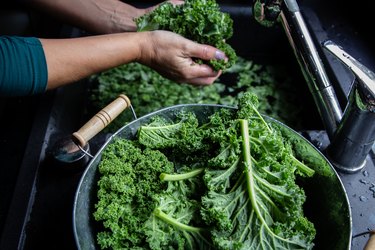
Raw, boiled, or stir-fried: cabbage is tasty, nutrient-rich and deserves a prominent place on your dinner plate. Cabbage is low-cost, low-calorie, fat-free and a good source of many vitamins, including vitamins A, C, E, B6 and B12; riboflavin; niacin; folate; pantothenic acid; choline; betaine -- and vitamin K.

Varieties of Cabbage and Their Vitamin K Content

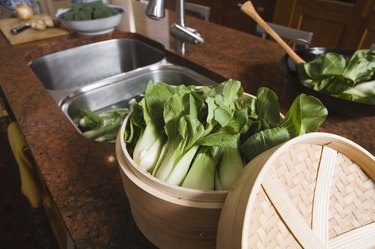
Dozens of varieties of cabbage are grown and consumed around the world. In the United States, green, red, and Savoy cabbages are the most popular. Bok choy, a Chinese cabbage variety, is quite popular as well. Depending on the variety and the way you prepare it, a 1-cup serving of cabbage contains about 30 to 60 micrograms of vitamin K. Raw, green cabbage has more vitamin K per 1-cup serving than raw bok choy, Savoy, or red cabbage. Cooked cabbage retains most of its vitamin K content.

Vitamin K Deficiency

Vitamin K is crucial to the body's ability to from clots to stop bleeding. Severe vitamin K deficiency can lead to heavy menstrual bleeding in women, anemia, bruising, and bleeding of the gums or nose. Fortunately, vitamin K deficiency is rare in adults. Vitamin K is fat soluble, which means your body can store extra vitamin K for later use. Bile fluids help the body absorb nutrients dissolved in fat, including vitamin K. Therefore, it's possible for patients with obstructions to bile flow to develop a vitamin K deficiency, since their bodies will absorb very little of the vitamin. Likewise, diseases impeding the intestine's ability to function may prevent the absorption of nutrients, including vitamin K, into the blood. In these cases, eating cabbage won't help your deficiency -- your doctor will likely order an injection of vitamin K.

Vitamin K Dietary Recommendations

For most healthy adults, however, their body has a very efficient reclaiming and recycling mechanism for vitamin K. In addition, bacteria in the large intestine synthesize a biologically active form of vitamin K. Therefore, most people are easily able to meet their dietary needs for vitamin K with little effort. The Linus Pauling Institute Micronutrient Center recommends that men over the age of 19 get 120 mcg of vitamin K per day and women over 19 get 90 mcg per day. Depending on your needs, a serving of cabbage provides about one-third to one-half of the recommended amount of vitamin K.

Cabbage, Vitamin K and Anticoagulant Drugs

Certain medical conditions cause blood clots to form in the arteries of the heart, brain, or lungs, which can sometimes cause heart attacks, strokes, or pulmonary embolisms. Doctors often prescribe an anticoagulant drug called warfarin to prevent clots from forming. The doctor will carefully calculate the warfarin dose. If the dose is too small, unwanted clots may form. If the warfarin dose is too large, the patient may bleed unnecessarily.

Warfarin is a vitamin K antagonist: It interferes with vitamin K's role in the clot formation process. Therefore, once the doctor finds the right warfarin dose, it's important for you not to ingest more or less vitamin K than usual. If you start eating more vitamin K-rich foods such as cabbage, the prescribed dose of warfarin will no longer be enough to control blood clots. On the other hand, if you drastically reduce the amount of vitamin K-rich foods in your diet, the doctor must also reduce the warfarin dose in order to avoid excessive bleeding.

References

Article reviewed by Alva Dane Last updated on: Mar 16, 2011

Must see: Photo Galleries

Member Comments