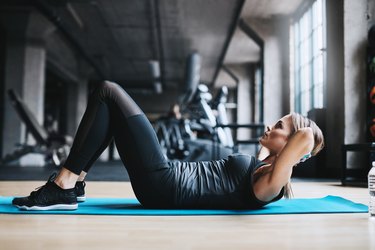
You're crunching, twisting and side-bending your way to more defined abs. But, the results of such labor won't show until you lose extra body fat covering the muscles. Monitoring your caloric intake helps you maintain or lose weight, recommends Harvard Health Publishing. When you burn more calories than you consume, you help induce fat loss.
When you're working out your abs, you may wonder how it contributes to your overall calorie burn. During most ab workouts fewer calories are burned than cardio or heavy weight training, merely because they don't require as much muscle engagement. This doesn't make them less valuable, just less impactful on your daily energy expenditure.
Video of the Day
Ultimately, the number of calories you expend during an abs workout depends on the type of workout, your size and gender.
Your Stats Matter
The larger you are, the more energy, or calories, you use to move. A mat-based workout that involves crunches, sit-ups and planks, for example, done by a 5-foot, 4-inch woman who weighs 140 pounds burns 71 calories in 15 minutes. If the same woman weighs 180 pounds, she burns 91 calories with the same moves in the same amount of time.
As men tend to be larger and more muscular than women, they burn more during workouts. A 6-foot, 200-pound man burns 102 calories in 15 minutes of crunches, sit-ups and planks.
The longer your workout, the more calories you burn. Most targeted abdominal workouts that involve moves such as seated twists, stabilization and crunches last between 5 and 20 minutes. Expect to expend 5 to 7 calories per minute when doing these kinds of ab moves.
Read more: The Cardio Abs Workout
Consider the Intensity
How you work out impacts the calorie burn too. If you take on an intense cardio abs workout that involves bouts of burpees, plank jacks and high knees, it burns calories like a round of vigorous calisthenics. For the 140-pound, 5-foot, 4-inch woman, that's about 256 calories per half hour; for the 6-foot-tall, 200-pound man, it's 366 calories. These aren't targeted ab movements, but use your abs and core for stabilization and movement.
Head to an intermediate Pilates class, which emphasizes the entirety of the muscles of your torso, known as the core — not just your abs — and expect to burn 164 calories in 30 minutes if you're a 5-foot, 4-inch woman weighing 140 pounds or 234 calories if you're the 6-foot tall man. Pilates doesn't include the same large muscle movements as the calisthenics-style routine does.
Focus on Function and Strength
An abs workout is about developing greater function and strength, not necessarily about burning calories, according to an article by exercise scientist Len Kravitz, PhD, of the University of New Mexico. These qualities build stamina and overall core strength so you can do longer, more-intense calorie-burning sessions.
Running, cycling and swimming laps vigorously are activities that burn more calories than your typical mat-based abs session. For example, in 30 minutes according to Harvard Health Publishing, a 155-pound person burns:
- 372 calories running at a 10-minute mile
- 409 calories swimming the butterfly
- 446 calories cycling at 16 mph
Ready to build stronger abs? This 10-minute core workout requires zero extra equipment and gets the job done in a fraction of the time. Press play on the video below to get started!