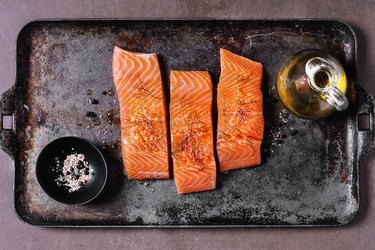
There are many different types of salmon — specifically, five types of Pacific salmon and two types of Atlantic salmon. Atlantic salmon is typically farmed, while Pacific salmon species are primarily wild-caught. Wild-caught Pacific salmon are typically considered to be the healthiest salmon.
Tip
Wild salmon is generally considered to be the best salmon to eat. Because wild Atlantic salmon isn't sold, this means that the healthiest salmon is wild Pacific salmon.
Video of the Day
Atlantic vs. Pacific Salmon
Atlantic salmon and Pacific salmon both live in regions around the northern United States. But any Atlantic salmon you find in your local supermarket likely comes from a farm.
Video of the Day
The Atlantic salmon and Pacific salmon sold throughout the United States were all once wild-caught. However, wild Atlantic salmon is now considered endangered because its population is declining. Catching wild Atlantic salmon is consequently banned.
Farmed Atlantic salmon are considered substantially different from their wild counterparts. It's fine to eat farmed Atlantic salmon, though most people don't consider this the best salmon to eat.
Pacific salmon can be obtained wild-caught or farmed. The Alaska Department of Fish and Game says that there are five main types of Pacific salmon:
- Chum or dog salmon
- Coho or silver salmon
- Chinook or king salmon
- Pink or humpy salmon
- Sockeye salmon
Fresh, wild-caught Pacific salmon is usually only sold between June and September.
Choosing the Healthiest Salmon
The main difference between farmed and wild salmon involves how the fish is raised. Farmed salmon are raised in pens and fed fishmeal, fish oil and other protein-rich foods. In comparison, wild salmon roam between freshwater and the open ocean. They eat a varied natural diet of zooplankton and smaller fish.
The differences in how these fish are raised influences their nutrition. According to Harvard Health Publishing, both wild and farmed salmon are rich in healthy unsaturated fats known as omega-3 fatty acids.
However, the exact nutritional benefits that farmed salmon can provide you with vary based on the food your salmon ate. Farmed salmon typically have higher levels of omega-3 fatty acids. Unfortunately, they also have larger amounts of unhealthy saturated fats compared to wild-caught salmon.
This difference is primarily caused by the food that the farmed salmon is fed throughout its life. A February 2016 study in the Journal of Scientific Reports found that farmed salmon primarily fed a land-based fishmeal diet had lower levels of healthy unsaturated fatty acids and more saturated fats than wild-caught fish and farmed fish that had been fed marine-based fishmeal.
The American Heart Association recommends minimizing your saturated fat intake and increasing your healthy unsaturated fat intake whenever possible. Because farmed salmon is likely to have more saturated fat than wild salmon, many people consider wild-caught fish the healthiest salmon. Farmed salmon may also lack certain essential nutrients present in wild-caught fish.
But if you're unable to get wild-caught salmon, both Harvard Health Publishing and the study in the Journal of Scientific Reports still consider farmed salmon to be a healthy choice. This is because both farmed and wild salmon have more healthy unsaturated fats and less unhealthy saturated fats compared to other commonly consumed sources of protein, like steak and chicken.
Eating fish like salmon twice a week can have benefits for your cardiovascular health, preventing issues like heart disease and stroke, thanks to the unsaturated omega fats.
Although many seafood options have omega fatty acids, both farmed and wild salmon are a particularly healthy choice of seafood because they are also low in mercury.
- Food and Agriculture Organization of the United Nations: "The Nutritional Benefits of Fish Are Unique"
- Oregon State University: "Farmed or Wild? Both Types of Salmon Taste Good and Are Good for You"
- Alaska Department of Fish and Game: "Alaska’s Five Species of Pacific Salmon: Lifecycle and Identification"
- NOAA Fisheries: "Atlantic Salmon - Protected"
- American Heart Association: "Eating Fish Twice a Week Reduces Heart Stroke Risk"
- Scientific Reports: "Impact of Sustainable Feeds on Omega-3 Long-Chain Fatty Acid Levels in Farmed Atlantic Salmon, 2006–2015"
- Harvard Health Publishing: "Finding Omega-3 Fats in Fish: Farmed Versus Wild"
- American Heart Association: "Saturated Fat"