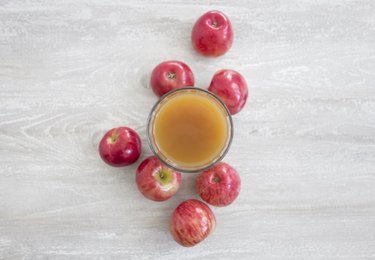
The effects of drinking lots of apple juice include positive and negative changes to your body. Apple juice has many nutrients, but it also has a lot of calories and can include contaminants. Learning more about apple juice will help you make good health choices.
Video of the Day
Video of the Day
Health Benefits of Apple Juice
Apples feature large quantities of polyphenols and pectin. These chemicals have many potential health benefits, according to a December 2014 report in Nutrients. Polyphenols, for example, have cardioprotective, antioxidant and anti-aging properties. Yet they can prevent you from properly absorbing dietary iron.
The writers of an April 2012 article in Trends in Food Science and Technology described similar health benefits of pectin. This substance offers you abundant fiber and might help you prevent cancer.
It's important to drink unfiltered apple juice. The authors of a December 2013 paper in the European Journal of Nutrition tested 23 healthy volunteers and showed that clear apple juice lacked the health benefits of whole apples or raw juice.
The filtering process removes the fiber you need to enjoy the cholesterol-lowering effect of apples, so choose a less processed version of apple juice. You can get these benefits by drinking apple juice in moderation. A May 2017 statement from the American Academy of Pediatrics encouraged you to drink only 100 percent juice and make it part of a balanced diet.
The authors also suggest that children under the age of 1 year shouldn't drink juice at all and kids aged 1 to 3 years should limit their intake to 4 ounces per day. Parents can gradually increase this amount to 8 ounces as their children mature.
Adults should also limit their intake to less than 8 ounces each day to limit the ingestion of incidental contaminants in fruit juice, according to a January 2019 paper from Consumer Reports.
Health Risks of Apple Juice
The paper from Consumer Reports notes the possible heavy metal cocontamination of fruit juice. Other authors have found similar results.
For example, a study described in the December 2012 edition of the Journal of Environmental Health showed that 32 percent of the fruit juices tested had unacceptable arsenic levels. The authors argued that the government should enact laws to better protect consumers as chronic exposure to arsenic can damage your brain and heart as well as cause cancer.
The effects of drinking lots of apple juice can also include toxicity from bacterial contamination. Strains like Alicyclobacillus continue to cause problems for juice makers, according to a February 2019 report in the Fresenius Environmental Journal.
These bacteria have a heat-resistant property that make them immune to pasteurization efforts. Fortunately, new technologies like hurdle processing extend the shelf life of fresh juice to an impressive 90 days.
You safely drink apple juice by using the October 2017 guidelines from the Food and Drug Administration. For home juicing, wash and dry both the produce and your hands before processing it. You should also cut away any damaged parts of the apples used.
For store purchases, look for a warning label indicating the lack of pasteurization. Finally, don't drink any apple juice unless you feel totally confident about the source.
Read more: Health Risks for Juice From Concentrate
Avoid Apple Juice Before Bed
The effects of drinking lots of apple juice could also include allergic reactions. A March 2014 paper in the Journal of the Science of Food and Agriculture stated that about 7 percent of adults and 12 percent of children have a fruit allergy and that nearly 9 percent of the latter group reacts specifically to apples.
A substance known as Mal d 1 triggers this reaction. Thus, you can decrease your allergy risk by choosing apples with low Mal d 1 like the Santana, Pinova and Elise. In contrast, you should avoid apples with high Mal d 1 like the Golden Delicious.
Some people also have difficulty digesting the main sugar in fruit — fructose. Doctors call this condition fructose intolerance. It affects about 1 in 130,000 people, according to a May 2013 paper in the Journal of Nutrition and Metabolism.
Symptoms include stomach pain, bloating and diarrhea. You can get similar symptoms by drinking too much apple juice, so please limit your daily intake. An 8-ounce serving counts as a single serving, but it's important to have diversity in your daily diet to keep your digestive system properly functioning.
Fruit juice is very acidic, so you will want to avoid drinking apple juice before bed. Similarly, doctors have patients avoid drinking juice before surgery. Under normal circumstances, you can balance the acidity of apple juice by eating alkaline foods like green beans and almonds.
This approach will help you protect the lining of your esophagus and stomach. The American College of Gastroenterology recommends not eating for two to three hours before bedtime to help prevent acid reflux.
- Nutrients: "Resources and Biological Activities of Natural Polyphenols"
- Trends in Food Science and Technology: "Pectin — An Emerging New Bioactive Food Polysaccharide"
- European Journal Of Nutrition: "Intake of Whole Apples or Clear Apple Juice Has Contrasting Effects on Plasma Lipids in Healthy Volunteers"
- AAP News: "Weighing in on Fruit Juice"
- Consumer Reports: "Consumer Reports Finds Concerning Levels of Heavy Metals in Popular Fruit Juices"
- Journal of Environmental Health: "Arsenic and Lead in Juice"
- Fresenius Environmental Journal: "Hurdle Technology in Mango Juice Processing"
- Food and Drug Administration: "What You Need to Know About Juice Safety"
- Journal of the Science of Food and Agriculture: "Effects of Long-Term Storage on Mal d 1 Content of Four Apple Cultivars With Initial Low Mal d 1 Content"
- Journal of Nutrition and Metabolism: "Fructose"
- NEJM Journal Watch: "New Guidelines on GERD"