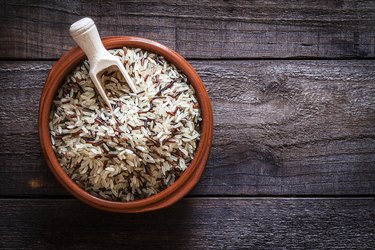
With so many different types of rice, it can be tricky to figure out which one you should be eating. White rice, whole-grain rice, brown rice, parboiled rice — the list goes on and on. Here's what you need to know about parboiled rice versus brown rice.
Brown Rice Nutrition
Video of the Day
Brown rice is considered to be a whole grain, because apart from the inedible hull, which is removed during processing, all the other layers of the grain remain intact, according to the Harvard T.H. Chan School of Public Health.
Video of the Day
The outer bran layer has plenty of fiber, the middle germ layer is rich in nutrients and the inner endosperm is the starchy heart of the grain, which provides carbohydrates that your body uses for energy. The bran and germ layers also give brown rice its distinctly nutty flavor and chewy texture.
According to the USDA, a 1-cup serving of cooked brown rice will give you:
- Calories: 218
- Total fat: 1.6 g
- Saturated fat: 0.3 g
- Trans fat: 0 g
- Cholesterol: 0 mg
- Sodium: 2 mg
- Total carbs: 45.8 g
- Dietary fiber: 3.5 g
- Sugar: 0 g
- Protein: 4.5 g
Most of the calories from brown rice come from carbs, with a cup giving you almost 46 grams or about 15 percent of the recommended daily value (DV). The bran and germ offer fiber — almost 4 grams per serving, or 13 percent of your DV.
Brown rice has some protein, too. You'll get almost 5 grams of protein per cup of brown rice, which is 9 percent of your DV. In general, rice is very low in fat, and brown rice will only give you about 2 grams per serving.
You'll get some other important vitamins and minerals from a cup of brown rice, including:
- Thiamin (vitamin B1): 17% DV
- Vitamin B6: 17% DV
- Niacin (vitamin B3): 16% DV
- Vitamin B5: 15% DV
- Manganese: 93% DV
- Magnesium: 20% DV
- Copper: 18% DV
- Phosphorous: 12% DV
- Zinc: 11% DV
Eating a diet rich in whole grains like brown rice has been linked to a lower risk of heart disease, cancer and diabetes, according to the Academy of Nutrition and Dietetics.
Parboiled Rice Nutrition
Short for partially-boiled rice, parboiled rice is also known as parcooked rice and converted rice. Parboiled rice is made by soaking whole grains, steaming them under pressure and drying, milling and polishing them. This process forces nutrients from the hull back into the grain, so that they are not completely lost while processing.
Slightly harder than regular rice, parboiled rice grains look golden. They take a little longer to cook than white rice and need more water per cup of rice.
According to the USDA, a cup of cooked white parboiled rice will give you:
- Calories: 194
- Total fat: 0.5 g
- Saturated fat: 0 g
- Trans fat: 0 g
- Cholesterol: 0 mg
- Sodium: 0 mg
- Total carbs: 41 g
- Dietary fiber: 1.2 g
- Sugar: 0 g
- Protein: 4.6 g
Parboiled Rice vs. Brown Rice
If you're trying to decide between parboiled rice versus brown rice, both are considerable choices. One difference between brown rice and parboiled rice is the cooking time. Most recipes will tell you to cook brown rice anywhere between 30 and 45 minutes, while parboiled rice takes about 20 minutes to cook.
Nutritionally, there are some differences between brown rice and parboiled rice. They're similar in terms of calories, carbs, fiber, protein and fat, but brown rice has more B vitamins, manganese, magnesium, phosphorus and zinc.
You can also purchase brown parboiled rice, which is parboiled rice that has been processed so only the hull is removed and the bran and germ are left intact. Parboiled brown rice is more nutritious than parboiled white rice but doesn't contain as much of the minerals you'll find in regular brown rice, according to the USDA.
Glycemic Index and Glycemic Load
When we talk about the nutritional advantages and disadvantages of rice, people will often bring up something called the glycemic index. The glycemic index is a system in which high-carb foods are assigned a number based on how much they raise blood sugar, according to the Mayo Clinic. Glycemic index values are divided into three categories:
- Low: 1 to 55
- Medium: 56 to 69
- High: 70 and higher
While eating foods that have a lower glycemic index could be beneficial for those actively managing their blood sugar, there's one caveat: these values don't account for the amount of the food you're eating, which is an important factor, per the Mayo Clinic.
The Mayo Clinic uses the example of watermelon, which has a glycemic index score 80, making it a potential food to avoid. But, a serving of watermelon has very few digestible carbs, and you'd have to eat quite a bit of it in order to significantly effect your blood sugar.
With this in mind, researchers have come up with a more accurate system assessing glycemic load, which is a number that's given to a food based on how much a serving of it changes your blood sugar levels, per the Mayo Clinic.
Effects of Brown Rice vs. Parboiled Rice on Blood Sugar
Many people assume that because brown rice is less processed than white rice or parboiled rice, the glycemic index and glycemic load values are lower than that of white parboiled rice, but this isn't necessarily the case. Early research shows these values may actually vary quite a bit for parboiled rice depending on how the rice was processed (i.e. using traditional parboiling or high-pressure parboiling), per a May 2000 study in the European Journal of Clinical Nutrition.
As for parboiled rice, the glycemic index can range from 35 to 62 while glycemic load values generally fall between 13 and 23, according to the University of Sydney. This is notably lower than both values for brown rice.
Tip
While glycemic index and glycemic load values may be helpful for people with diabetes, the amount of total carbs in a food likely matter more when it comes to predicting blood sugar, per Harvard Health Publishing and the American Diabetes Association.
- Harvard T.H. Chan School of Public Health: “Rice”
- Academy of Nutrition and Dietetics: “What Is a Whole Grain?”
- USDA: “Rice, White, Long-Grain, Parboiled, Unenriched, Cooked”
- Mayo Clinic: Glycemic index diet: What's behind the claims
- European Journal of Clinical Nutrition: Glycaemic index of parboiled rice depends on the severity of processing: study in type 2 diabetic subjects
- Harvard Health Publishing: The lowdown on glycemic index and glycemic load
Was this article helpful?
150 Characters Max
0/150
Thank you for sharing!
Thank you for your feedback!