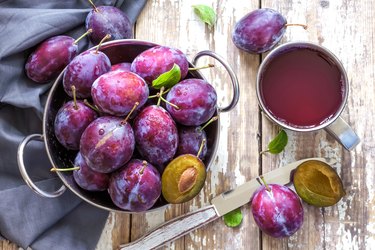
One of the first things you'll notice about prune juice is that it's far thicker than the average fruit juice. This is because there's no juice to extract from prunes — instead, the dried fruit is pulverized into a thick paste that's dissolved in hot water. Although the highly concentrated juice is often used to alleviate constipation or maintain regularity, getting too much of a good thing can lead to diarrhea.
Rich in Sorbitol
Video of the Day
Prune juice has long been a first-line defense against minor bouts of constipation — the laxative effects of prune juice are notorious. Like the dried plums it's made from, prune juice is an excellent source of sorbitol, a naturally occurring sugar alcohol that can't be digested. Four ounces of prune juice — or the equivalent of a 1/2-cup serving — supplies about 14.5 grams of sorbitol. While this amount of sorbitol will probably get your bowels moving, it isn't likely to cause loose, watery stools. Drinking a full 8-ounce glass of prune juice, however, could easily lead to diarrhea.
Video of the Day
Dietary Fiber, Too
Unlike most juices, prune juice contains an appreciable amount of dietary fiber. Although some of the whole fruit's insoluble fiber is degraded during processing, a 1/2-cup serving of prune juice still supplies 1.3 grams of total fiber, according to the U.S. Department of Agriculture. Dietary insoluble fiber helps digested food particles move through your intestinal tract more efficiently, and soluble fiber promotes softer stools. While this does enhance the overall digestive effects of prune juice, the amount of fiber in a 4-ounce serving of prune juice isn't enough to cause diarrhea. The higher fiber content of a larger serving may contribute to looser stools, especially if you're not accustomed to a fiber-rich diet.
Balancing the Effects of Prune Juice
A major factor in avoiding diarrhea while using prune juice to promote bowel regularity lies in how you consume it. Some people are more prone to diarrhea after drinking the beverage on an empty stomach, according to one manufacturer's website. Because the laxative effects of prune juice are intensified by an increased serving size, it's best to consume it in smaller portions throughout the day — rather than drinking one 8-ounce serving, opt for a 4-ounce serving in the morning and another later in the day. If you still experience loose stools, however, limit yourself to about 4 ounces of juice a day. You may be able to boost your intake once your digestive system adapts.
Choose a Milder Alternative
If you are unable to tolerate prune juice and usually have loose watery stools after drinking it, you may want to consider other juice alternatives. Juices made from pears, sweet cherries, peaches or apples also contain sorbitol, but the laxative effect of theses juices is less potent. Pear juice is about 83 percent lower in sorbitol than prune juice, while apple juice contains even less. Drinking plenty of water and eating a handful of prunes each day may be a better option — the whole fruit provides more stool-firming insoluble fiber and is digested more slowly than juice.