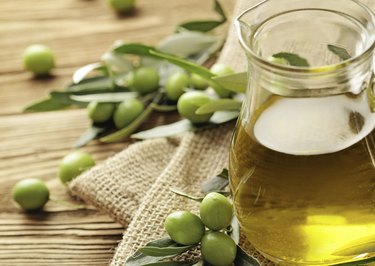
Olive oil has taken on new importance for its antioxidant levels as well as for its heart- healthy unsaturated nature. Cooking with mostly monounsaturated olive oil rather than saturated fats such as lard can decrease your risk of heart disease. Frying foods with olive oil may negate the health benefits of the oil by forming less healthy types of fat, but this is less likely to happen when cooking at home than it is in commercial kitchens.
Trans Fats Definition
Video of the Day
Trans fats, also known as partially hydrogenated oils, form when manufacturers add hydrogen to vegetable oils to make them more solid. Trans fats also occur naturally in small amounts in some dairy and beef products. Man-made trans fats can increase your low-density lipoprotein, the "bad" form of cholesterol and decrease your "good" cholesterol, high-density lipoprotein.
Video of the Day
Heating Effects
When you heat oils to their smoke point, their chemical composition begins to change as the oils break down. The amounts of antioxidants found in the oils can decrease, removing one of the oil's positive health benefits. High quality extra-virgin olive oil has a high smoke point compared to cheaper olive oils. The Olive Oil Source states that the smoke point of olive oil falls between 365 and 400 degrees F. Olive oil exposed to light and air will have a lower smoke point. Oil that's already been heated one or more times will also smoke at lower temperatures. Olive oil turns to trans fat only when repeatedly reused and heated to very high temperatures.
Rules to Follow
To keep olive oil from reaching its smoke point, do not reuse the oil. Store olive oil in a dark place. Do not overcook foods or fry them for long periods. Choose high-quality oils; although they are more expensive, they have a higher smoke point and will hold up better during frying.
Considerations
Monounsaturated fats like olive oil have high resistance to the oxidation and hydrogenation needed to turn them into trans fats. Turning oils into trans fats takes several hours, according to the Olive Oil Source. This type of transformation will not occur under normal home cooking conditions. For very high temperature cooking, like stir-frying, consider using another oil, such as peanut oil or canola, which have even high smoke points, registered dietitian Karen Collins, M.S., suggests.