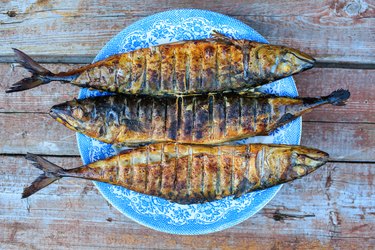
According to the Marine Stewardship Council, mackerel is the name used to describe more than 30 species of mid-water dwelling fish. Mackerel nutrition shows that it is similar to salmon in both flavor and omega-3 fatty acid content.
What is Mackerel?
Video of the Day
Mackerel is a fatty fish with multiple varieties to choose from including, king mackerel, atka mackerel, Atlantic mackerel and Spanish mackerel. The Environmental Defense Fund (EDF) Seafood Selector shows that king mackerel and atka mackerel have the best eco ratings. Mercury levels tend to be elevated in king mackerel but are lower in atka, which also has a high concentration of omega-3s.
Video of the Day
Atlantic mackerel has an "OK" eco-rating with low but mercury levels and high levels of omega-3 fatty acids. Spanish mackerel isn't rated for its eco-friendliness and contains elevated levels of mercury. It also isn't rated for its omega-3 content.
The EDF recommends that men have less than one serving of king mackerel per month while women and children don't have any. Atlantic mackerel is recommended at four or more servings per month for men, women and children. The same can be said of atka mackerel. If you opt to eat Spanish mackerel, men and women should have no more than two servings per month, while children should only have one serving per month.
Mackerel are considered an eco-friendly fish option because they mature quickly, which makes them resilient to fishing pressure. Both Atlantic and Spanish mackerel populations have rebounded because of stronger regulations. But because of mackerel contamination, it's important to limit the amount of Spanish mackerel you consume.
Mackerel Nutrition Facts
According to the U.S. Department of Agriculture (USDA), king mackerel calories and nutrition facts for a 100 gram raw portion are:
- 105 calories
- 20 grams protein
- 2 grams of fat
- 0 grams carbohydrates
- 0 grams fiber
- 31 milligrams calcium
- 2 milligrams iron
- 32 milligrams magnesium
- 435 milligrams potassium
- 158 milligrams sodium
- Trace amounts of other minerals such as zinc, copper, manganese and selenium
- 2 milligrams vitamin C
- Trace amounts of thiamin and riboflavin
- 9 milligrams of niacin
The USDA says Atlantic mackerel calories and nutrition facts for a 100 gram raw portion are:
- 205 calories
- 19 grams protein
- 14 grams fat
- 0 grams carbohydrate
- 0 grams fiber
- 12 milligrams calcium
- 2 milligrams iron
- 76 milligrams magnesium
- 217 milligrams phosphorus
- 314 milligrams potassium
- 19 milligrams sodium
- Trace amount of zinc, copper, manganese, selenium, vitamin C, thiamin and riboflavin
- 9 milligrams of niacin
The difference in calories between king and Atlantic species is likely due to the increased fat content found in the Atlantic variety. Grilling the mackerel won't change the nutrition much, unless you add fat like olive oil to the grill to keep it from sticking.
Mackerel Health Benefits
The omega-3 fatty acids in mackerel offer a number of health benefits. According to a January 2012 study published in Advances in Nutrition, the fish-derived fatty acids EPA and DHA are important for proper fetal development. They may also affect multiple aspects of cardiovascular function including anticoagulation, inflammation and peripheral artery disease. The fatty acids have also been associated with promising results in cognitive function in those with mild Alzheimer's disease and in weight management.
According to a systematic review published in the British Journal of Nutrition in June 2012, marine omega-3s are effective in preventing cardiac deaths, cardiovascular events and coronary events. This is especially the case in people with high cardiovascular risk.
Mackerel fish protein content is also impressive because it is a complete protein. That means it contains all of the essential amino acids our bodies cannot manufacture. According to the Harvard T.H Chan School of Public Health, protein is an essential macronutrient found throughout the body. Not all food sources of protein are created equally. Because the mackerel fish protein content is complete, you don't have to combine it with other protein foods to make sure you're getting all the amino acids you need in your diet.
Harvard Health Publishing says adults need a minimum of 0.8 grams of protein for every kilogram of body weight, or .36 grams for every pound. This amounts to a little over 7 grams for every 20 pounds of body weight. A 140-pound person needs approximately 50 grams of protein a day. The mackerel fish protein content means that a 100 gram serving covers nearly half of the day's required protein intake for a 140-pound person.
- U.S. Department of Agriculture FoodData Central: "Mackerel, Atlantic, Raw"
- U.S. Department of Agriculture FoodData Central: "Fish, Mackerel, King, Raw"
- Marine Stewardship Council: "What is Mackerel?"
- Environmental Defense Fund Seafood Selector: "Mackerel"
- Advances in Nutrition: "Omega-3 Fatty Acids EPA and DHA: Health Benefits Throughout Life"
- Harvard T.H. Chan School of Public Health: "Protein"
- Harvard Health Publishing: "How Much Protein Do You Need Every Day?"
- British Journal of Nutrition: "Long Chain Omega-3 Fatty Acids and Cardiovascular Disease: A Systematic Review"