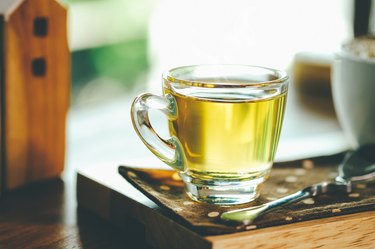
If you have gastroesophageal reflux disease (GERD), you know that the acid reflux of a GERD flare-up can be a pain. Coffee is a common GERD trigger — but what about tea? Research suggests you can go ahead and have your cup of tea, but opt for non-flavored teas and avoid it if it leads to reflux.
Related Reading
Video of the Day
No Link Between Tea and GERD
Theoretically, tea could be triggering for people living with GERD due to its acidity and caffeine content. The acidity of tea varies across different types — black tea is more acidic than green tea, for example, says Alexander T. Hewlett, DO, a gastroenterology specialist at University of Nebraska Medicine in Omaha.
Video of the Day
And while your experience will depend on your unique GERD triggers, Dr. Hewlett says there is no strong evidence tea causes acid reflux.
He points to a research review of 23 academic studies in the January 2019 edition of Medicine that found tea drinking had no significant association with the risk of GERD. "A review of multiple studies does not show that tea causes acid reflux," he says.
What Drinks Are Bad for GERD?
Some people find certain drinks increase their GERD symptoms, according to the National Institute of Diabetes and Digestive and Kidney Diseases. Acidic drinks, like orange juice or tomato juice, tend to be GERD triggers, as do drinks with caffeine and alcohol.
"Extremely erosive drinks can damage the esophagus of someone who has GERD. This is called erosive esophagitis, and it is evidence of very significant reflux. Colas, citrus juices and alcohol are usually the worst drinks for GERD," Dr. Hewlett says.
But your triggers will be unique to you. "When it comes to what triggers your GERD, there is no hard data to guide you. You need to be the judge," he says.
Tea Might Help a GERD Flare-Up
Some people get relief from heartburn with natural remedies, according to Harvard Health Publishing. Although there's not a lot of scientific evidence to support these remedies, you might try chamomile tea, ginger or licorice.
Soothing teas made from chamomile, licorice or ginger might help, but you need to be your own judge, Dr. Hewlett says. What works for some people may not work for others. An over-the-counter antacid is often helpful if you're having heartburn symptoms, he says.
Related Reading
Tip
Dr. Hewlett recommends diaphragmatic breathing as another tool that can help reduce GERD flare-ups. Here's how to try it, according to the Cleveland Clinic:
- Sit up straight but relaxed in a chair.
- Place one hand over your chest and the other over your upper belly.
- Breathe in slowly and deeply through your nose and feel your stomach push out against your hand.
- When you breathe out, tighten your stomach muscles, and let the air flow through your lips.
- Try to feel your stomach moving in and out while your chest remains still.
“Doing about 20 of these breaths may reduce heartburn,” Dr. Hewlett says.
- Alexander T. Hewlett, DO, gastroenterology, University of Nebraska Medicine, Omaha
- National Institute of Diabetes and Digestive and Kidney Diseases: “Eating, Diet, & Nutrition for GER & GERD”
- Journal of the American Dental Association: “The pH of Beverages Available to the American Consumer”
- Harvard Health Publishing: “Herbal Remedies for Heartburn”
- Cleveland Clinic: “Diaphragmatic Breathing”
- Medicine: "Association between tea consumption and gastroesophageal reflux disease: A meta-analysis"
Is this an emergency? If you are experiencing serious medical symptoms, please see the National Library of Medicine’s list of signs you need emergency medical attention or call 911.