In this day and age, we usually don't have a ton of free time. Between work, errands, kids, pets and catching up with friends, it's hard to fit in a lengthy workout. If you like running, that might mean foregoing a few outdoor miles in favor of jogging in place at home.
If that's the case, you may be wondering: Is running in place effective? Ahead, we'll break down everything you need to know about running in place versus running longer distances.
Video of the Day
First, How to Jog in Place With Proper Form
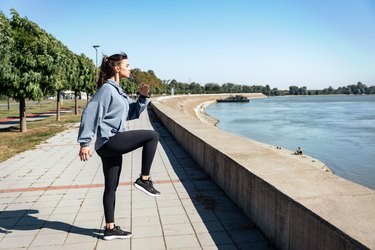
- Start with your feet hip-width apart.
- Raise one knee to your chest, while pumping your arms.
- While staying on the balls of your feet, hop and switch to the opposite leg, pumping your arms in sync.
- Continue doing this at a fast space (your feet should only make contact with the ground for a second or so).
The Benefits of Jogging in Place
1. You Can Work Out Anywhere
A common reason for not exercising is lack of time. After a long day of work, it may be difficult to drive to a gym or track to perform a 30-minute cardiovascular workout. By the time you change clothes, park, perform your exercise and get home, you may have used one to two hours of your day.
While jogging in place takes more concentration and effort to match the intensity of general jogging, it doesn't require any additional equipment or space. Jogging in place can also easily happen in your bedroom with no extra effort other than changing into workout gear or following an exercise video on your smartphone.
2. You Can Prevent Chronic Disease
When jogging in a stationary place, you can reap health benefits similar to those of jogging around your block or a park. Regular physical activity can reduce your risk of developing heart disease, diabetes, dementia and certain types of cancer, according to the Centers for Disease Control and Prevention (CDC).
3. You Can Build Muscle
Jogging in place engages your quadriceps, hamstrings, glutes and calves. You also work your core because it stabilizes your body during movement, and your upper body as you swing your arms.
4. You Can Burn Calories
Does running in place burn calories? While you won't burn as many calories jogging in your house as you would running a 5K, you'll still torch a decent amount of calories. So, how many calories does running in place burn? A 150-pound person jogging in place for 12 minutes, for example, would burn more than 100 calories, according to MyFitnessPal's physical activity calculator.
Tip
To increase these benefits, you can add body-weight exercises — like sets of push-ups, squats or lunges — in between your short bursts of running in place, according to the University of Connecticut Health Center. This type of workout is perfect if you have less than 30 minutes available in a day to exercise.
Running in Place vs. Running Outside
1. Muscles Worked
Because running in place doesn't use the same body mechanics as running for distance, the two activities target your muscles in slightly different ways.
When you jog around the neighborhood, for example, you're constantly propelling your body forward. In contrast, jogging in place requires you to lift your knees straight up, which uses your glutes less.
Additionally, when you run in place, you're landing on your toes more than if you were running regularly, which builds more ankle and calf strength. The potential downside of landing on your toes is that it can put more pressure on your knees and hips.
You may also engage more upper-body muscles jogging outdoors because you must use your arms to propel your body forward. When you jog in place, you depend less on your upper body for momentum.
2. Calories Burned
The caloric burn of jogging in place is less than jogging outside. When you jog outside, you are able to change your terrain, which can increase the demands placed on your body. For example, running uphill is more strenuous than running on a flat surface. And it's not uncommon to encounter rolling hills when you run outdoors, too.
A 150-pound person burns 272 calories in 30 minutes jogging in place, while jogging outside for 30 minutes at a 10-minute-per-mile pace burns 340 calories, according to MyFitnessPal's physical activity calculator.
However, if your house has stairs, jogging up and down the stairs can ramp up your calorie burn. A 150-pound person who jogs up and down the stairs for 12 minutes could burn more than 200 calories. Hold onto the rail for stability if needed as you jog up and down -- going down is sometimes harder, because it works your legs differently, especially your knees.
A Quick Note on Calories
Reducing exercise to nothing more than calories can lead to restrictive or disordered behaviors. You can be sure you're making the best choices for your health when you do a physical activity you enjoy.
3. Intensity
When jogging in place or outdoors, you can increase your intensity during exercise. When you jog in place, increase your efforts by increasing your speed and/or bringing your knees higher to your chest. When jogging outside, increase your stride length, speed and even your incline. While both are effective when it comes to intensifying your workout, modifying your outdoor run in this way places a greater demand on your body than lifting your knees higher.
Incorporating the principles of high-intensity interval training (HIIT) into your daily jogging-in- place workouts will help increase your heart rate. Alternate portions of medium-to-low-intensity exercise with periods of high-intensity exercise.
Increase your pace by adding high knee lifts for the high-intensity portion of your workout, followed by periods of medium-to-low intensity where you jog in place at a regular pace. This will result in more calories burned along with a faster rate of losing weight if that's your goal.
The Mayo Clinic gives some useful advice on gauging your workout intensity: If you're aiming for a vigorous-intensity jogging workout, you can monitor your heart rate and aim for a target that lies between 70 to 85 percent of your maximum heart rate.
Tip
Jogging at home doesn't have to mean running from room to room for hours every day. Instead, break up your jogging routine into several short sessions that are manageable and fit into your schedule. How many sessions you should do depends on how many calories you want to burn and your fitness goals. Put on some good running shoes to give your feet and legs the proper support, then either jog in place in front of the TV or choose a route that winds through your house. Make sure your route is free of obstacles.
The Bottom Line
So, is jogging in place good exercise? To stay healthy, adults should spend at least 150 minutes on moderate-intensity exercise a week, according to the CDC. With that being said, it might be more of a challenge to run in place for 30 minutes a day five days a week in your house than it is to go for a 30-minute run (or walk) outside to reap the benefits of weekly moderate-intensity exercise.
While you can get the same results in half the time by working out at a vigorous intensity instead, you still may be better off running outdoors or doing other forms of cardio. But any exercise is better than no exercise at all, so if running in place works for you, keep it going!
- CDC: "Physical Activity Helps Prevent Chronic Diseases"
- MyFitnessPal Physical Activity Calculator: "Calories Burned From Running (jogging), in place"
- University of Connecticut Health Center: "Burn Calories Just by Sitting Around"
- Mayo Clinic: "Exercise intensity: How to measure it"
- CDC: "How much physical activity do adults need?"