
Let's face it: Heartburn isn't a great way to start the day. Mornings can be tough enough without adding that burning pain in your chest that comes after eating certain foods.
Speaking of which, the standard American breakfast fare doesn't include a lot of low-acid foods and is often high in fatty foods — both of which can trigger symptoms for those with acid reflux or gastroesophageal reflux disease (GERD).
Video of the Day
Video of the Day
If you have regular heartburn, especially after breakfast, you might want to reconsider what goes into your a.m. meal. Here are eight of the best breakfast foods for acid reflux.
Keep in mind that different foods trigger heartburn for different people. To figure out what works and what doesn’t in your diet, try keeping a food log — in other words, writing down what you eat and when you have heartburn so you can find the patterns.
“Keeping a food diary is really important to try to determine your triggers,” says Starr Steinhilber, MD, an internist and assistant professor of medicine at UAB School of Medicine, adding that “caffeine, spicy food, chocolate, peppermint and carbonated beverages are common culprits, and one may affect you more than another.”
1. Low-Acid Fruits and Juices
Fruits and their juices are common breakfast choices and typically considered a healthy addition to your morning. Unless, of course, you have acid reflux.
If your go-tos are considered acidic — we're looking at you, pineapples, oranges, grapefruits, kiwis and other citrus fruits — skip them, per the International Foundation for Gastrointestinal Disorders. These can lead to heartburn and also activate the digestive enzyme pepsin, which could damage the lining of the esophagus, according to the Triological Society.
Instead, eat lower-acid fruits, per the IFFGD, such as:
- Apples
- Bananas
- Watermelon
- Cantaloupe
- Pears
2. Lean Breakfast Meats
High-fat meats (think: bacon and sausage) can decrease lower esophageal sphincter pressure and take longer to digest (delaying stomach emptying), per the IFFGD, both of which can up the risk of reflux.
Instead, look to:
- Ham
- Canadian bacon
- Turkey or chicken sausage
These are all leaner choices that typically don't increase acid production in the stomach as much as bacon or sausage.
3. Oatmeal

This easy-to-make hot cereal is a great way to get some fiber. And eating fiber-packed foods helps you feel full, and potentially eat less, according to Johns Hopkins Medicine. That's helpful for GERD symptoms because overeating can trigger heartburn.
Plus, fiber keeps things moving, which is a good thing. Diets low in fiber are linked with slower digestion, according to a June 2018 study in the World Journal of Gastroenterology — which, as we noted above, is bad news for people with acid reflux.
Tip
To add protein to your oatmeal, stir in a couple tablespoons of peanut butter, which is rich in the kind of healthy fats recommended for people with GERD by the IFFGD.
4. Eggs
Eggs are another great protein choice that's fairly lean.
It's smart to reach for protein at breakfast because, calorie for calorie, it's more filling than carbs or even fat, per a February 2015 study in Nutrition Journal. That means it has the potential to help you feel full on less food — similar to fiber-packed oatmeal — and that helps with heartburn because you're less likely to overeat.
Need some inspiration? Try one of these recipes:
Tip
If you notice that fat triggers your heartburn, make your eggs with mostly egg whites and just a couple yolks.
5. Breakfast Salad

That's right, the salad-for-breakfast trend gets the green light when it comes to eating for heartburn.
Fill your plate with water-rich veggies like celery and cucumber, in addition to lettuce, of course. Eating foods that have a lot of water in them is believed to dilute stomach acid, per Johns Hopkins Medicine.
Throw in some green veggies like asparagus, broccoli, green beans and others to pump up the fiber count on your salad. And consider topping it with a protein-rich poached egg.
You may want to skip some common salad add-ins that are high in acid, including tomatoes and citrus fruits, if these trigger your heartburn.
6. Whole-Grain Cereal With Milk
Just like oatmeal is a great breakfast for people with acid reflux, so is cereal made with whole grains, because it's also a good source of fiber. Your cereal doesn't have to be as earnest as bran flakes or shredded wheat (though both are solid choices!). Simply look for a cereal that's made primarily with whole grains (it should be first on the ingredient list) and delivers at least a few grams of fiber per serving (Cheerios is one example).
Then add your choice of milk. Cow's milk is usually well tolerated, although if you're sensitive to fat, go with low-fat or nonfat milk instead of whole milk, per Johns Hopkins Medicine.
Some plant-based milks, such as those made from almond or soy, are more alkaline, per the American College of Healthcare Sciences, and may reduce stomach acidity, making them a good choice to go with your cereal.
7. Potatoes
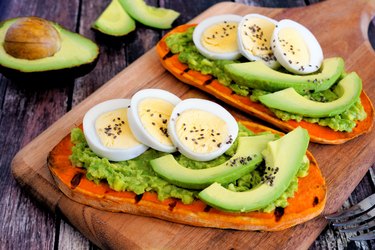
Both white and sweet potatoes are another so-called complex carb — they come with a variety of nutrients and some fiber, per the IFFGD, making them a good add to the list of GERD-friendly breakfast options.
Be mindful of how they're prepared, though. For instance, fried potatoes (think: hash browns) could trigger acid reflux because they're cooked with a lot of fat. Or if the potatoes are cooked into a hash or medley, they might be accompanied by onions and garlic, which lead to heartburn for some folks.
8. Herbal (Caffeine-Free) Tea
OK, so tea isn't technically a food. But if you like to start your day with a hot cup of something, try brewing yourself some herbal tea. That's because caffeine — which is in regular, non-herbal teas — relaxes the lower esophageal sphincter (which is what keeps the contents of the esophagus and stomach separate), per the American Society for Gastrointestinal Endoscopy (ASGE), and that sphincter relaxing is what allows acid to creep up into the esophagus.
Coffee, whether it's caffeinated or decaffeinated, also relaxes the lower esophageal sphincter, according to ASGE. And there's one herbal tea to skip: peppermint, another sphincter relaxer.
Related Reading
- Triological Society: "Otolaryngologists Research the Role of Pepsin in Reflux, Lung Disease"
- International Foundation for Gastrointestinal Disorders: "Diet Changes for GERD"
- American Journal of Gastroenterology: "Guidelines for the Diagnosis and Management of Gastroesophageal Reflux Disease"
- Nutrition Journal: "A randomized, controlled, crossover trial to assess the acute appetitive and metabolic effects of sausage and egg-based convenience breakfast meals in overweight premenopausal women"
- Johns Hopkins Medicine: "GERD Diet: Foods That Help with Acid Reflux (Heartburn)"
- American College of Healthcare Sciences
- World Journal of Gastroenterology: "Fiber-enriched diet helps to control symptoms and improves esophageal motility in patients with non-erosive gastroesophageal reflux disease"
Is this an emergency? If you are experiencing serious medical symptoms, please see the National Library of Medicine’s list of signs you need emergency medical attention or call 911.