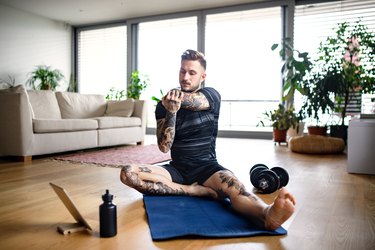
Before you ever pick up a weight or hop on a treadmill, it's a good idea to set a goal. Having one — for that day, week, month and year — will give you direction and motivation. And it can help light a fire under your butt and get you to do the darn thing.
When it comes to fitness goals, trainers want you to consider setting ones that have nothing to do with your size, shape or how you look. Why? Because it can actually provide better motivation in the long run.
Video of the Day
Video of the Day
Not sure what your new goal should be? Here are seven great mental and physical fitness goals that have absolutely nothing to do with changing how you look. They might just change your life.
1. Find a Workout You Actually Enjoy
The best workout is the workout you'll actually do and like. That's because you're going to have a very hard time being consistent with your routine if you really don't like what you're doing. Plus, workouts are meant to be enjoyed!
"You have to find movement that makes you happy to do it," says Morit Summers, CPT, a certified personal trainer and owner of Form Fitness Brooklyn. "And sometimes it takes a minute to find that." If you really dread running, there's no reason to force yourself to do it. Find a different form of cardio.
Achieve It
One workout session isn’t really enough to know if you really like or dislike something. You have to give it some time.
“I don’t expect someone on day one of starting a fitness plan to be like, ‘This is the greatest thing I’ve ever done,’ but if you can tolerate it for a little while you might find the different joys within it,” Summers says. “You have to push through a little. You can’t just give it one day, you have to give it a solid try.”
Give it a few weeks or month before making your ruling. Also, it’s not a bad idea to try a few different types of exercise (like running, lifting and climbing) at once, so you can compare how each makes you feel before, during and after.
2. Develop a Consistent Routine
One great goal is to just work out regularly, Summers says. It sounds simple, but it takes a lot of commitment and work to get there. When exercise becomes something that's as ingrained in your life as are brushing your teeth or taking out the trash, you're able to get the biggest benefits.
Achieve It
If you’re trying to get into a regular routine, start with something small. Go for a 15-minute walk once or twice a week. Or just try move in some way three to four times a week, Summers says.
Be realistic about how often you can exercise, and then, after a few weeks of consistency, add some time. Put the walk or activity into your calendar, just like you do with an important phone call or Zoom meeting.
3. Improve Your Flexibility and Mobility
When pressed for time, stretching is something most people choose to skip. But improving flexibility and mobility is a goal you shouldn't sleep on.
"Improving your flexibility and mobility should be first on the list of goals to achieve," says Mikey Newson, CPT, a certified personal trainer and coach at Row House in Chicago. "It prevents injuries, promotes better posture and increases your range of motion for your workouts and everyday life movements like pushing, pulling and squatting."
Achieve It
Start small by adding one short yoga workout into your weekly schedule, Newson says. It’s also a good idea to warm up with dynamic stretches before every workout. Doing some mobility work before a workout can help prep your muscles for the exercises to come, which can make it easier to do everything with proper form and avoid hurting yourself.
For example, before a run, you could do some high kicks and reverse lunges, Newson says.
4. Conquer a Performance Goal
There are endless performance-based fitness goals you can set — run a 5K, do 10 push-ups, do a pull-up. These kinds of goals allow you to best measure your progress and both see and feel yourself accomplishing a little more each time, Summers says.
"The reason I love fitness is because all I want to do every single workout is get better," she says. "Fitness is working toward accomplishment every single day."
Achieve It
First, pick something you’re actually excited to conquer.
Be realistic when setting performance-based goals, Summers says. For example, if your goal is to do 10 push-ups but you can’t do one yet, it’s probably not realistic to say you’ll reach that goal in eight weeks. Sometimes, you have to start by learning proper form.
Next, test where you’re at. How many push-ups can you do currently? This will give you a baseline. Then, after following a program to work toward that goal for eight to 12 weeks, retest and see how far you’ve come.
“If you don't hit the goal, but did more than before you started, that’s still progress,” Summers says.
5. Gain Confidence
Improving your self-esteem, confidence and relationship with your body are some of the most worthwhile fitness goals anyone can set.
Conveniently, keeping a regular workout routine naturally helps many people improve their mental health and self-esteem. "Putting yourself through something that is uncomfortable is actually going to help you become a stronger person mentally," Summers says.
Throughout your fitness journey, you'll become more confident in your abilities and comfortable challenging them.
Achieve It
“This is an ongoing goal and working on your attitude and mindset is definitely not a linear progression,” Summers says. “It takes a lot of time to kind of change the mindset over to have more good days than bad, but there will always be hiccups in between.”
Keep a journal about your training and how you feel before and after each session. Establishing a daily mantra or affirmation can also help you move away from negative comments about your body and focus more on the positive.
Swap out negative internal chatter like, "I can't do a pull-up" with "I can't do a pull-up yet. But I will with practice."
6. Learn a New Skill
As Summers says, one of the coolest things about fitness is being able to see yourself get better at something. So try learning a new skill.
If you've been lifting with dumbbells, maybe try learning how to use kettlebells. If you're a runner, maybe you want to get into biking to mix things up a bit. Or maybe you want to venture into something totally new, like boxing or mixed martial arts.
Learning something new is a great way to grow both mentally and physically. At first, it's a humbling experience. Sticking with it and growing your skills will give you that confidence boost.
Achieve It
When you start learning a new skill, it’s important to be patient with yourself. “When it comes to building up a better version of yourself you have to take one step at a time in your fitness journey and have fun along the way," Newson says.
Pick something that interests you — remember, you don’t want to dread the workouts. If you want to try something totally out of your wheelhouse, consider hiring a trainer or coach with an expertise in that activity, so that you can build a strong foundation and not only grow your skills but avoid getting hurt along the way.
7. Feel Your Healthiest
Fitness comes with endless health benefits, from reducing the risk of cardiovascular disease to helping maintain bone density, decrease falls as we age, and even help us live longer, according to the Centers for Disease Control and Prevention.
But exercising regularly can help you feel really good and healthy in your body in all the small, everyday ways, too, Summers says. For example, reducing uncomfortable belly bloat, keeping your bathroom habits regular and even helping you sleep better at night.
Achieve It
Getting into a consistent, regular exercise routine. Many exercise benefits, like a better mood and focus, can be immediate. But you have to pay attention to really notice them, Newson says.
Try keeping tabs on your energy levels, sleep and mood with a journal. Logging them in your fitness app can help you see how your workouts and health are connected.
Was this article helpful?
150 Characters Max
0/150
Thank you for sharing!
Thank you for your feedback!