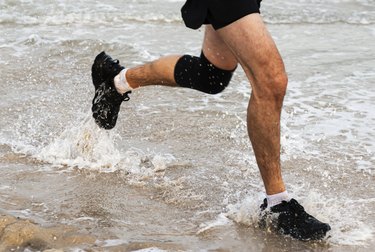
Injuring your meniscus may feel like a major blow to your running routine, however, this isn't necessarily the case. While the meniscus plays a vital role in absorbing the impact your knee sustains while you run, many people with a meniscus tear end up with minimal symptoms.
In fact, a May 2005 study in Arthroscopy: The Journal of Arthroscopic and Related Surgery found that 20 percent of asymptomatic professional basketball players had meniscus tears when they had an MRI. This means they played with the injury and had no pain.
Video of the Day
Video of the Day
If you're recovering from a meniscus injury — pain or no pain — take these steps to increase your odds of returning to running safely.
Warning
There are risks to running with a torn meniscus. If you're unable to comfortably return to running after following these steps — or your pain worsens — see a doctor about your lingering symptoms. It's important not to push through pain, as this can cause further damage to the knee and limit your options going forward.
Rest and Restore Range of Motion
Allowing the inflammation that often accompanies a meniscus injury to subside is the first step toward recovery. Before you think about running, make sure the pain, swelling, redness and warmth in your knee have resolved.
Icing three times a day for 10 minutes at a time will help speed up this process. In addition, it's important to restore your knee's previous range of motion so you're able to return to a normal gait pattern when you run.
Stretches are an effective way to accomplish this, and one particular exercise, known as a heel slide, is a good torn meniscus rehab exercise.
- Lie on your back with your legs extended straight out along the ground.
- Slowly slide your heel toward your butt until you feel a gentle pull.
- Hold this for 5 seconds
- Straighten your knee until a similar stretch occurs.
- Again, hold this position for 5 seconds before relaxing.
- Complete 10 reps twice daily until you regain normal mobility.
Strengthen Your Glutes and Quads
Your quadriceps (quad) are a set of four muscles that help support your knee and reduce the strain on your meniscus. Building quad strength can help decrease the pain associated with a meniscus injury and increase the likelihood of running again. Mini-squats are an effective meniscus injury exercise for targeting this important muscle group.
- Stand with your feet shoulder-width apart and your arms extended out in front of you.
- Slowly perform a squat by sitting your butt back and bending your knees in a pain-free range of motion. Your knees shouldn't buckle in or travel forward past your toes.
- Hold this position for 1 to 2 seconds.
- Slowly stand up.
- Complete 3 sets of 10 reps each day.
The gluteus medius is a small hip muscle that assists with maintaining good knee alignment as you run. By helping to pull your knee and hip outward (abduction), this muscle equalizes the force placed on the knee joint and prevents you from falling into a "knock-knee position." Side-lying leg raises are one way to strengthen your gluteus medius.
- Lie on your side with your legs straight and stacked on top of each other.
- Without allowing your hips to rock forward or backward, lift your top leg 8 to 10 inches in the air. Make sure to lead with your heel instead of your toes as you lift your leg up to engage your glutes.
- Slowly lower the top leg back down again. Try to keep your top leg in line with the rest of your body the entire time.
- After performing 3 sets of 10 reps, flip over and repeat the exercise with the other leg.
Adjust Your Stride and Progress Slowly
After the inflammation has subsided and you've focused on improving your range of motion and strengthening your glutes and quads for four to six weeks, you may be ready to begin running again. However, you may want to shorten your stride (step length) when you do.
Decreasing the length of your steps by 10 percent forces your foot to hit the ground at the middle and diminishes the amount of force applied to the knee, according to a March 2017 study in Clinical Biomechanics.
And even if you feel fine after returning to running, it's important to progress slowly to avoid reinjury. Despite everything detailed above, running still places pressure on your body but won't cause knee damage. Make sure to allow one to two days of rest in between runs and progress mileage by no more than 10 percent each week.
Can You Use an Elliptical With a Torn Meniscus?
Cross-training on the elliptical is a low-impact, non-twisting way to allow your knee to recover while staying active, as it reduces the impact on your legs, per a September 2007 study in Medicine and Science in Sports and Exercise.
Just make sure that you first have good knee mobility and stability and sufficient leg strength. And when you do hop on the elliptical, your knees should stay behind your toes and you should sit back on your feet without bouncing as you stride.
Elliptical exercise is only recommended if you have a minor tear and no pain. If you're running after meniscus surgery, wait until your physical therapist gives you the green light to use the elliptical. They can help design a specific program to minimize the chances of the pain returning.
If you experience swelling, pain when squatting or locking of the knee, discontinue your elliptical exercise and any heavy weight-bearing activities until further evaluation by your doctor.
- Arthroscopy: The Journal of Arthroscopic and Related Surgery: "Magnetic Resonance Imaging of the Knee in Asymptomatic Professional Basketball Players"
- Clinical Biomechanics: "Reduced Step Length Reduces Knee Joint Contact Forces During Running Following Anterior Cruciate Ligament Reconstruction but Does Not Alter Inter-limb Asymmetry"
- Medicine and Science in Sports and Exercise: "Joint loading in the lower extremities during elliptical exercise"