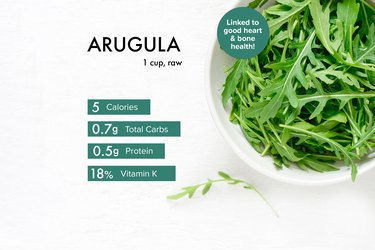
Arugula is a leafy green with a peppery, earthy taste that is an explosion of flavor, which makes it easy to understand why the Brits call it "rocket." Arugula's spicy mustard-like qualities add distinct energy to any dish, which has endeared it to legions of aficionados.
This lively green is often thought to be a zestier lettuce or salad green. But, arugula is actually a cruciferous vegetable and a member of the health-enhancing Brassica family, which also includes kale, cabbage, Brussels sprouts and broccoli.
Video of the Day
Video of the Day
Arugula has small flat leaves and long stems. While it's delicious raw, its flavors can be enhanced and sweetened by a quick sauté or steam. Plus, it's a low-calorie option that's chock-full of vitamins, minerals and phytochemicals, packing a powerful punch of benefits.
Arugula Nutrition Facts
According to the USDA, in a 1-cup serving of arugula, you'll get:
- Calories: 5
- Total fat: 0.1 g
- Saturated fat: 0 g
- Trans fat: 0 g
- Cholesterol: 0 mg
- Sodium: 5.4 mg
- Total carbs: 0.7
g
- Dietary fiber: 0.3 g
- Sugar: 0.4 g
- Protein: 0.5 g
Arugula Macros
- Total fat: A cup of raw
arugula has 0.1 grams of total fat, which includes 0 milligrams of unsaturated
fat, 0 grams of saturated fat and 0 grams of trans fat.
- Carbohydrates: One cup of raw arugula has 0.7 grams
of carbs, which includes 0.3 grams of fiber and 0.4 grams of natural sugars.
- Protein: One cup of raw arugula has 0.5 grams of protein.
Vitamins, Minerals and Other Micronutrients
- Vitamin K: 18% of your Daily Value (DV)
- Folate: 5% DV
- Vitamin A: 3% DV
- Vitamin C: 3% DV
- Manganese: 3% DV
- Calcium: 2% DV
- Potassium: 2% DV
- Iron: 2% DV
- Copper: (2% DV
- Magnesium: 2% DV
Health Benefits of Arugula
Like many leafy greens, arugula has a rich and varied nutrient profile. It has a small amount of fiber as well as a wide range of vitamins, minerals and antioxidants.
1. It's Linked to a Reduced Risk of Cancer
Cruciferous vegetables, like arugula, have a group of anti-cancer compounds known as glucosinolates, which are sulfur-containing chemicals.
Glucosinolates break down when cooked and eaten to form biologically active compounds that have been linked to preventing the development of cancer, the National Cancer Institute states.
Epidemiological evidence has tied eating more cruciferous vegetables with a reduced incidence of cancer, according to an article in the December 2014 (BBA) - Reviews on Cancer journal.
Arugula also has high amounts of erucin, which may be responsible for many anticancer activities, according to research in the June 2014 edition of PLOS One.
What's more, arugula boasts antioxidants, which help protect our cells from oxidative damage. Studies suggest that eating two to three servings of dark leafy greens such as arugula every week is linked to a lower risk of breast, skin and stomach cancer, according to the USDA Agricultural Research Service.
2. It's Tied to Good Heart Health
Green leafy vegetables, including arugula, have long been touted as health-promoting foods.
In fact, leafy green vegetables are associated with a decreased incidence of heart disease and can help support heart health, according to a January 2016 meta-analysis in JRSM Cardiovascular Disease.
And research shows that a diet rich in fruit and veggies, notably cruciferous vegetables (hello, arugula), is inversely associated with atherosclerosis, according to an April 2018 article in the Journal of the American Heart Association.
3. It Has Nutrients That Are Linked to Bone Health
Our bones bear the brunt of our weight on a daily basis, but did you know that bone is a living tissue that continuously breaks down and rebuilds throughout life?
We typically reach our peak bone mass by the time we hit age 30, after which it may remain fairly steady (depending on diet and lifestyle) for another 20 years, according to Harvard Health Publishing. After that, people going through menopause generally experience bone loss more quickly because of hormonal changes.
That being said, vitamin K is essential for good bone health. And clocking in with more than 25 percent of a person assigned female at births' (AFAB) daily needs and 18 percent for a person assigned male at birth (AMAB) per 1-cup serving, arugula is high in this bone-building nutrient.
Not getting enough vitamin K is associated with an increased risk of osteoarthritis and fractures in older adults, a June 2014 study in Molecular Nutrition & Food Research found.
Getting enough K can also help reduce bone breakdown and improve bone strength, according to an April 2012 article in the Open Orthopedics Journal.
Arugula Health Risks
Food Allergies
Arugula is generally regarded as safe for most people to eat and is not known to be associated with any food allergies to date.
But, leafy greens, including arugula, have low amounts of oxalate. It is recommended that those with a history of oxalate-containing kidney stones should avoid over-eating oxalate-containing foods, according to Harvard Health Publishing, so speak to your doctor about adding arugula to your diet if you have calcium oxalate stones.
Drug Interactions
Vitamin K can interact with a few medications and certain medications can also have an adverse effect on vitamin K levels, according to the National Institutes of Health.
Vitamin K is vital for blood clotting, so high amounts of this nutrient dilutes the effects of prescription blood thinners, such as warfarin. But people taking blood thinners should not cut out vitamin K completely because it is an integral part of healthy eating, according to the Cleveland Clinic.
Instead, be consistent about the amount of vitamin K you eat daily to keep a constant level because sudden changes (increased or decreased levels) can disrupt the medication's coagulating power.
People on antibiotics or bile acid sequestrants to reduce cholesterol may experience decreased vitamin K status. Be sure to discuss any medication and food interactions with your doctor.
Arugula Preparation and Useful Tips

Arugula can be found year-round, but it hits peak season is June through December. Similarly to many leafy greens, arugula is highly perishable. Follow these tips to keep your arugula fresh and vibrant:
- Buy leaves that are dark green; avoid wilted greens and those with yellow spots and brown edges.
- To maintain freshness, wrap roots in damp paper towels and then place the entire bunch into a plastic bag and into a crisper drawer. You can also place the roots in a glass of water (like you would flowers) and then cover greens with a plastic bag and refrigerate.
- To maintain crispness without leaving the roots, rinse and spin-dry in a salad spinner. Then, wipe spinner bowl dry and store arugula in the bowl or wrap arugula in clean paper towels and place into a plastic bag in the refrigerator.
- Store arugula separate from bananas, apples and pears, which give off ethylene gas as they ripen, causing the arugula to spoil quicker.
Arugula is a delicious part of many meals when eaten raw. But, it can range in intensity depending on when, where and how it is grown. The best way to determine how peppery the bite is by tasting it. When cooked, arugula's flavor sweetens and may become less potent.
Arugula can be used a myriad of ways. Here are some quick serving ideas to get you started:
- Mix raw arugula with milder greens to make a well-balanced salad. It goes particularly well when combined with Boston or Bibb lettuce, which is soft and buttery.
- Pair it with rich ingredients like avocado or parmesan cheese and citrus fruit such as orange or grapefruit.
- Make arugula pesto by blending together raw arugula with garlic, nuts, parmesan, olive oil, lemon juice, salt and pepper. Toss the pesto with pasta or grains, add it to meat, poultry and fish or serve it as a dip with crostini and vegetables.
- Add a handful of raw arugula on top of pizza or into a sandwich or wrap.
- Spice up your smoothie or soup by adding arugula to the mix.
How to Cook Arugula
While arugula is often enjoyed fresh, cooking it can help soften its peppery flavor, making it almost sweet. Here's how to cook the green in just a few easy steps.
Once you've got your sauteed arugula, use it as a side dish, as a salad base or add it to cooked pasta or a whole grain like farro.
Things You'll Need
skillet
2 teaspoons olive oil
1 clove garlic, minced
1 bunch arugula
1/2 teaspoon kosher salt
1/8 teaspoon ground black pepper
Instructions
- Add oil to a skillet over medium heat.
- Add garlic and saute for 30 seconds.
- Add arugula, salt and pepper and saute until wilted, about 2 to 3 minutes.
Alternatives to Arugula
If you're not a fan of arugula or just want a break from its peppery bite, try:
- Watercress
- Spinach
- Dandelion greens
Watercress belongs to the same Brassica family but offers a less-spicy flavor profile. Similar to arugula, spinach is nutrient-dense and can be served raw or cooked.
Spinach has a much milder taste than arugula and is often a more budget-friendly option. Dandelion greens are another swap-out you can try, offering a similar earthy bitter flavor without the peppery kick.
- MyFoodData: "Arugula"
- Cruciferous Vegetables Fact Sheet
- "Biochimica et Biophysica Acta (BBA) - Reviews on Cancer: "Phenethyl isothiocyanate: A comprehensive review of anti-cancer mechanisms"
- PLOS One: "Erucin, the Major Isothiocyanate in Arugula (Eruca sativa), Inhibits Proliferation of MCF7 Tumor Cells by Suppressing Microtubule Dynamics"
- USDA: "Dark Green Leafy Vegetables"
- JRSM Cardiovascular Disease: "The effect of green leafy and cruciferous vegetable intake on the incidence of cardiovascular disease: A meta-analysis"
- Journal of the American Heart Association: "Cruciferous and Total Vegetable Intakes Are Inversely Associated With Subclinical Atherosclerosis in Older Adult Women"
- Harvard Health Publishing: "Key minerals to help control blood pressure"
- Harvard Health Publishing: "Keeping bones strong"
- Molecular Nutrition & Food Research: "Vitamin K and musculoskeletal health in postmenopausal women"
- Open Orthopedics Journal: "Essential Nutrients for Bone Health and a Review of their Availability in the Average North American Diet"
- Harvard Health Publishing: "Kidney Stones"
- National Institutes of Health: "Vitamin K Fact Sheet for Health Professionals"
- Cleveland Clinic: "Why Vitamin K Can Be Dangerous If You Take Warfarin"