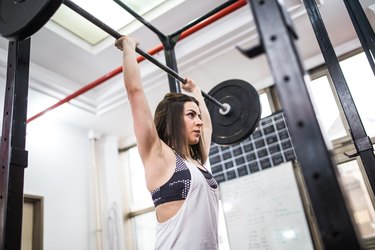
If you're looking for a way to work your shoulders, consider the overhead press, one of the most effective shoulder exercises you can tackle. That said, your shoulders aren't working alone — and no single exercise will work all of this fairly complex joint.
Tip
The primary movers for most variations of the overhead press are your anterior deltoids, assisted by your medial deltoids, pecs and triceps.
Video of the Day
Overhead Press Form
First, take a look at proper form for doing an overhead press with dumbbells. Although the overhead press can be done with dumbbells or a barbell, dumbbells are usually a much more convenient and flexible option, unless you're powerlifting.
Video of the Day
Dumbbell Overhead Press
- Sit down on a weight bench with back support, holding a dumbbell in each hand. Plant both feet on the floor for stability, and keep your back in contact with the back rest.
- "Rack" the dumbbells at about chin level, palms facing forward (also known as an overhand grip) and slightly wider than shoulder-width apart.
- Smoothly straighten your arms, pressing the dumbbells straight overhead.
- Bend your arms and smoothly lower the weights to the "rack" position.
If you do this exercise with barbells, it works very similarly — but you'll either need to do it while standing or use a weight bench paired with the appropriate barbell rack. Here are directions for a seated barbell press, on the assumption that you're already seated in the bench with your back against the back support.
- Hold the bar in an overhand grip, hands slightly wider apart than your shoulders. Think "chest up and out" and squeeze your abs to stabilize your core.
- Starting with the bar close to your body, near your upper chest, press it straight up overhead.
- Slowly return the bar to the starting point, near your upper chest.
Losing control of weights during an overhead movement can easily result in injury, so it's always good practice to lift with a spotter — especially if you're working anywhere near your strength limit.
The Muscles at Work
So, which muscles make this movement happen? The prime mover is the anterior deltoid, or the front of the cap-like deltoid muscle that sits where your upper arm meets your torso. The movement known as shoulder abduction — moving your upper arm up, away from your body — is one of its key jobs.
Your medial or lateral deltoid, the middle portion of the same cap-like muscle, also helps with this movement. The upper fibers of your pectoralis major — the big muscle on the front of your chest — help out with this motion too, especially if you use a relatively narrow grip on the bar. However, that doesn't mean you should skip chest exercises in favor of the shoulder press.
Last, but definitely not least among the major muscles at work during an overhead press, is your triceps brachii, the meaty muscle in the back of your upper arm. This muscle's primary job is to straighten your arm at the elbow — without that, you wouldn't be able to complete the motion of the overhead press.
But of course, there's more happening any time you move your shoulders. The shoulder girdle is a complex entity so, in addition to the main movers that power you through the overhead press motion, muscles like your trapezius and levator scapulae also kick in to stabilize and shift your scapula. Next time a gym buddy does this lift, ask if you can place your hands on his shoulder blades while he performs the movement; you might be amazed by how much you feel happening.
Dumbbells or Barbells?
What type of weight is best for doing an overhead press? For many exercisers, dumbbells are simply easier and more convenient; you're more likely to have access to an array of them at home or in the gym, and you don't risk being trapped under the bar of a barbell.
To dig a little deeper, in a small study of EMG activity in 15 participants, published in the July 2013 issue of the Journal of Strength and Conditioning Research, researchers found that doing a shoulder press with dumbbells provoked more deltoid activity than doing a shoulder press with barbells. They also tested the exerciser's positioning and found that doing a standing dumbbell overhead press provoked more shoulder activity than doing the same exercise seated.
It's not surprising that the researchers found this exercise — which forced the exerciser to do the most work stabilizing the weight — to have the lowest maximum lift weight of the exercises tested, despite it provoking the most neuromuscular activity. Introducing any sort of instability commonly decreases the amount of weight you can lift, not because your muscles are working less, but because they're responsible for doing multiple things at once (both pushing the weight and stabilizing it.)
Or, to put it another way, how much weight you can lift isn't always the best measure of how much work you're doing during an exercise.
Read more: 5 Dumbbell Moves You Haven't Tried Before
What About Kettlebells?
The overhead press appears frequently in kettlebell workouts too, with the exerciser holding the kettlebell's handle with his palm facing forward and the weight of the kettlebell sitting slightly behind him, resting against the back of his hand.
It's interesting to note that, in a 2018 issue of the International Journal of Exercise Science, researchers conducted another small EMG test, this time using 21 subjects, and discovered that using the more stable implement, dumbbells, provoked a slightly greater increase in anterior deltoid muscle activity (63.3 percent) as compared to the slightly smaller 57.9 percent increase in activity from kettlebells.
Although the researchers did deem that difference to be statistically significant, it's not huge. Ultimately, if you like doing your overhead presses with kettlebells and have adequate shoulder stability to do so, there's absolutely no reason not to. Any exercise that fits readily into your workouts so that it's done consistently is preferable to one dubbed the "best" that's never done.
Read more: 8 of the Best Bodyweight Shoulder Exercises
The Best Shoulder Exercise
Speaking of the "best" designation, here's more good news about the overhead press. In a small, independent study sponsored by the American Council on Exercise, exercise scientists from the University of Wisconsin-LaCrosse recruited 16 volunteers and monitored their EMG activity while doing 10 of the most popular shoulder exercises.
Of these, the dumbbell shoulder press — essentially, a dumbbell overhead press — was found to produce significantly more activity in the anterior deltoid than the other exercises. The shoulder press produced 74 percent activity when compared to the same exerciser's "maximum voluntary contraction" or MVC, a baseline contraction the exerciser demonstrated before beginning the exercises.
The next closest follower for anterior deltoid activity, the dumbbell front raise, produced just 57 percent activity compared to the MVC, followed by battle ropes at 49 percent. That doesn't mean the overhead press is the only shoulder exercise you should do; in fact, the researchers make it a point to note that neglecting the medial and posterior deltoids can lead to shoulder dysfunction that affects up to 69 percent of people at some point in their life.
The overhead press is good for your deltoids too, generating a nice, middle-of-the-pack result at 62 percent of MVC. The top exercise for medial deltoid activity was the 45-degree incline row, at 84 percent of MVC. But the shoulder press's activity in the posterior deltoid is minimal, at 10 percent of MVC — compared to 73 percent MVC for seated rear lateral raises, the top workout for your posterior or rear deltoid.
In addition to seated rear lateral raises, some of the other effective exercises you can include in your workouts to strengthen your rear deltoids include the 45-degree incline row (which generated 69 percent of MVC in the rear deltoids), followed at a great distance by battle ropes at 38 percent of MVC.
Finally, even if the overhead press is your favorite exercise for the anterior deltoids, it's good to shake up your workouts every once in a while — so don't be afraid to sample some of the other exercises already mentioned. Part of this is for mental variety, but exposing your body to new stimuli will also cause it to adapt in response — or, in other words, it helps keep you from getting stuck at a fitness "plateau." Switching up your shoulder exercises every so often also helps reduce your risk of overuse injuries.
What About Other Muscles?
It can be tempting to focus on muscles like your shoulders — especially the fronts of your shoulders — because they're readily visible in the mirror and can have a real impact not just on your appearance but on everyday activities, too. Still, don't forget to work all your other major muscle groups, including your chest, back, arms, core, hips, quads, thighs and calves.
In point of fact, the U.S. Department of Health and Human Services recommends working all your major muscle groups at least twice a week. That doesn't have to mean spending all day in the gym, twice a week; one or two sets of eight to 12 repetitions are sufficient for building strength and maintaining health.
So, you can pair your shoulder presses and other shoulder workouts with exercises such as squats or lunges for your legs and hips, chest presses or push-ups for your chest, pull-ups or lat pulldowns for your back, dips and biceps curls for your arms and crunches, planks and bicycle crunches for your core.
- Journal of Strength and Conditioning Research: "Effects of Body Position and Loading Modality on Muscle Activity and Strength in Shoulder Presses"
- American Council on Exercise: "Dynamite Delts: ACE Research Identifies Top Shoulder Exercises"
- International Journal of Exercise Science: "Stability of Resistance Training Implement Alters EMG Activity During the Overhead Press"
- ExRx.net: "Barbell Military Press"
- American Council on Exercise: "Seated Overhead Press"
- ExRx.net: "Barbell Shoulder Press"
- ExRx.net: "Deltoid (Anterior)"
- ExRx.net: "Deltoid (Lateral)"
- ExRx.net: "Triceps Brachii"
- Health.gov: "Dietary Guidelines for Americans, 2015-2020: Appendix 1. Physical Activity Guidelines for Americans"