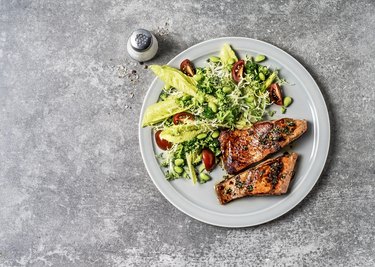
A bodybuilding diet for women competitors involves precision control of calorie and nutrient intake to produce just the right balance of muscle gain versus fat loss. But even if your plan is a more modest one — to tone and look more sculpted — you can still benefit from the right diet.
Bodybuilding or Just Building Strength?
Video of the Day
Choosing bodybuilding as a sport means you'll be judged on muscular appearance in competitions. Getting bulked to the sort of degree that would allow you to compete means matching a competitive drive with a huge amount of training and (ideally) a natural genetic propensity to build muscle.
Video of the Day
If you have neither the time nor inclination to become a professional bodybuilder, you can still reap health benefits and improve your body shape with less intensive strength work. Many women don't want to have Popeye-style muscles anyway, but still can — and should — do regular strength-training exercises for peak wellbeing.
When health and fitness is your aim rather than competition, two to three sessions of strength work for 20 to 30 minutes on non-consecutive days a week is sufficient, according to the American College of Sports Medicine.
Healthy adult males and females should aim for eight to 12 repetitions of eight to 10 exercises that target the major muscle groups. Examples of these exercises using just your body weight as resistance include:
- Push-ups
- Pull-ups
- Arm circles
- Reverse grip pull-ups
- Dips
- Crunches / prone planks
- Lunges
- Hip-ups
According to the Mayo Clinic, strength-training — which can also be done using free weights, machine weights or stretchy resistance bands/tubes — has these important health benefits:
- Reduction in risk of osteoporosis. By stressing your bones, strength training can increase bone density.
- Weight management. Strength training can increase your metabolism to help you burn more calories.
- Improvement of chronic conditions. Strength training can also reduce the signs and symptoms of many chronic conditions, such as arthritis, back pain, obesity, heart disease, depression and diabetes.
Read more: Your Guide to Strength Training for Women
Bodybuilding Diet for Women: Bulking
If you do feel ready to take up bodybuilding seriously, the July 2019 edition of the journal Sports (Basel) has an evidence-based review of the diet that works best to build muscle gains during the off-season — which is when you're bulking up outside the competition season. Its recommendations, for both females and males, are as follows:
- Consume 10 to 20 percent extra calories to increase your body weight by a steady rate of 0.5 to 1 percent a week. For a 120-pound female, this equates to an ideal gain of 0.6 to 1.2 pounds a week. (Note: advanced bodybuilders should be more conservative with caloric surplus and weekly weight gain than novice bodybuilders).
- Get at least 50 percent of your calories from carbohydrates. For a bodybuilding woman consuming 2,200 calories a day, that would be 275 grams of carbohydrates a day.
- Consume protein at a level of 1.6 to 2.2 g per kilogram body weight per day. For a 120-pound woman, this equates to 87 to 120 grams of protein a day. Protein intake should be distributed throughout the day.
- Include fat in moderate amounts, providing 25 to 30 percent of calories. If you were consuming a 2,200-calorie diet, that's between 61 grams and 73 grams fat a day.
Tip
If you need help with a personalized women's bodybuilding nutrition plan, your best option is a Registered Dietitian Nutritionist, as they will give evidence-based advice. You can search for one here using the drop down menu to find a sports specialist.
Bodybuilding Diet for Women: Competing
The female bodybuilding diet weight loss phase kicks in several weeks before competition. After bulking up during the off-season, bodybuilders usually need to pare down body fat to an absolute minimum in order to showcase their muscular physique on stage.
However, for success it's absolutely vital that you maintain that lean body mass while shedding fat. A May 2014 review in the Journal of the International Society of Sports Nutrition discusses the best competition preparation diet, which looks something like this:
- Adjust caloric intake such that weight is lost at approximately 0.5 to 1 percent of body weight a week. If you're at 140 pounds, that's a recommended loss of no more than 0.7 to 1.4 pounds a week to preserve muscle.
- Go for the little and often approach to fueling — three to six meals per day with a meal containing 0.4 to 0.5 grams per kilogram bodyweight of protein. For a 140-pound woman, that's around 25 to 32 grams of protein per meal.
- 15 to 30 percent of calories should come from fat — that's between 28 and 56 grams daily if you are consuming 1,700 calories.
- The remainder of calorie intake should come from carbohydrates.
Many bodybuilders pare down their carbs to virtually nothing in the days before competition, but this may not be wise, according to a January 2018 review in the Journal of the International Society of Sports Nutrition. The review looked at nutritional strategies used by 51 high level bodybuilding competitors, including 16 females, and found a trend towards better competition results, with more podium places, in those that kept up carb intake to some degree.
According to the authors, "There may be a threshold for carbohydrate intake, after which there is an increase in the rate of lean body mass loss regardless of protein intake or resistance training".
Read more: A Low-Carb Meal Plan for Bodybuilding
Plant-Based Bodybuilding
For the average person, plant proteins are a healthier bet than animal proteins, as well as being more environmentally-friendly. But can athletes, including female bodybuilders, get enough protein from vegetarian or vegan diets for their needs?
According to the Cleveland Clinic, the answer is yes. But if you're a fully vegan athlete — avoiding all dairy and eggs, as well as animal flesh and fish — you'll require even more protein than the average vegetarian or omnivorous athlete since the higher fiber content of solely plant-based protein sources slightly inhibits absorption.
For example, a September 2016 study in the Journal of Nutrition found that muscle protein synthesis increased after study subjects consumed 60 grams wheat protein, but not after they ate 35 grams.
"Plant protein sources are generally not as efficient at building muscle than animal or dairy because they tend to be lower in the amino acid leucine, which is an important trigger for protein synthesis in muscle," UK-based Anita Bea, RNutr, tells LIVESTRONG.com
"However, you can compensate by eating bigger portions of plant proteins, and also by combining several different sources over the course of a day to produce a more balanced amino acid profile," Bean adds.
A few plant proteins provide a "complete" amino acid package and so should be among your top picks every day if you are vegan. The Cleveland Clinic says these are soy, quinoa, buckwheat and hemp.
Tip
Protein intakes aren't as crucial if you are only trying to strengthen and tone rather than bodybuilding more seriously. Nevertheless, Bean says if you weight train three or more times a week, you still need extra protein, though this can be covered by eating some at each meal and adding a small amount to your carbohydrate-based post-workout snack.
Consider Specific Supplements
According to the January 2018 Journal of the International Society of Sports Nutrition report, the most commonly used supplements by female bodybuilders preparing for competition are protein (88.9 percent) and multivitamins (60 percent).
Both of these make sense: protein because of the increased need for this nutrient (though it's always best to try to get food sources of protein) and multivitamins because as a bodybuilder in the pre-competition stage, you could be cutting down on nutrients through restricting calories.
However, the May 2014 Journal of the International Society of Sports Nutrition review also highlights these two more specialized supplements that may help:
Creatine monohydrate: Numerous studies have found significantly increased muscle size and strength when creatine — a naturally occurring compound produced by your body that helps your muscles release energy — is added to a strength training program. However, the Cleveland Clinic notes that the majority of studies have been conducted on men, so it's not certain whether they're so useful as part of a women's bodybuilding nutrition plan.
Beta-alanine: This amino acid may also increase exercise performance and lean mass in bodybuilders, though studies are needed to determine the long-term effects of the supplement.
Official International Society of Sports Nutrition position papers on how beta-alanine and other sports supplements may help (or not) can be found here.
Per the May 2014 Journal of the International Society of Sports Nutrition article, caffeine is also a popular and well-documented performance enhancer, but the level of intake needed to get results in bodybuilding may be at the top end of a safe intake. Once your body has acquired a tolerance for caffeine, the usefulness of the stimulant also likely drops off, so it may be better using it in an on/off cyclical fashion.
A consideration if you are a female athlete who may become pregnant: caffeine intake should be kept minimal during pregnancy, according to the American Pregnancy Association.
Know that because supplements are regulated as foods, not as drugs, the Food and Drug Administration (FDA) doesn't evaluate the quality of supplements or assess their effects on the body. If a product is found to be unsafe after it reaches the market, the FDA can restrict or ban its use, but the damage could already have been done.
A good rule, according to the National Institutes of Health, is to only buy products sold nationally in stores or online at known outlets where you would normally shop.
Dangers of Bodybuilding
Potentially disreputable supplements aren't the only problems in bodybuilding. Another issue that plagues the darker side of the sport includes some competitors deliberately misusing anabolic steroids drugs in an attempt to boost performance or improve physical appearance.
The National Institute on Drug Abuse (NIDA) says the majority of people who misuse steroids are male weightlifters in their 20s or 30s and that anabolic steroid misuse is much less common in women.
But women are not immune to the temptation. If you're a female bodybuilder flirting with the idea, it's worth noting that the NIDA lists reduced breast size, deepened voice, facial hair, disruption to the menstrual cycle and male pattern baldness as side effects. With continued administration of steroids, some of these effects become irreversible.
Eating and body image disorders are also a risk for women bodybuilders. A study in the April 2017 issue of Journal of Exercise Physiology Online found that female athletes who participate in sports in which body weight control is a feature (of which bodybuilding is one), were often dissatisfied with their body image and at risk for the development of eating disorders.
Read more: 3 Essentials for Becoming a Bodybuilder
- American College of Sports Medicine: "ACSM Guidelines for Strength Training"
- Mayo Clinic: "Strength Training: Get Stronger, Leaner, Healthier"
- Sports (Basel): "Nutrition Recommendations for Bodybuilders in the Off-Season: A Narrative Review"
- Journal of the International Society of Sports Nutrition: "Evidence-Based Recommendations for Natural Bodybuilding Contest Preparation: Nutrition and Supplementation"
- Journal of the International Society of Sports Nutrition: "Nutritional Strategies of High Level Natural Bodybuilders During Competition Preparation"
- Cleveland Clinic: "Yes, You Can Be a Vegetarian and an Athlete Too"
- Journal of Nutrition: "Ingestion of Wheat Protein Increases In Vivo Muscle Protein Synthesis Rates in Healthy Older Men in a Randomized Trial"
- Anita Bean: "Registered Health Writer, Nutritionist and Author"
- Cleveland Clinic: "Creatine"
- BioMed Central:"International Society of Sports Nutrition position stands"
- National Institutes of Health: "Should You Take Supplements?"
- National Institute on Drug Abuse: "What Are Anabolic Steroids?"
- Journal of Exercise Physiology Online: "Body Image and Eating Disorders in Female Athletes of Different Sports"
- Academy of Nutrition and Dietetics: "Find an Expert"
- Harvard T.H. Chan School of Public Health: "Protein"
- American Pregnancy Association: "How Much Caffeine is Too Much?"