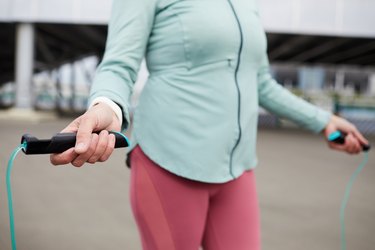
Jumping rope develops coordination, agility and, when done properly, can provide an intense cardiovascular workout. According to Harvard Health Publishing, jumping rope can burn 300 to 444 calories every half-hour, depending on your body weight.
Proper jump rope technique depends on having a rope of the appropriate length; if the rope is too short, you'll have a difficult time clearing it safely, and if it's too long you won't be able to get up to speed.
Video of the Day
Video of the Day
Both instances also set you up for shoulder, wrist and arm problems, as they force you to alter your jump rope technique to accommodate the incorrect rope length.
Tip
If you want to have the optimum jump rope workout, you'll have to find the best rope for your height. Or you can adjust the one you already have with a little work.
Determine Appropriate Rope Length
Having a jump rope that fits your height is very important. It just takes a few minutes to determine whether the one you have is good to go or needs some adjustments.
- Stand on the middle of the jump rope.
- Bring both handles up as far as they'll go. On a jump rope of appropriate length, the handles should reach up to your armpits.
- Shift your hands down to armpit height on the rope. Take a few practice jumps with your hands in this position to confirm that it is the appropriate length; the rope should just graze the ground with every jump. You may need to bundle up the loose handles of the rope in your hands as you do this to keep them from tangling with the rest of the rope.
- Mark where the inside edge of each handle should sit with a piece of tape.
Read more: How Much Should I Jump Rope a Day?
Adjusting the Rope
If you've determined your rope is too long, adjust it following the instructions. It'll be worth it and, frankly, safer.
- Pry the end cap, if present, off the jump rope handle.
- Push the rope through the handle so that it comes out the end hole you just opened. Pull the rope through until the inside edge of the handle lines up with the mark you made in Section One.
- Crimp the loose metal collar around the rope with pliers to hold it in place in the handle. If your rope doesn't have a collar to crimp, knot the rope so that the knot holds the handle in place at the new position. Pull an extra handle-length of rope through the handle before doing this because you'll have to feed the rope back into the handle afterward.
- Feed the rope back through the handle, or simply pull it from the inside edge of the handle, until the collar or knot sits firmly inside the jump rope handle. Cut off any excess rope protruding from the far edge of the handle.
- Re-apply the end cap (if it was present to be removed in Step 1).
Use Your Ingenuity
ACE Fitness recommends buying a rope that is easy to adjust. However, not all jump ropes are adjustable. If there's simply no way of actually altering the length of your jump rope, wrap the extra rope around each fist until what's left loose between your hands is the appropriate length.