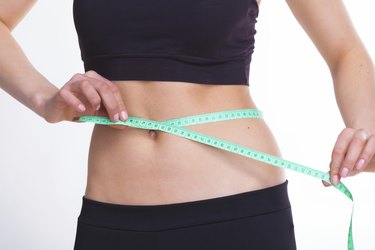
The extra fat that hangs over your belt is not only uncomfortable, it's also unhealthy. There are a number of ways you can test your body fat to see where you stand, but some tests, such as bioelectric impedance and hydrostatic weighing, require special equipment. If you have a tape measure, you can use a test developed by the Navy that uses waist and neck measurements to assess your body fat. Consult your doctor to discuss body fat and your health.
Measuring Neck and Waist for Men
Video of the Day
Body fat testing, using neck and waist measurements based on parameters established by the Navy, are different for men and women. For men, measure the circumference of the neck by placing a measuring tape directly on the skin just below the larynx -- also known as the Adam's apple -- and extend the tape horizontally all the way around the neck. For accuracy, your shoulders need to be relaxed, not hunched, while measuring. Round your neck measurement to the nearest half inch and write down the measurement.
Video of the Day
For the abdominal measurement, place the tape measure around your belly over your belly button and extend the measuring tape horizontally all the way around. The measurement should be taken on the exhale. Round up to the nearest half inch.
.
Measuring Neck, Waist and Hips for Women
In addition to the neck and waist, testing body fat for women also requires measuring the hips. The neck measurement for women is taken the same way as for men. The method for measuring a woman's waist differs from the method for men. Measure at your natural waist, which is generally located halfway between your belly button and your sternum. The tape measure needs to be horizontal all the way around and the measurement is taken on the exhale. The hip measurement is taken around your hips, passing over the fullest part of the buttocks, and rounded down to the nearest half inch.
Formula to Determine Body Fat
Once you have all the necessary measurements, a mathematical formula that includes height is used to determine body fat percentage. Like the measurements, the formula differs between men and women.
For men, the formula is [86.010 x log10(abdomen - neck)] - [70.041 x log10(height in inches)] + 36.76.
For women, the formula is [163.205 x log10(waist + hip - neck)] - [97.684 x log10(height in inches)] - 78.387.
For example, a 72-inch tall male with a neck measurement of 16 and a waist measurement of 36 has 19 percent body fat. A 64-inch tall woman with a neck measurement of 12 inches, waist 28 inches and hips 42 inches has 34 percent body fat.
The Navy also offers circumference value -- which is abdominal circumference minus neck circumference for men, and abdominal circumference plus hip circumference minus neck circumference for women, and it also includes height tables so you can get your approximate body fat percentage without having to use the equation.
What Your Body Fat Means
You need a minimum amount of body fat -- called essential fat -- for good health. For men, that amount is 3 percent and for women, it is 12 percent. Women need more body fat for childbearing, according to Human Kinetics.
The ideal amount of body fat for athletic men ranges from 5 percent to 10 percent, and 8 percent to 15 percent for athletic women. A healthy body fat for men ranges from 11 percent to 14 percent, and for women 16 percent to 23 percent. While not ideal, it's acceptable for a man to have a body fat range from 15 percent to 20 percent, and for women from 24 percent to 30 percent. A body fat percentage ranging from 21 percent to 24 percent for men and 31 percent to 36 percent for women is considered overweight, and any percentage above these numbers is considered obesity.
If you currently carry too much body fat, lifestyle changes can help you get down to a healthy range. A calorie-controlled diet made up of healthy foods, regular aerobic exercise and a strength training routine can help you shed body fat and improve your overall health.