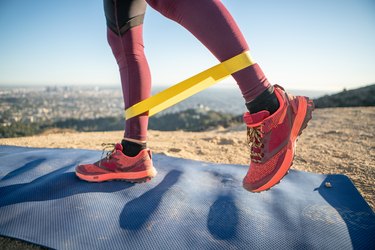
Good things come in small packages, and the mini resistance band is proof. Small yet mighty, this circular piece of elastic is a must-have fitness tool, especially when it comes to toning and lifting your derriere. One reason why: It helps you target smaller, stabilizing muscles like the glute medius, located on the outside of the hip.
"Using resistance bands while working your booty helps ensure you're actually working the correct muscle," Kira Stokes, a celebrity trainer and creator of The Stoked Method, tells LIVESTRONG.com. "Lots of people think they are working the glutes, but when you ask them what they are feeling, they can't describe it. With a band, you feel that burning sensation; you know what's happening in your body."
Video of the Day
Video of the Day
Once you ensure you're targeting the right muscles, glute gains are imminent. A stronger butt will "take the pressure off of the lower back; stabilize your pelvis when you walk, run or cycle; and bolster hip extension, which is what produces power in your movements," says Stokes, who is also the creator of the Get Fit with Kira Stokes app and Stoked Resistance Bands. "And call it vanity, but you want to see a round butt, too."
Stokes pulled together 13 killer (no, really, your glutes will be burning!) resistance band exercises that can be done anywhere, anytime. Her recommendation: Pick three to five moves below to form your own personalized glutes of glory routine and do 3 sets of each move.
Tip
Remember to keep your pace slow. “This is not supposed to be a cardio workout,” Stokes says. “Take the time to allow your mind to connect with your body to really feel the glutes.”
Move 1: Robot Step-Out With Ab Activation

- Loop a mini resistance band around the balls of your feet and stand with your knees soft and your feet slightly wider than hip-width apart, creating tension in the band.
- Lift your right leg up until your thigh is parallel to the floor and your right knee is bent at a 90-degree angle.
- Lower your leg, then immediately take a wide step out to the right side.
- Step the right foot back in to complete one rep.
Reps: 10 per side
Tip
“Make sure you tuck the tailbone slightly and draw the navel in, so that you are squeezing the glutes the entire time,” Stokes says. “It should look really robotic with that step-out.”
Move 2: Squat With Glute Medius Activation
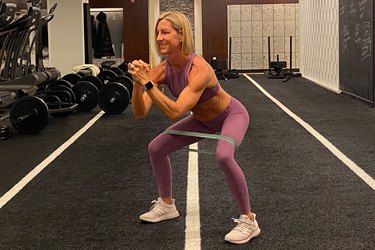
- Loop a mini resistance band around your thighs just above your knees and stand with feet shoulder-width apart, creating tension in the band. Keep your chest high and your abs tight.
- Push your hips back, bend your knees and lower down into a squat.
- Maintaining this position, pulse your knees out for your desired number of reps.
- After your last rep, push into your heels to stand.
Reps: 15 to 20
Tip
This should be an outward movement only, Stokes says. “You never want your knees to adduct [move inward], so your knees should always come back to your good squat form."
Move 3: Squat With Tap-Out
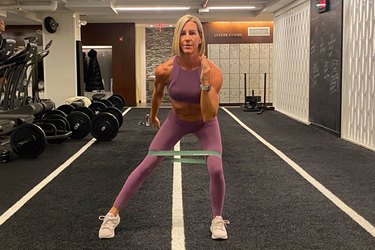
- Loop a mini resistance band around your thighs just above your knees and stand tall with your feet shoulder-width apart, creating tension in the band.
- Push your hips back, bend your knees and lower down into a quarter squat.
- Straighten your right leg out to the right side.
- Bring the right foot back in and then repeat the movement with the left foot.
- Complete your reps on both sides, and then rise back to standing.
Reps: 10 per side
Move 4: Squat With Abduction

- Loop a mini resistance band around your thighs just above your knees and stand with your feet hip-width apart, creating tension in the band.
- Push your hips back, bend your knees and lower into a squat.
- Stand up and lift your right leg out to the right side, keeping the leg straight.
- Lower your right leg and return to squatting.
- Stand up and lift your left leg to the left side.
- Lower your left leg and squat again. Continue alternating sides.
Reps: 10 per side
Tip
Keep tension in the band throughout the whole movement, Stokes says, and don't let your knees fall toward each other in your squat.
Move 5: Tap Back
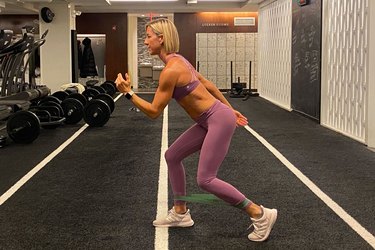
- Loop a mini resistance band around your ankles and stand with your feet hip-width apart, creating tension in the band.
- Push your hips back, bend your knees and lower down into a quarter squat with your arms in front of your chest.
- Keeping your knees bent, step your right foot back.
- Return your right foot to start and repeat with your left foot. Continue alternating.
Reps: 10 to 15 per side
Move 6: Squat to Step-Out

- Loop a mini resistance band around your ankles and stand with your feet hip-width apart, creating tension in the band.
- Push your hips back, bend your knees and lower down into a squat.
- Take a step to the right with your right foot so that your stance is wider than your hips, then return to start.
- Repeat with the left leg, and then step back in. This is one rep. Continue alternating.
Reps: 10
Tip
To max out the benefits, maintain your squat during the entire move, Stokes says. "Make sure your weight is even on both feet as you step out and that you shift and bring your hip with you.”
Move 7: Fire Hydrant
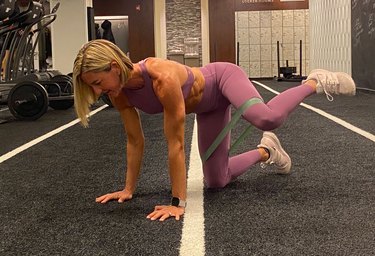
- Loop a mini resistance band around your thighs just above your knees, then get onto all fours with your knees under your hips and hands under your shoulders.
- Without shifting your hips, lift your left knee out to the side.
- Slowly return to start.
Reps: 20 per side
Tip
Challenge yourself by adding a few up-and-down pulses when your knee is out to the side, Stokes says. Or, if your hips are tight, don't lift your leg as high. Everyone's range of motion is different. “This isn’t a contest to see how high your leg can go. You want to maintain a neutral spine and a neutral pelvis, and lift from there.”
Move 8: Bent-Knee Donkey Kick
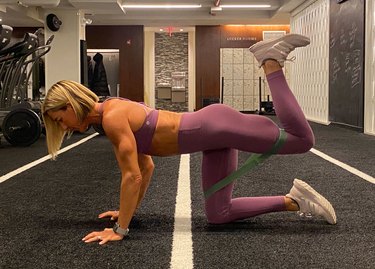
- Loop a mini resistance band around your thighs just above your knees, then get onto all fours with your knees under your hips, hands under your shoulders and your core tight.
- Keeping your knee bent and left foot flexed, lift your left leg up; hold for one count, then return your left knee to the floor. This is one rep.
Reps: 20 per side
Move 9: Straight-Leg Donkey Kick
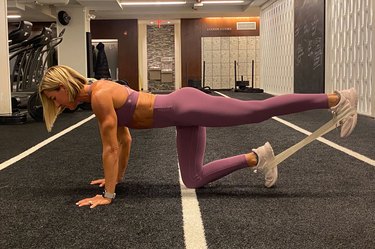
- Loop a mini resistance band around the balls of your feet, then get onto all fours with your knees under your hips, hands under your shoulders and your core tight.
- Keeping your left foot flexed, extend your left leg back and up to a straight-leg position.
- Hold for one count, and then return your left knee to the floor. This is one rep.
Reps: 20 per side
Tip
The goal in both types of donkey kicks is to maintain a neutral spine, Stokes says. You can make this move more challenging by pulsing your leg a few times while it's lifted.
Move 10: Clamshell
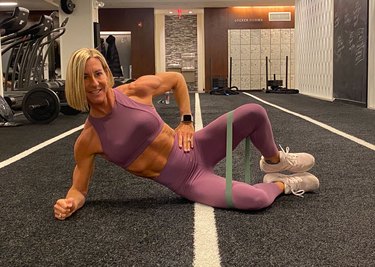
- Lie on your right side with a mini resistance band looped around your thighs just above your knees with your legs stacked.
- Bend your legs to 45 degrees and prop yourself up on your right forearm.
- Keeping your feet together, raise your left knee to engage your glutes.
- Pause for one count, and then lower the left knee back down. That's one rep.
Reps: 20 per side
Tip
Move only your top leg, Stokes says; avoid rolling your hips or torso back.
Move 11: Side-Lying Abduction
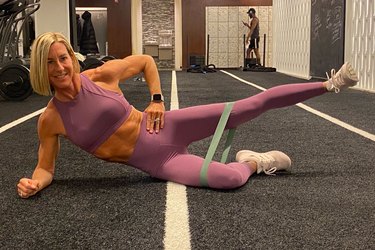
- Lie on your right side with a mini resistance band looped around your thighs just above your knees with your legs stacked.
- Bend your right leg to 45 degrees and prop yourself up on your right forearm.
- Engage your core, flex your left foot and lift your left leg to engage your glutes; keep your leg straight.
- Slowly lower your leg until it is hovering above the floor for one rep.
Reps: 20 per side
Move 12: Glute Bridge With Glute Medius Press
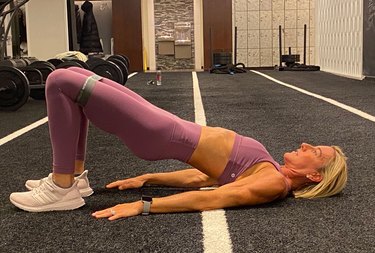
- Loop a mini resistance band around your thighs just above your knees.
- Lie on your back with your hands at your sides, your knees bent and your feet flat on the floor, hip-width apart.
- Squeeze your glutes as you lift your hips, forming a straight line from your shoulders to your knees.
- From this position, press your knees open while keeping your feet stationary. Return your knees to hip-width apart, then lower back to start. That's one rep.
Reps: 20
Tip
"Lift to a neutral spine, not a hyperextended low back,” Stokes says.
Move 13: Single-Leg Deadlift
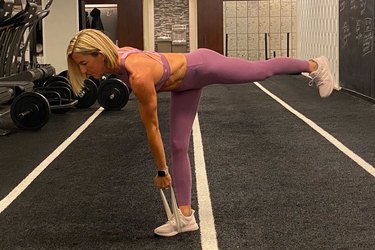
- Loop a mini resistance band underneath the ball of your right foot, holding the opposite end in your left hand.
- Stand tall and extend your right arm straight out to the side.
- Keeping your right knee slightly bent, hinge at the hips and lower your torso as you lift your left leg up behind you.
- With control, rise back to standing as you lower your left leg back down. This is one rep.
Reps: 15 per side
Tip
“Remember this is a hinge: As the leg extends behind you, you want to keep pulling that hip down so you maintain squareness and pull the opposite hip back," Stokes says. "Although the standing leg is getting the most work, you can get the glute benefit in the leg that extends, too, by squeezing and keeping the leg nice and straight."