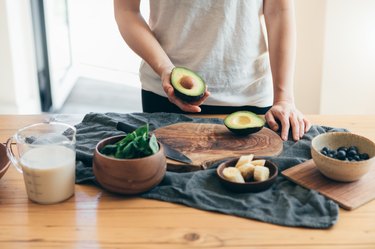
They say an apple a day keeps the doctor away, but what about an avocado? Turns out, incorporating this fantastic fruit (yes, avocado is technically a fruit) into your daily diet can support your health today, tomorrow and in the long term.
Here, Phyllis Famularo, DCN, RD, CSG, a dietitian with a specialty in gerontology, explains why eating avocado is amazing for longevity (good news for you guac lovers!).
Video of the Day
Video of the Day
Benefits of Avocado for Longevity
1. It's Good for Your Heart
Avocados are terrific for your ticker: That's because they're heaping with heart-protective monounsaturated fats.
"Research indicates that individuals who consume avocados (as well as a diet high in other fruits and vegetables) have healthier lipid profiles, including higher HDL, which is the good cholesterol," Famularo says.
Indeed, a small study found that swapping avocado oil for butter improved total cholesterol, LDL cholesterol ("bad cholesterol"), triglycerides levels and insulin, per a June 2019 review in Molecules.
And a healthy heart helps your odds of enjoying a longer life.
2. It Supports Brain Function
For a sharper mind, add an avocado to your plate.
The fruit's heart-protective properties play a role in brain health, too. Here's why: "Many dementias are vascular in nature," meaning that they're related to a problem with your blood vessels, Famularo says.
Think of it like this: When your blood vessels are working at their best, they can supply your brain with the oxygen and nutrients it needs to perform at its peak.
So, foods like avocado — which promote heart health and healthy blood flow — can also aid in brain function, she says. Plus, avocados are ample in antioxidants, including a carotenoid (or pigment) called lutein, Famularo says.
In fact, an August 2017 study in Nutrients found that eating avocado increased lutein levels in the brain and improved cognition (including working memory and problem-solving skills) in older adults.
3. It Promotes Healthy Eyes
"Because avocados contain antioxidants like carotenoids [such as lutein], they can be beneficial to eye health," Famularo says.
Case in point: The same August 2017 study in Nutrients observed a 25 percent increase in lutein levels in the eyes of older adults who ate an avocado daily for six months.
Avocados are also abundant in antioxidants like vitamins C and E, which both boast protective properties for your peepers, Famularo says.
Safeguarding your eye health is fundamental at every stage of life, but it's especially important as you grow older because your vision changes. Advanced age is also associated with a higher risk for certain eye diseases, according to the American Academy of Ophthalmology (AAO).
4. It's Linked to Helping Manage Diabetes
When left unchecked or unmanaged, diabetes can cause some serious, potentially life-threatening medical issues, so it's important to do whatever you can to control the disease for a longer, healthier life. And eating avocado as part of an overall healthy diet can be one of the many strategies you take to do just that.
For one, these fruits have few carbs and are low on the glycemic index, Famularo says. This is important for folks who must watch their sugar and carb intake, she explains.
The healthy fat content in avocados also supplies satiating calories that may help curb carb consumption as well, Famularo says. And to top it off, the dietary fiber in these fantastic fruits is beneficial for diabetes control, too, she adds.
Plus, avocados are full of free-radical fighting antioxidants, which aid in inhibiting the inflammation that contributes to chronic diseases such as diabetes.
So, How Much Avocado Should You Eat Per Day?
Famularo recommends enjoying 1/3 to 1/2 of a whole avocado each day. Even better if you substitute it in place of butter and other saturated fats, she says.
A 1/3 of an avocado will give you 106 calories, 9.7 grams of fat and 4.4 grams of fiber while a 1/2 avocado has 161 calories, 14.7 grams of fat and 6.7 grams of fiber, per the USDA.
Want to start eating more avocado? Find some avocado recipe inspiration here.