

















































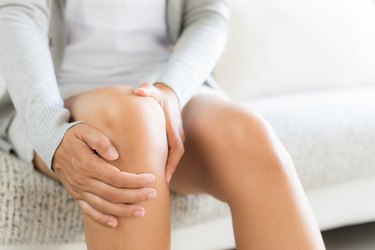









Many bone diseases can affect the knee. According to the National Institute of Arthritis and Musculoskeletal and Skin Diseases, or NIAMS---a division of the National Institutes of Health---knee problems are common, occur in people of all ages and can significantly affect a person's activities of daily living. NIAMS states that the two principal causes of knee problems are disease and injury and that bone diseases of the knee can be temporary or long-lasting, depending on the condition.
Chrondromalacia Patellae
Chondromalacia patellae is a bone disease of the knee. According to NIAMS, chondromalacia patellae is a softening of the articular cartilage of the patella or kneecap that's most common in adolescents and young adults. Common causes of chondromalacia patellae include the following: trauma or injury, overuse, improper patella tracking, or alignment and weakness of the muscles surrounding the kneecap. NIAMS states that in a person who has chondromalacia patellae, the kneecap rubs against the lower portion of the femur or thigh bone, which damages the cartilage on the underside of the patella, and that the severity of cartilage damage can range from mild wearing to a surface that's entirely devoid of cartilage.
Common symptoms associated with chondromalacia patellae include the following: dull pain around or under the patella that gets worse when going up or down stairs and pain with simultaneous knee extension and weight bearing. According to NIAMS, chondromalacia patellae is common in runners and may also be seen in skiers, cyclists and soccer players.
Osgood-Schlatter Disease
Osgood-Schlatter disease is a bone disease of the knee. The American Academy of Orthopaedic Surgeons, or AAOS, states that Osgood-Schlatter disease is an overuse injury that manifests in the knees of children and growing teenagers, and that it's caused by patellar tendinitis or inflammation of the tendon that joins the kneecap to the tibia, or shinbone. According to the AAOS, adolescents who engage in certain athletic activities, such as soccer, gymnastics, basketball and long-distance running, have a greater likelihood of developing Osgood-Schlatter disease.
Common symptoms associated with this disease include knee pain, swelling and tenderness below the kneecap. The AAOS states that, in Osgood-Schlatter disease, a person's tibial tubercle, which is the prominent, bony bump at the top of the shin, is almost always inflamed and tender to the touch.
Osteochondritis Dissecans
Osteochondritis dissecans is a bone disease of the knee. According to the Mayo Clinic website, osteochondritis dissecans is a joint disorder characterized by the separation or fracturing of a small piece of cartilage from the joint surface---along with a thin layer of underlying bone---on the end of a bone, and the disease is most common in young men.
The Mayo Clinic website states that, although osteochondritis dissecans can occur in a person's elbow, shoulder, ankle and hip, it usually manifests in the knee, and that osteochondritis dissecans is caused by decreased circulation to the end of a bone. Sometimes, the liberated piece of cartilage will remain near the fracture site, in which case few osteochondritis dissecans-related symptoms will be felt. However, if the cartilage interferes with the knee joint's moving parts, surgical excision or removal of the cartilage may be necessary.


