

































































Pain from lifting your legs while lying on your back is most likely a result of sciatica. Actually, many medical professionals use this exact movement as part of a basic muscle test to help diagnose this condition, the Mayo Clinic says. Pain often worsens when lifting one of the legs in the air.
Symptoms
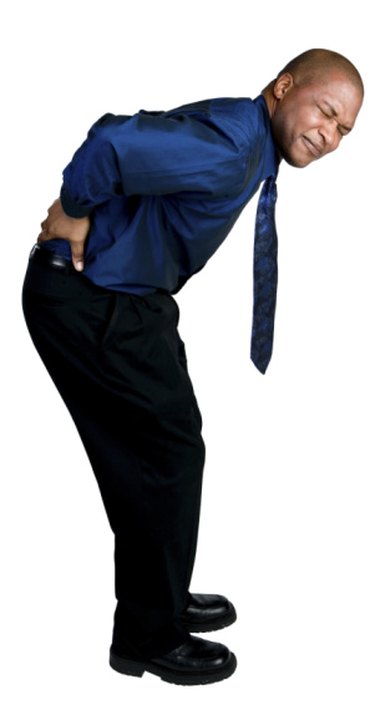
Pain associated with sciatica can range in intensity from mild to severe. It usually begins in the lower back and radiates down into the buttocks. Sometimes, this pain can continue down into the leg and is accompanied by the sensations of numbness, tingling, burning or prickling, according to the American Academy of Orthopaedic Surgeons. Weakness of the muscles can occur as well.
Development
Most often, sciatica develops as a result of compression of the sciatic nerve root within the lower back. The American Medical Association claims that herniated or slipped disks are the most common cause of this pain, but you may also suffer pressure on the nerve root due to tumors, trauma and spinal stenosis. The latter is a narrowing somewhere within the spinal column. Even muscle spasms in the lower back can compress the sciatic nerve and lead to sciatica.
Effects
Though many people can recover from the pain on their own, leaving sciatica untreated can result in permanent nerve damage, the Mayo Clinic says. This may result in a loss of feeling in the affected leg as well as a loss of movement. Occasionally, people experience impaired bowel or bladder function.
Treatment
Bed rest, coupled with non-steroidal anti-inflammatory drugs, helps lessen inflammation that places pressure on the sciatic nerve and subsequently relieve pain. If pain is moderate to severe, muscle relaxants may be necessary. However, roughly 80 percent to 90 percent of people experience improvement with this method of self-care treatment, notes the American Academy of Orthopaedic Surgeons.
Medical Intervention
If self-care measures fail to improve the pain, you may need to take part in physical therapy to correct your posture as well as improve the strength and flexibility of the lower back muscles. From there, steroidal injections and surgical procedures can help correct the compression placed on the sciatic nerve root.


