
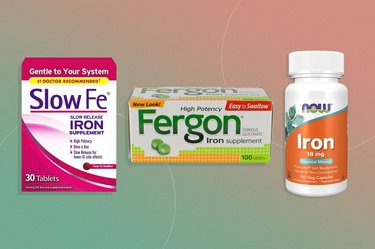
If you're taking iron supplements, you may find yourself experiencing unexpected — even downright disconcerting — gastrointestinal side effects. Yes, we're talking about changes to your poop. If you find yourself wondering, "why is my stool black?" know you're not the only one.
Changes to the color of your stools is not typically cause for concern if it happens after taking iron supplements. Nor is it the only GI side effect that can accompany iron supplements: Constipation and diarrhea are also common, according to the U.S. National Library of Medicine (NLM).
Video of the Day
Video of the Day
Find out why iron pills can upset your stomach, and in particular, why they can lead to changes in the color of your feces.
Don't be alarmed if your stools turn black after taking iron supplements. This is a common occurrence, and your blackened stools mean your body is absorbing the supplement.
Why Do Iron Pills Turn Poop Black?
Black-colored stool may seem like an unusual reaction, but UK-based state-registered dietitian Ruth Kander says it's a harmless side effect that occurs because of how iron is absorbed in the upper part of the small intestine.
If there are no changes in the color of your poop after taking short-term iron supplements, this is typically an indication your body is not absorbing the iron. If you are only on a short course of iron, and your stool does not turn black, ask a doctor or pharmacist to recommend another brand or type of supplement.
One exception to note: Some coated iron supplements don't change the color of poop, even when taken for a long time.
How Much Iron Do You Need?
Adults between the ages of 19 and 50 should get between 8 and 18 milligrams (mg) of iron each day, per the National Institutes of Health Office of Dietary Supplements (ODS). People who menstruate need those 18 milligrams; people who are pregnant need even more, at 27 recommended daily milligrams.
For most people, eating iron-rich foods — or foods fortified with iron — is sufficient to get your body enough of this essential mineral, according to the ODS. But in some cases — like if you're pregnant, donate blood frequently or have certain diseases and conditions — you may fall short, per the ODS. Doctors may also recommend iron supplements if you have iron-deficiency anemia.
Does Black Stool Mean Too Much Iron?
The color of your stool isn't an indication of taking too much iron. Rather, if you are taking more than the recommended daily dose, you may experience symptoms such as nausea, vomiting, abdominal pain and diarrhea, Kander says.
Adults should not take in more than 45 milligrams of iron in a day, per the ODS — that includes all sources of the mineral, including foods and supplements.
"In serious cases, there may be evidence of reduced blood flow in the body," Kander says. This can lead to your legs and arms feeling cold, very low blood pressure, a blue tint to fingers and lips, shallow and rapid breathing and feeling weak and tired, she says.
Other serious effects from getting too much iron include ulcers and inflammation of the stomach lining. And, it is possible to overdose on iron, which can lead to a coma or even death, although this only happens if you take very large amounts (hundreds of milligrams), per the ODS.
Always keep iron supplement out of reach of children.



What Limits Iron Absorption?
In some ways, black stools when you're taking iron supplements can be a reassuring side effect, indicating that you're absorbing iron properly. (That said, as mentioned above, some supplements won't lead to this side effect.)
Several factors may prevent iron absorption, which will prevent your poop from darkening. Here are best practices, per the Cleveland Clinic, for taking an iron supplement:
- Take iron supplements on an empty stomach, and wait 1 to 2 hours before eating. If you find the supplement upsets your stomach, it's OK to take it with food.
- Take the supplement as directed — measure carefully if it's in a liquid form (using a dosing syringe and not a spoon) and do not crush, break up or cut tablets.
- Do not take it with: dairy products, including milk or calcium supplements; caffeine (think: a mug of coffee or tea); or antacids.
- But do take iron supplements with vitamin C if possible, because that helps increase absorption.
You should also avoid taking iron with high-fiber foods, according to the NLM.
Tip
Preliminary research — including a small October 2017 study in The Lancet — suggests taking iron supplements every other day, instead of daily, may improve absorption and be an easier routine to stick to. Talk to your doctor about the best iron supplement dosage and routine for you.
How Do You Know if Iron Supplements Are Working?
Black poop can suggest you are effectively absorbing your iron supplements. But maybe you're interested in other signs — along with how long to wait for these indicators the supplements are making a difference.
Kander says there aren't any specific signs your iron pills are working, but you may notice an increase in energy and a reduction in tiredness and fatigue. You can also have bloodwork done to determine just how well you're absorbing iron.
"The best way to check is with a blood test that measures your ferritin and hemoglobin levels," Kander says.
When to See a Doctor About Black Stools
If you only have black stools following taking iron supplements and don't have other symptoms, it's likely a result of the supplements. However, if black stools are accompanied with other symptoms, like abdominal pain or constipation, nausea and vomiting, this can indicate something more serious, like an obstruction.
If your symptoms last more than a few days, talk to your doctor, Kander says.
Blood in your stool can be a sign of anal fissures, hemorrhoids and some cancers, per Beaumont Health. While it may be due to something relatively minor, there's potential for more serious causes, so reach out to your doctor if you notice blood in your poop.
If you're taking iron supplements and have black poop without blood it typically isn't a cause for concern. But if your stools are both black and have red streaks, or if they look tarry, that's cause to reach out to your doctor, according to the NLM. Also get in touch if you experience stomach cramps or sharp pains.
Other Side Effects of Iron Pills
Digestion Changes
Constipation, heartburn, nausea and diarrhea are common side effects of iron supplements, according to the Cleveland Clinic.
If you're constipated from iron, taking a stool softener can help, per the NLM. Decreasing your iron dosage may be helpful if you're experiencing diarrhea or nausea.
Stained Teeth
Another unexpected side effect: stained teeth. This can occur when you take a liquid iron supplement. To prevent stains, mix the liquid iron supplement with water or other liquids or use a straw to drink down the dose, according to the Mayo Clinic.
If you do notice stains, try removing them by brushing with baking soda or peroxide, per the NLM.
Iron Supplements and Your Weight
If you're concerned about gaining weight while taking iron supplements, rest assured: There is little scientific evidence to suggest a correlation between iron pills and weight gain, Kander says.
Some people believe iron supplements can lead to an increase in appetite, but Kander says this isn't the case.
"Iron pills do not cause any weight gain. They purely help your body to make iron that you are not getting enough of," she says.
How to Up Your Iron Intake
If you're looking to increase your iron levels, supplements are just one option. Other strategies include:
- Eat foods with iron. Meat, poultry and seafood are good sources of heme iron, while you can find non-heme iron in legumes (like beans), nuts and seeds, per the Harvard T.H. Chan School of Public Health.
- Look for iron-fortified foods. Breakfast cereal, for instance, is often fortified with iron.
- Try using a cast-iron skillet while cooking. Doing so may help to boost your iron intake, although it's a bit of an imprecise strategy. Using cast-iron cookware could help reduce the risk for iron deficiency anemia, particularly in children, per a September 2019 systematic review in PLOS One.
- Coordinate what you eat. Try vitamin C-rich foods alongside iron to aid with absorption, and avoid eating foods that inhibit iron absorption right before or after an iron-rich meal.


- Office of Dietary Supplements: "Iron"
- U.S. National Library of Medicine: "Taking iron supplements"
- Cleveland Clinic: "Iron Supplement (Ferrous Sulfate)"
- Beaumont Health: "Blood In Your Stool"
- Mayo Clinic: "Iron Supplement (Oral Route, Parenteral Route)"
- Harvard T.H. Chan School of Public Health: "Iron"
- PLOS One: "Iron-containing cookware for the reduction of iron deficiency anemia among children and females of reproductive age in low- and middle-income countries: A systematic review"
- The Lancet: "Iron absorption from oral iron supplements given on consecutive versus alternate days and as single morning doses versus twice-daily split dosing in iron-depleted women: two open-label, randomised controlled trials"