




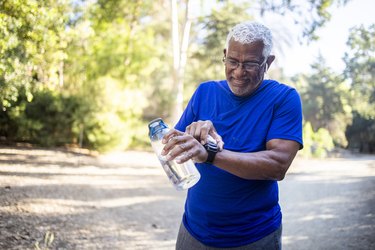



































































Glucose Gel for Marathoners

Glucose Gel for Marathoners
Photo Credit Photodisc/Photodisc/Getty Images

The dreaded wall; veteran marathoners prepare to avoid it, while novices anxiously await it. What marathoners call, "hitting the wall," is an uncomfortable phenomenon --- to say the least. The legs lock up, the brain says, "give up," and the result is one miserable day at the races. You do not have to "hit the wall" though. Incorporate glucose gels into your marathon training program for a healthy dose of preventative medicine.

Significance and Preparation

For many marathoners, glucose gel is second only to water on the list of race-day necessities. Glucose is a carbohydrate; it is a primary source of energy needed by many of the body's tissues. Glucose gels can help to preserve a balance in carbohydrate utilization when the demand by one tissue increases over the other. However, you need to use them correctly, and understand how they metabolize to reap the benefits. For marathoners wanting to use glucose gels, timing and preparation are key. Introduce gels on longer training runs, not on race day. Try taking gels at different points during training runs; there is a limited window of opportunity.

Basics of Digestion

Metabolism involves chemical processes whereby complex structures, such as food, get broken down into smaller parts. Consider digestion. Food enters the stomach, is broken down by enzymes, and moves on to the small intestines, where secretions from the liver and pancreas break it down further. Carbohydrates are the body's preferred energy source. They include fructose, glucose, and galactose. Keep in mind, however, that these raw nutrients will first undergo conversions to make them useful fuels for muscles.

From Digestion to Glycogen

The liver synthesizes glycogen from ingested glucose, fructose, and galactose. According to Dr. Timothy Noakes, author of "Lore of Running," the muscles use a portion of ingested glucose for fuel, but much of it gets transported to the muscle tissue for conversion to lactate, then gets transported back to the liver, and gets reconverted to glucose, and further prepared for storage in the form of glycogen.

Glycogen in the Liver

Glycogen interacts with an enzyme in the liver to form usable glucose, and then is released into the bloodstream. The brain, muscles, kidneys, and red blood cells extract this blood glucose for energy. During a marathon, muscles may extract more blood glucose, therefore, depriving other tissues of fuel -- particularly for the brain. According to Dr. Timothy Noakes, when the rate of blood glucose utilization by the muscles exceeds the rate of production by the liver, exhaustion occurs. The marathon is notorious for requiring both physical and mental toughness. While training will spare you in failing the former, glucose gels will spare you in failing the latter; the most well-conditioned muscles collapse under the command of a starving brain.

Glycogen in the Muscles

Glycogen stored in the muscles lacks the enzyme found in the liver that converts glycogen to glucose. Muscle glycogen undergoes a different process called glycolysis. The body can use a portion of the ingested glucose as fuel in the process. The result is a reduction in the utilization of blood glucose from the liver. According to Dr. Timothy Noakes in a 1995 report from the World Forum on Physical Activity and Sport, glucose taken during exercise has the benefit of preventing hypoglycemia. Ingested glucose gets burned in place of blood glucose derived from the liver, thus sparing liver glycogen depletion. Marathoners should remember the many processes involved in deriving fuel from nutrients, and keep in mind the brain, as well as the legs.

References

Article reviewed by GlennK Last updated on: Nov 2, 2010

Must see: Photo Galleries