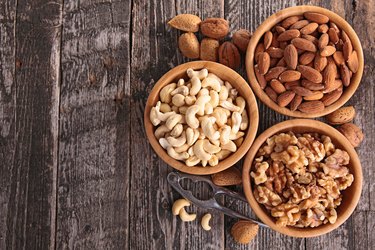
You may see the health claim approved by the U.S. Food and Drug Administration, which states that eating 1.5 ounces of nuts per day as part of a healthy diet may reduce your risk of heart disease.
Almonds and cashews both contain heart-healthy unsaturated fats, but almonds have a better fat profile. Cashews provide more vitamin K and zinc, but almonds make a better choice for fiber, vitamin E and calcium.
Video of the Day
Video of the Day
Calories in Cashews vs. Almonds
One of the important points to remember about eating nuts is to watch portions, or you'll quickly consume enough calories to ruin your daily goals. One serving of nuts is 1 ounce, or about 1/4 to 1/3 cup.
More specifically, a 1-ounce serving of almonds equals about 22 whole kernels and has 170 calories, while the same portion of cashews consists of about 18 nuts and contains 163 calories. They have about the same amount of protein, but almonds have three times more fiber, with 1 ounce supplying 12 percent of women's and 8 percent of men's recommended daily intake.
Read more: 9 Healthy Nuts That May Help You Live Longer
Fat Content Favors Almonds
Cashews and walnuts are high in unsaturated fats, which can lower bad cholesterol and boost the amount of good cholesterol in your bloodstream, according to the Harvard School of Public Health. One ounce of cashews contains 13 grams, and almonds have 15 grams of total fat.
In spite of having more fat, almonds are the healthier choice because they have a higher percentage of unsaturated fats. Cashews have more saturated fat, containing 3 grams in 1 ounce, or almost three times more than almonds. For this reason, the University of Massachusetts Medical School recommends eating almonds frequently and cashews only occasionally.
Calcium and Zinc
Almonds have the advantage, if you need more calcium in your diet. One ounce of almonds provides 76 milligrams of calcium, or six times more than cashews, and supplies 8 percent of your recommended dietary allowance.
Cashews have double the amount of zinc, with 1.6 milligrams in a 1-ounce serving. Since women and men need different amounts of zinc to maintain their health, a serving of cashews gives women 20 percent of their RDA, while men get 15 percent. Cashews and almonds are both good sources of iron and magnesium.
Almonds Win for Vitamin E
Almonds are one of the best sources of the essential antioxidant vitamin E, according to the Harvard School of Public Health. If you eat a 1-ounce serving of almonds, you'll get 45 percent of your recommended dietary allowance of vitamin E. By comparison, the same portion of cashews only has 2 percent of the RDA.
Cashews beat almonds when it comes to vitamin K content. Almonds don't contain any vitamin K, while 1 ounce of cashews has 10 micrograms. Women should get 90 micrograms, while men need 120 micrograms of vitamin K daily. Cashews and almonds both provide small amounts of niacin, vitamin B-6 and folate.