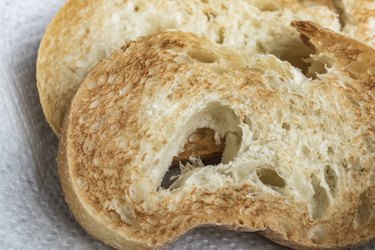
Toasted bread calories aren't any fewer than untoasted bread calories. Toasting also doesn't affect carbohydrates or gluten; it may lower the glycemic index of bread, which is an advantage.
Tip
Toasting bread doesn't change its nutritional value, but it may decrease the glycemic index.
Video of the Day
Toast vs. Untoasted Bread Calories
In an interview with LIVESTRONG.com, Toronto nutritionist Julie Mancuso, RHN, of JM Nutrition, addressed some common questions concerning toast vs. bread. Toasting has an effect, but not on calorie count.
Video of the Day
First of all, toasting bread is a chemical reaction, during which some molecules break apart, Mancuso says. The water content of the bread is reduced during this process, but that doesn't mean that calories are removed.
The scope of changes also depends on the degree to which the bread is toasted. "If bread is lightly toasted, the differences in calories would be too insignificant to mention," Mancuso states. On the other hand, if bread is heavily burned, the differences in calories may be more noteworthy. But in this state, the bread would be virtually inedible, or at least, unpalatable, so it's a moot point.
The more you heat or burn bread in the toaster, the greater the chemical reaction, Mancuso continues. "If you toast it lightly, only the outer edges are toasted or burned; but if you toast it thoroughly, more of the molecules undergo the chemical reaction, leading to a more considerable change."
Carbohydrates and Gluten
What about . carbohydrates and gluten? Just like calories, any difference would be minimal, according to Mancuso. Toasting bread will not eliminate gluten
"That said, toasted bread has been shown to have a lower glycemic index than untoasted bread. Since toasted bread, a carb, breaks down more slowly, it releases glucose into the bloodstream much more gradually, so it would be less likely to cause an insulin and blood sugar spike," she explains.
Numerous studies show insulin and insulin resistance are closely linked to weight gain. As a result, toasting bread can play a small role in assisting people desiring weight loss or better blood sugar control.
Read more: Is Toast Good to Eat When You Are Dieting?
It's also important to note that many of the studies conducted in this area deal with white bread, the most commonly-consumed bread variety. "Would the results be similar if other breads were toasted? The jury is still out because more evidence is needed," Mancuso adds.
Disadvantages of Toasted Bread
Actually, there is only one disadvantage of toasted bread. It involves a chemical called acrylamide, but it's only a problem with over-toasted bread.
Acrylamide is a chemical that forms in certain foods when they are cooked at high temperatures, such as bread experiences during toasting, states the Food and Drug Administration (FDA). Acrylamide is created from the amino acid asparagine, and natural sugars in food. Studies show that high levels of this chemical are linked to cancer, so the FDA is conducting research to determine if lower levels also pose a risk.
An August, 2008 study published in Food Additives & Contaminants measured the acrylamide content of untoasted and toasted wheat and rye bread. While the experiment wasn't conducted recently, it merits notice because it reveals that the toasting process affects the levels of the chemical. The results showed the acrylamide intake from untoasted bread is relatively low, but levels of the chemical are several times higher in toasted bread.
To lower your exposure to acrylamide in bread, don't toast it to a dark brown color, instead, toast it lightly, the FDA advises. Avoid eating the darker brown parts of toast, since they contains more acrylamide.