
































































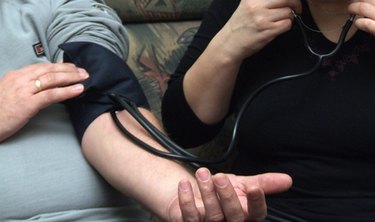



Every time your heart pumps, it pushes blood throughout your body creating blood pressure, which is the force of the blood against the walls of your arteries. Blood pressure consists of two readings: the systolic (the higher number) represents the pressure when the heart contracts, and the diastolic (the lower number) is the pressure when the heart is relaxed. The medical community urges everyone to work toward having an ideal blood pressure, but exactly what the ideal pressure is and how to measure it is controversial.
Threshold
The threshold for what is considered to be high blood pressure, or hypertension, has changed throughout the years. Today, it is significantly lower than 20 years ago. As of 2009, the American Heart Association (AHA) recommends any systolic reading over 140 mm Hg (millimeters of mercury) be diagnosed as hypertension. The AHA also recommends any diastolic reading over 90 mm Hg be diagnosed as high blood pressure.
Other institutions and organizations, however, have different standards. Some doctors diagnose any reading greater than 120 mm Hg over 80 mm Hg as hypertension, while others use 130 mm Hg as their upper limit. Butt all medical professionals do agree that the ideal pressure reading is 120/80 mm Hg.
Technique
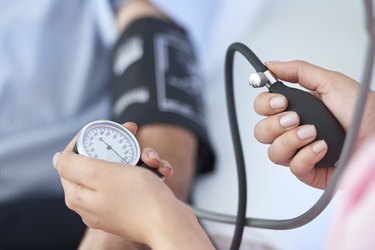
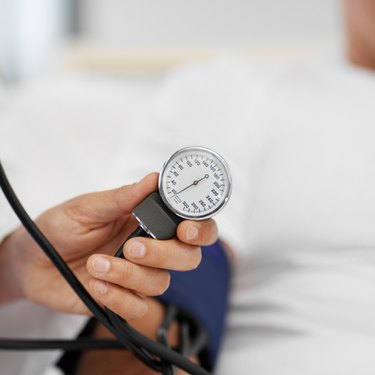
Blood pressure is typically taken on the upper arm, but this is a matter of controversy. Some clinicians have questioned whether measuring the blood pressure in the arm (the brachial pressure) is actually representative of the central aortic blood pressure as was once believed. Because the central aortic blood pressure is important in predicting the risk of heart attack and stroke, the validity of brachial blood pressure readings is in question.
Time Frame
A diagnosis of hypertension often is made after a doctor has measured your blood pressure and determined it is too high. But some people question whether a blood pressure reading taken in a physician's office is accurate, because anxiety over your appointment can raise blood pressure.
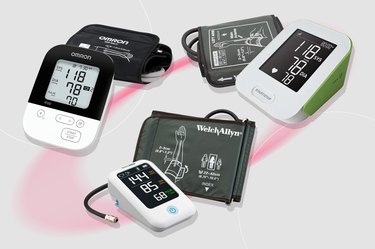
Some doctors recommend that patients do self-monitoring by taking their own blood pressure readings first thing in the morning; other doctors recommend taking several readings in a short time period and averaging them. Because blood pressure can change depending on what you are doing and how you are feeling, it is best to take readings several times a day over a period of several days to get a true reading.
How Low?
Once you have been diagnosed with hypertension and treatment has begun, the question remains: What is the ideal blood pressure to reach through treatment? Blood pressure that's too low can become just as life-threatening as readings that are too high; a phenomenon doctor's refer to as the J-curve. Proponents of the J-curve support doctors in aggressively controlling hypertension, but they warn that special attention should be paid to the diastolic pressure to be sure it does not dip too low while treating the systolic pressure.
Importance
Blood pressure is an indication of overall health. Dig through all the controversy and you see a common theme: Keeping your blood pressure near the ideal reading, 120/80 mm Hg, will help keep your heart and other organs working properly.


