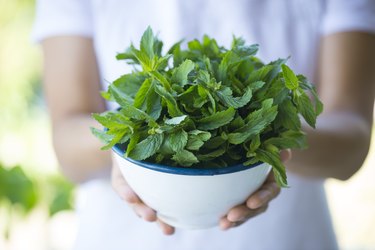
When you hear the word "mint" you probably think of clean, fresh breath, but the leaf has a lot more to offer than that (although fresh breath is a plus). There are many other health benefits of mint, and the good news is that you don't have to eat the whole leaf to experience them.
You can reap all the benefits of mint through essential oils, extracts, putting mint leaves in water and, of course, the mint leaf itself, but there hasn't been any research done on whether there's an added benefit of eating the mint leaves whole. So, feel free to incorporate mint into your diet in any way that works best for you.
Video of the Day
Video of the Day
Tip
There's not a lot of research on whether there's any benefit to eating whole mint leaves; however, there is some research that mint, in general, can improve oral health, increase exercise performance, combat inflammation and soothe digestive troubles, among other things.
What is Mint?
Most people use the term "mint" to describe peppermint and spearmint, two of the most common flavors in gum and other mouth-freshening products, but the mint family actually includes a lot more than that. Mint is the sixth-largest species of flowering plants, and it encompasses lots of different herbs and garden favorites, like:
- Basil
- Oregano
- Rosemary
- Sage
- Thyme
- Bergamot
- Skullcap
- Lavender
- Catnip
However, since most people think of peppermint and spearmint as the quintessential "mints," those are the two that a lot of the research focuses on when discussing the health benefits of mint.
Mint and Your Mouth
While mint may be able to freshen your breath, it's oral benefits don't stop there. Researchers from a study that was published in the European Journal of Dentistry in September 2013 looked at the antimicrobial (or germ-killing) properties of five different essential oils, including peppermint oil. They wanted to see if any of these oils could reduce the amount of bacteria and fungi in your mouth that can cause tooth decay and oral infections.
They found that out of all five oils, peppermint oil had one of the most powerful effects against oral pathogens, including C. albicans, E. coli, S. aureus and E. faecalis_,_ which are responsible for many human infections.They also found that peppermint oil can increase the amount of saliva you produce, which can help prevent dry mouth and chronic bad breath that can come along with it.
Another study, published in the Journal of Dental Hygiene in 2014, looked at how mint, specifically as a mouthwash ingredient, could help participants with signs of gingivitis — a gum disease characterized by swelling, inflammation and redness of the gingiva, the part of the gum that sits at the base of your teeth. Researchers reported that participants who rinsed with mint-infused mouthwash showed significant improvement in gingival sites when compared with participants who rinsed with a placebo.
But the mouthwash didn't just help reduce swelling and inflammation; it also helped get rid of plaque in a period of only four weeks. Of course, it's important to note here that the mouthwash also contained other dental-health-promoting ingredients, so it's impossible to say for sure whether these benefits could be attributed to mint, or eating mint leaves, alone.
Exercise Benefits of Mint
Although mint is really powerful, you may be surprised to hear that it may positively affect your exercise performance. There's not a lot of research on the subject, but researchers from one small study (that was done on 30 healthy males) published in the Avicenna Journal of Phytomedicine in February 2014 wanted to see if peppermint oil could improve different physical parameters in athletes.
They gave the athletes an oral dose of peppermint oil and then tested their grip strength, standing vertical jump and standing long jump (and compared to it their results before taking the peppermint oil). They also looked at their breathing rate and lung function. The researchers reported significant improvements in every parameter.
They noted, however, that these positive effects of taking mint were at a peak five minutes after ingestion and started to drop within an hour after consuming the mint. They weren't entirely clear why this happened, but speculated that mint may have some short-term positive effect on the smooth muscles in the lungs.
Antioxidants in Mint
Another study published in Current Research in Nutrition and Food Science in November 2016 didn't quite look at the health benefits of eating mint leaves whole, but researchers did see what adding it in the form of powder, extract and pure menthol to biscuits could do for your health.
They found that the mint increased the antioxidant activity of the biscuits, even after the biscuits were properly stored for a period of up to five months. The researchers also noted that the mint helped prevent the biscuits from spoiling, which means that you could incorporate mint into your baked goods to reap the health benefits and make your meal prep even easier.
Of course, traditional biscuits may not be in line with your health goals, but you can add mint to paleo biscuits, keto biscuits or gluten-free biscuits — whatever type fits into your diet. You can also just add mint to any baked goods or throw some mint leaves in water for an antioxidant boost in your beverage.
Medicinal Uses of Mint Leaves
In addition to the oral benefits that researchers set out to test, the September 2013 report in the European Journal of Dentistry also listed some other well-known medicinal uses of mint leaves. These benefits include:
- Antiseptic properties
- Antiviral properties
- Antibacterial properties
- Insect repellent
- May help reduce nerve and muscle pain
- May reduce headaches and migraines
- May reduce mucus and relieve coughing
- Helpful for asthma, cold, flu, bronchitis and sinusitis
- May relieve skin inflammation and itchiness
- Soothes digestion (heartburn, diarrhea, indigestion, excess gas)
- Can help relieve travel sickness and nausea
- May help provide cooling relief for varicose veins and hemorrhoids
- May help improve mental health (anxiety and depression)
Read more: Peppermint Oil and Acne
While mint comes with tons of benefits, some people should use caution before consuming it in any form. The UCLA Center for East-West Medicine recommends that anyone with gastrointestinal reflux disease, hiatal hernia or kidney stones should use caution with mint, especially essential oils. While consuming whole mint leaves occasionally probably won't pose much of a problem, concentrated essential oils can make overdoing it easier and more likely.
If you have a health problem and you're not sure whether mint is right for you, check with your doctor before including it in your diet, especially if you're not used to eating it.
- European Journal of Dentistry: "Antimicrobial Efficacy of Five Essential Oils Against Oral Pathogens: An in Vitro Study"
- Avicenna Journal of Phytomedicine: "Instant Effects of Peppermint Essential Oil on the Physiological Parameters and Exercise Performance"
- UCLA Center for East-West Medicine: "Eat Right, Drink Well, Stress Less: Stress-Reducing Foods, Herbal Supplements, and Teas"
- Michigan State University: "MSU Exploring Mints’ Health, Food Benefits"
- Current Research in Nutrition and Food Science: "Antioxidative Properties of Mint (Mentha spicata L.) and its Application in Biscuits"
- Emory Healthcare: "Health Benefits of Mint"
- Mayo Clinic: "Gingivitis"
- Journal of Dental Hygiene: "Early Benefits With Daily Rinsing on Gingival Health Improvements With an Essential Oil Mouthrinse--Post-Hoc Analysis of 5 Clinical Trials"