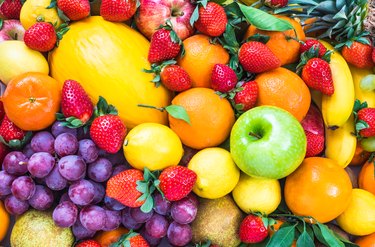
If you dream about being able to eat whatever you want and not gain weight, you're not alone. While no miracle foods are available to help you lose weight, filling your diet with the right foods may help you attain and maintain a healthy weight.
Tip
If you're concerned about your diet and weight, talk to your doctor or dietitian to discuss the best food choices for your needs.
Video of the Day
Calorie Balance and Healthy Weight
The food you eat supplies your body with energy in the form of calories. Many people struggle to maintain a healthy weight because they eat too many calories. While certain foods are linked to lower body weights, eating more calories than your body needs from any source, good or bad, causes weight gain.
Video of the Day
How many calories you need to maintain your weight depends on your age, gender and activity. To maintain your weight, eat just enough calories to replace the ones you burn throughout the day without exceeding your needs, which, for women, ranges from 1,600 to 2,400 calories a day and, for men, 2,000 to 3,000 calories a day. Your doctor or dietitian can help you determine your exact calorie needs.
Avoid Weight Gain With Produce
While calories are the most important aspect of not gaining weight, people who eat more fruits and vegetables may be more successful at maintaining their weight. A 2015 prospective cohort study published in PLoS Medicine investigated the association between fruit and vegetable intake on weight in a large group of men and women.
The researchers found an inverse relationship between the intake of fruits and nonstarchy vegetables and weight, which means the more of these foods that people ate, the less they were likely to weigh. The researchers also noticed that people who ate certain fruits, including berries and citrus fruit, and certain vegetables, including cruciferous vegetables such as broccoli and cauliflower and leafy greens, were more likely to gain less weight.
Fruits and vegetables have a low-energy density, which means you get to eat a nice-sized portion without spending too many of your calories. Fullness is based on the quantity of food you consume, not total calories. Filling up on low-calorie foods helps you eat fewer calories overall for better weight control. Other good fruits and veggies to add to your no-weight-gain diet include tomatoes, carrots, apples and watermelon.
Read more: Nutrition Facts on Fruits and Vegetables
Eat Whole Grains Too
Whole grains might also help limit weight gain. A 2011 prospective study published in the New England Journal of Medicine also found an association between a higher intake of whole grains and a lower body weight. Like fruits and vegetables, whole grains are also considered low-energy dense foods.
Whole grains are also high in fiber, which keeps you feeling full. Good whole grains to add to your diet for a healthier weight include quinoa, barley, brown rice, amaranth, oats and bulgur. Also, use whole-wheat bread, whole-grain cereals and whole-wheat pasta to get more whole grains in your diet.
Lower Weight Gain With Yogurt
The 2011 study published in the New England Journal of Medicine also found that those who ate more yogurt were less likely to gain weight. The researchers are not certain why yogurt may be associated with less weight gain, but they theorize it may have something to do with the friendly bacteria in the fermented dairy food.
Read more: Benefits of Nonfat Plain Yogurt
Yogurt is also rich in protein — a nutrient that helps you feel full after eating — along with bone-building calcium, vitamin D and magnesium. For overall good health, choose low-fat or nonfat yogurt varieties, without added sugar or artificial colors, recommends the Academy of Nutrition and Dietetics.
- Harvard T.H. Chan School of Public Health: The Best Diet: Quality Counts
- New England Journal of Medicine: Changes in Diet and Lifestyle and Long-Term Weight Gain in Women and Men
- Health.gov: Dietary Guidelines for Americans, 2015-2020
- PLoS Medicine: Changes in Intake of Fruits and Vegetables and Weight Change in United States Men and Women Followed for Up to 24 Years: Analysis From Three Prospective Cohort Studies
- Centers for Disease Control and Prevention: Eat More, Weigh Less
- Nutrition: Dietary Fiber and Body Weight
- Academy of Nutrition and Dietetics: Yogurt Mania