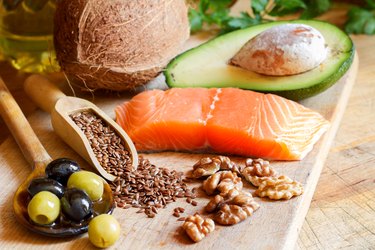
Society is still licking its wounds from the fat-phobic '80s and '90s when diet culture suggested any and all dietary fat was bad for you. Food manufacturers loaded up grocery store shelves with fat-free and low-fat snacks that were packed with sugar instead.
But fat is a crucial nutrient required to give our bodies energy, support cell growth, protect our organs, help with nutrient absorption, produce hormones and even keep us warm, according to the American Heart Association (AHA).
Video of the Day
Video of the Day
But the type of fat matters. Healthy fats include the following:
- Monounsaturated fats (MUFA): These fats are found in fatty plant-based foods, such as olives, avocado, nuts and seeds as well as these foods' oils (like olive oil) and butters (like peanut butter). MUFAs are linked to a reduced risk of heart disease, and monounsaturated fat foods also usually contain the antioxidant vitamin E, per the AHA.
- Polyunsaturated fats (PUFA): These fats are also found in plant-based sources, such as walnuts, sunflower seeds, tofu and soybeans as well as these foods' derivatives. PUFAs are also linked to a reduced risk of heart disease, and polyunsaturated fat foods also usually contain vitamin E, per the AHA. Omega-3s are a form of polyunsaturated fat.
Unlike the not-so-good-for-you saturated fat and downright-bad trans fats, unsaturated fats are liquid at room temperature — not solid — according to Harvard Health Publishing. Unhealthy fat foods include fried foods, like french fries and doughnuts, as well as commercially packaged baked goods like muffins and croissants.
How Much Fat Do You Need Per Day?
The recommended daily intake for fat in adults is 20 percent to 35 percent of total calories, with no more than 10 percent coming from saturated fat, according to the Dietary Guidelines for Americans (DGA).
The DGA recommends keeping trans fat intake as low as possible as diets high in saturated and trans fats are tied to increased risks of stroke and heart disease.
Health experts recommend swapping out foods high in saturated and trans fats with foods high in unsaturated fats, like those below. Note that the FDA's Daily Value (DV) percentages are based on eating 78 grams of total fat per day.
1. Avocados: 29.5 g, 38% Daily Value (DV)
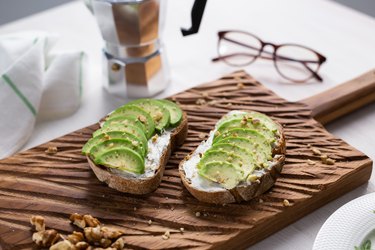
There's a reason avocados are all the rage: Not only does the fruit provide 38 percent of the DV of fat per one avocado, but it's also high in fiber and vitamin E, a powerful antioxidant.
The fat breakdown of avocados is notable: They have about 26 grams of unsaturated fat (aka good fats to eat) and just 4 grams of saturated fat. It's also one of the best foods high in fat and low in carbs, with one avo containing less than 20 grams of carbs. Try avo in these tasty recipes that aren't toast or guac.
2. Tofu: 22 g, 28% DV
Tofu is high in complete protein — meaning it contains all nine essential amino acids — as well as fiber and fat. One cup has 27 percent of the DV of fat, including 18.8 grams unsaturated fat.
Tofu is a vegetarian favorite thanks to its mild taste and versatility, making it a popular ingredient in egg scrambles and stir-fry dishes. Try it in these anything-but-bland tofu recipes.
3. Macadamia Nuts: 21.5 g, 28% DV
The creamy nut that makes a cameo in delicious white chocolate cookies packs a nutritional punch as it packs fiber, protein and is one of the tastiest foods high in monounsaturated fat.
An ounce of macadamia nuts provides 28 percent of the DV for fat, including 18.1 grams of unsaturated fat, and just 4 grams of carbs. Like all nuts, Macadamias are low in saturated fat.
4. Salmon: 21 g, 27% DV
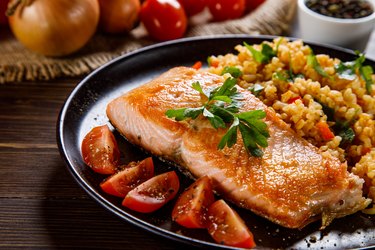
Salmon is one of the healthiest fish thanks to its lean protein, omega-3 fatty acids (healthy fat) and vitamin D. A 6-ounce serving contains 27 percent of the DV for fat, including 16.9 grams of unsaturated fat.
The AHA recommends adults eat two 3.5-ounce servings of fatty fish like salmon every week
5. Pecans: 20.4 g, 26% DV
OK, so pecan pie probably isn't the best way to get your healthy fat (hello, butter and sugar), but pecans themselves boast 26 percent of the DV for fat per 1 ounce, with 18.6 grams of unsaturated fat.
Pecans also contain very little saturated fat — fewer than 2 grams per serving. Pecans, like all nuts, are a vegan food high in fat and low in carbs.
6. Walnuts: 18.5 g, 24% DV
Just 1 ounce of walnuts contains 24 percent of the DV for fat — 17 grams of its 19 grams of fat are unsaturated. Plus, walnuts are known for high levels of vitamin E, making them a powerful antioxidant-rich food.
What's more, walnuts are linked to delayed cognitive decline in high-risk adults, according to a January 2020 study in the American Journal of Clinical Nutrition.
7. Almond Butter: 17.8 g, 23% DV
Almond butter seems like peanut butter's fancier cousin, but both nut butters (well, peanuts are actually legumes), offer comparable nutrition, including plant-based protein and fat.
A 2-tablespoon serving has 23 percent of the DV for fat mostly coming from unsaturated fats (8.2 grams). But almond butter contains slightly higher levels of iron, vitamin E and fiber compared to its peanutty counterpart.
8. Peanut Butter: 16.4 g, 21% DV
Speaking of peanut butter, a 2-tablespoon serving provides 21 percent of the DV for fat (with 13.1 grams of unsaturated fat and a bit of saturated fat) as well as 7 grams of plant protein and 1.6 grams of fiber. It's one of the best foods high in MUFA.
To make the most of your peanut butter, choose brands that contain just peanuts, and maybe a little bit of salt for flavor. Try it in these delicious PB recipes.
9. Tahini: 16.1 g, 20% DV
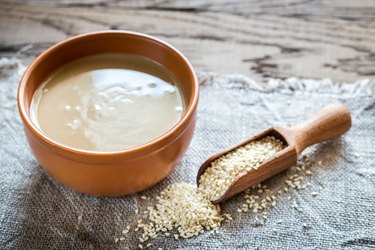
Tahini — also known as sesame seed butter — is a popular Middle Eastern sauce that often accompanies falafel. A 2-tablespoon serving has some fiber, protein and 20 percent of the DV for fat, including 7 grams of unsaturated fat.
Like other seeds, sesame seeds are high in unsaturated fat, so they're a rich, filling addition to any meal. Try it in these tahini recipes that aren't hummus.
10. Edamame: 15.4 g, 20% DV
Edamame, aka boiled soybeans, is high in plant-based complete protein, fiber and healthy fats.
A 1-cup serving provides 31 grams of protein, 10 grams of fiber and 20 percent of the DV for fat, including 13.2 grams of unsaturated fat. It's high in plant-based omega-3s, deeming it one of the best vegan foods high in PUFA. What's more, edamame is high in plant-based iron, with half of your DV per cup.
11. Flaxseed Oil: 13.6 g, 17% DV
Oils from nuts and seeds are known for being foods high in MUFA. Flaxseed oil, which comes from heart-healthy flaxseeds, is no exception: 1 tablespoon offers 17 percent of the DV for fat — the majority (12.4 grams) coming from unsaturated fats.
Flaxseed oil mixes well in homemade salad dressings and drizzled over roasted veggies or whole-wheat pasta.
Tip
Other oils rich in healthy fats (with 17 percent of your DV per tablespoon) include avocado, walnut and sesame oils.
12. Dark Chocolate: 12.1 g, 16% DV

Yes, chocolate is a food high in good fat. But there are few things you should know before you scarf down that bar as not all chocolate is created equal. In order to cash in on the health benefits associated with dark chocolate — like reduced risk of heart disease and type 2 diabetes, per the Harvard T.H. Chan School of Public Health — reach for those made with at least 70 percent cocoa.
An ounce (around one square) contains 16 percent of the DV for fat — 5 grams of unsaturated fat and 9 grams of saturated fat. Dark chocolate also contains iron and fiber.
13. Cheese: 9.5 g, 12% DV
Cheese (and dairy, in general) is an excellent source of many nutrients, including calcium, protein and fat. While cheese does contain higher levels of saturated fat than other good fat foods, it's still nutritious.
Just 1 ounce contains 12 percent of the DV for fat (including 4.1 grams unsaturated), 13 percent of the DV for protein and 16 percent of the DV for calcium.
14. Whole Eggs: 5.3 g, 7% DV
One large egg offers high-quality nutrition, including protein, vitamins A, D, E, iron and, yes, fat. But the yolk is where all the fat is.
In 2015, the Dietary Guidelines for Americans removed the daily 300-milligram limit of dietary cholesterol (one egg contains roughly 200 milligrams), pointing out that there was no significant association between eating eggs and mortality, according to a May 2020 paper in the Journal of the American Heart Association.
While eggs do contain saturated fat (1.5 grams), they also contain healthy unsaturated fats — 7 percent of the DV with 3.7 grams of unsaturated fats per one hard-boiled egg.
15. Olives: 2.3 g, 3% DV
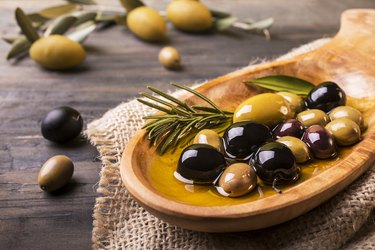
Olives — which, of course, make the famous heart-healthy oil — provide health benefits on their own. Five olives contain 3 percent of the DV for fat, with 2 out of 2.3 grams coming from unsaturated fats. They're also low in carbs, deeming olives one of the best keto foods high in fat.
Tip
While these fat-rich foods are nutritious, you'll still want to limit your portions because they're calorie-dense. To avoid weight gain (if that's your goal) stick to one serving or less of these foods at each meal.
Remember, 20 to 35 percent of your total calories should come from fats. So if you're eating 1,800 calories per day, that works out to about 40 to 70 grams of total fat per day.
- American Heart Association: "Dietary Fats"
- Harvard Health Publishing: "The Truth About Fats: The Good, the Bad, and the In-between"
- U.S. Department of Health and Human Services: "Dietary Guidelines for Americans"
- American Heart Association: "Fish and Omega-3 Fatty Acids"
- American Journal of Clinical Nutrition: "Effect of a 2-year Diet Intervention With Walnuts on Cognitive Decline. The Walnuts And Healthy Aging (WAHA) Study: A Randomized Controlled Trial"
- International Journal of Food Sciences and Nutrition: " Effect of Sesame Seed on Lipid Profile and Redox Status in Hyperlipidemic Patients"
- Harvard School of Public Health: "Dark Chocolate"
- Journal of the American Heart Association: "Dietary Intakes of Eggs and Cholesterol in Relation to All‐Cause and Heart Disease Mortality: A Prospective Cohort Study"
Was this article helpful?
150 Characters Max
0/150
Thank you for sharing!
Thank you for your feedback!