
How Bad Is It Really? sets the record straight on all the habits and behaviors you’ve heard might be unhealthy.
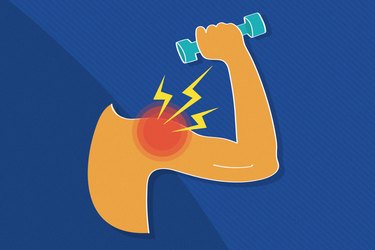
Contemplating pushing through another grueling workout even though your muscles are screaming? If your legs feel stiff when you get out of bed or you find it difficult to wash your hair because of sore shoulders, you might be experiencing delayed-onset muscle soreness (DOMS).
So is working out with sore muscles is OK? That depends on the severity of your DOMS and how you plan to continue exercising.
Video of the Day
Video of the Day
Tip
While it's not necessarily bad to continue working out with sore muscles, you may want to take more than a few days off and consult your doctor if you're experiencing sharp, extreme or persistent pain.
What Is Delayed-Onset Muscle Soreness?
When you exercise, your body develops small tears in the muscle fibers. This microscopic damage is likely the cause of DOMS. According to the American College of Sports Medicine (ACSM), the pain you're feeling is a side effect of the repair process that happens in response to this muscle damage.
DOMS can happen if you start a new exercise regimen, go back to something you haven't done in a while or increase the intensity of your usual activity. The discomfort or soreness typically shows up 12 to 24 hours after a workout, but don't be surprised if you feel the most pain around 24 to 72 hours after exercise.
While the pain can be a nuisance, certified athletic trainer, Ian Elwood, CSCS, says it isn't necessarily an indicator of the extent of the damage. "Instead, it's possibly a reaction by the nervous system to 'warn' you not to push hard physically, and in this sense, it acts as a protective mechanism, allowing the body to heal," he says.
Should You Work Out With Sore Muscles?
Do you ever question whether muscle pain after a workout is good or bad? If you're active most days of the week, there's a good chance you know what it's like to feel the day-after burn. If that's what you're feeling, it's likely alright to proceed — with a bit of added TLC.
While dealing with muscle soreness is a part of working out, experiencing pain that severely limits your daily activity is not. To determine whether or not you should work out with sore muscles, you need to assess the severity of the pain.
Is it hard to move without pain shooting through your muscles? Is your range of motion severely restricted due to pain? You'll likely need to ease up and go low-impact or pause workouts altogether.
Since many activities can cause DOMS, pay attention to how long the pain lasts. Generally speaking, DOMS can last anywhere from three to five days, according to the ACSM. If you want to get your sweat on during that time, knowing the pros and cons of working out while sore can help you decide if it's worth it. Here are some of the potential benefits of exercising with sore muscles.
- May help lessen soreness: Elwood says this is especially true if you re-create the initial stimulus that caused it in the first place.
- Increases blood flow to the muscles: If you're slightly sore, Austin Martinez, CSCS, director of education for StretchLab, says working out and stretching can be beneficial to your sore muscles. "Mobility exercises such as swimming or cycling can help increase blood flow to the muscles and help reduce soreness sooner," he says.
- Provides opportunity to focus on other muscle groups: Another pro to working out while sore, Martinez says, is the chance to focus on other muscle groups. "This is why a lot of people practice split-body training, in which they might work on upper body one day, then lower body the next, working around their soreness," he says.
Need a reason not to work out if you're too sore? These are a few of the drawbacks to exercising with sore muscles.
- Decreases muscle function: Elwood says this can express itself as weakness, tightness, decreased motor control or a combination of the three. "If you're sore and try to work out with high intensity, you could potentially injure yourself," he says.
- May lead to a subpar workout: "Decreased function means less weight moved, less weight usually means less gains," Elwood says. Being sore may be evidence that you had a good workout, but he says if that soreness lingers and gets in the way of your next workout, perhaps it isn't worth it. "Ultimately our workouts are only as good as our ability to recover from them," he says.
What Workouts Are OK When You're Sore?
If you're sore, but still want to stay active, modifying your routine is a good way to go, according to the Mayo Clinic. Walking, low- or moderate-intensity swimming, gentle yoga or slow bike riding can all help keep you active while minimizing any further muscle soreness.
Martinez says other activities like stretching, foam rolling, massage and light movement are all beneficial and can expedite this process. The key to working out with sore muscles is to go slowly and keep it low-impact, according to the ACSM. This is a great time to focus on your warm-up and cooldown and spend some extra time stretching.
So, How Bad Is It Really to Work Out With Sore Muscles?
While experts say that working out with sore muscles is usually OK, you need to be aware of any sharp, strong or persistent pain. The minor discomfort or soreness you feel in your muscles in the days after exercise is normal, especially if you've just increased the intensity of your workout or tried something new.
But if the pain you're experiencing is unbearable or interfering with daily activities, you might want to reassess your workout routine. If you experience this, stop exercising and rest your body. If the pain is significantly affecting your daily activities, it's time to consult your doctor.
The bottom line is this: If you're noticing inflammation, which is linked to increased pain, redness and potentially swelling, Martinez says you may be too sore to work out.
Related Reading
- American College of Sports Medicine: ACSM's Health & Fitness Journal: Sore and More
- American College of Sports Medicine: Delayed Onset Muscle Soreness (DOMS)
- Mayo Clinic: The Best Ways to Bounce Back After a Tough Workout
- Cleveland Clinic: When Is It OK to Push Through Pain During Exercise?
- Mission Mvmt: "Ian Elwood, Certified Athletic Trainer, Personal Interview"
- StretchLab: "Austin Martinez, Director of Education, Personal Interview"