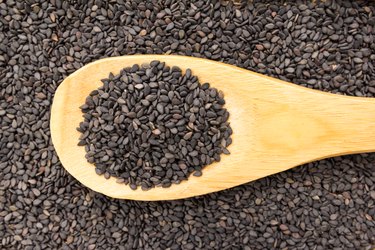
White and black sesame seeds come from the herb Sesamum indicum, which belongs to the Pedaliaceae family. It is one of the oldest cultivated plants in the world, grown for culinary use as well as in traditional medicines. Each seed pod contains hundreds of seeds that vary in color from creamy white to charcoal black depending on the cultivator. Black sesame seeds have a slightly nuttier flavor than the white counterpart, but both kinds are excellent sources of phytonutrients, antioxidants, dietary fiber and health-promoting nutrients.
Ways to Eat Sesame Seeds
Video of the Day
You can buy black sesame seeds raw, toasted, hulled or with the seed coats on. Unhulled seeds provide more fiber. Buying organic seeds will assure they don't contain pesticides.
Video of the Day
It's easy to incorporate nutrient-dense black sesame seeds into your diet. Sprinkle some on your rice, salads, cereals, noodles or any other dishes at mealtime. They have a rich nutty flavor and are good in yogurt or smoothies. For some added crunch, add sesame seeds to breads, cakes, cookies and candies.
Many traditional dishes use sesame seeds. For example, halva is a popular Middle Eastern candy; tahini is sesame paste made from hulled, lightly roasted seeds. In Japan, whole seeds are typically sprinkled on sushi rolls and black sesame seeds are used to make gomasio, a dry condiment. Black sesame seeds are popular in Korean cooking as a marinade. In Africa, ground black sesame seeds are used to make Wangila, which is served with smoked fish.
Black Sesame Seeds Nutrition
Both black and whole dried white sesame seeds have similar nutritional content.
Of the 100 calories per 2-tablespoon serving, or 18 grams, of black sesame seeds, 80 comes from fat. Black sesame seeds contain no cholesterol, sodium or sugar. According to the USDA Food Composition Database, the macronutrients in 2 tablespoons of whole black sesame seeds include:
- Total fat: 9 grams
- Low in carbohydrates: 4 grams
- High in fiber: 2 grams
- Good source of protein: 3.2 grams
Black sesame seeds benefits include an impressive nutrient profile that includes key vitamins and minerals important for your health. For every 2 tablespoons, the little seeds provide a good portion of your daily value (DV), based on a 2,000 calorie diet, for:
- Calcium: 14 percent DV
- Thiamine (vitamin B1): 12 percent DV
- Riboflavin (vitamin B2): 3 percent DV
- Folate: 4 percent DV
- Niacin (vitamin B3) 4 percent DV
- Phosphorus: 9 percent DV
- Zinc: 13 percent DV
- Manganese: 19 percent DV
- Vitamin E: 2 percent DV
- Iron: 15 percent DV
- Magnesium: 15 percent DV
- Copper: 82 percent DV
Helps Your Digestive System
Because black sesame seeds are such a good source of dietary fiber, providing 8 percent DV in just a 2-tablespoon serving, they can help keep you regular. Fiber is the part of food that your body cannot digest or absorb. It remains intact, adding bulk and drawing in water to your digested food, softening your stool, so it can pass smoothly through your stomach and colon and help prevent constipation.
By keeping your digestive system working properly, the fiber in sesame seeds may help alleviate symptoms caused by irritable bowel syndrome, hemorrhoids, diverticulitis and other gastrointestinal disorders. In addition, dietary fiber has been shown to reduce the risk of colon cancer, according to research in the American Journal of Clinical Nutrition in October 2015.
Contains Healthy Fats
Another one of black sesame benefits is from their good source of healthy fats that your body needs to produce energy for performing many vital biological and physiological processes associated with your heart, muscles, blood cells and nervous system. Fats are also needed to absorb fat-soluble nutrients and help insulate your body.
Black sesame seeds do not contain trans fat. Per 2 tablespoons, they have 1.3 grams of saturated fat, which you should limit to less than 10 percent of your total daily calories, recommends Dietary Guidelines.
Sesame seeds contain 50 to 60 percent of high-quality fat which is rich in polyunsaturated fatty acids — 4 grams — and monounsaturated fats — 3.4 grams, per 2 tablespoons. Replacing saturated fat for unsaturated fats may contribute to lowering your LDL (bad) cholesterol, which may help reduce your risk of heart disease by about the same amount as cholesterol-lowering drugs.
Keeps Your Bones Healthy
Calcium in black sesame seeds is the most important mineral for bone health. But black sesame seeds contain many other minerals that help to keep your bones strong. Magnesium, phosphorus, calcium, copper, iron and zinc all play a role in maintaining bone density, according to American Bone Health.
About 50 to 60 percent of magnesium resides in your bones, making the mineral important for maintaining your skeletal system. Maintaining adequate magnesium levels may help reduce the risk of osteoporosis in women after menopause, says National Institutes of Health. With 85 percent of the phosphorus in your body found in bones as calcium phosphate, a deficiency of phosphorus can result in depletion of calcium and lead to serious bone disease, according to NIH.
The calcium in your body is needed to support the hardness and structure of your teeth and bones. A deficiency in calcium can cause low bone mass and increase the risks of osteoporosis and bone fractures. Copper, iron and zinc in black sesame seeds are involved in collagen synthesis, which helps provide the infrastructure required to hold your bones together.
Contains Beneficial Antioxidants
Black and white sesame seeds and the oil from the seeds can help prevent disease and illness because of their antioxidant effects. This may be due to a group of phenylpropanoid compounds in sesame, namely sesame lignans, which include two unique components — sesamin and sesamolin. These antioxidants provide defense against harmful free radicals. Free radicals are byproducts of metabolic functions in your body, such as digestion, and can also come from the environment, such as pollutants.
Antioxidants may play a role in the prevention of degenerative diseases such as cancer, cardiovascular diseases, atherosclerosis and the process of aging, according to a July to December 2014 study published in Pharmacognosy Review.
Sesame lignans have various other health-promoting properties in addition to its antioxidant activity, including antitumor, lowering cholesterol levels and reducing blood pressure. In addition to sesame lignans, sesame seeds also contain vitamin E, another important antioxidant nutrient.
Relieves Stress and Anxiety
Anxiety related conditions are a common disorder present in 15 percent of the general population. Stress and anxiety is often accompanied by mood disorders and depression, which can be caused by a low intake of magnesium.
A review, published in the May 2017 journal Nutrients, administered magnesium to adults 18 years of age and older to assess the effect of magnesium against a placebo. Conclusions suggested evidence for a beneficial effect of magnesium for reducing mild anxiety and symptoms of PMS. However, researchers advised further, more controlled studies to define the role of magnesium in response to stress.
Higher levels of magnesium also help create healthy amounts of serotonin in the brain and spinal fluid. And magnesium is required for the synthesis of dopamine, which can affect your mood.
Helps Prevent Heart Disease
Due to its known anti-inflammatory and antioxidant properties, sesame oil was used in a study to review the association between sesame and atherosclerosis, a disease in which plaque builds up along the walls of your arteries. Since elevated LDL is a risk factor for atherosclerotic disease, it was supposed that a reduction of cholesterol might reduce the incident of atherosclerosis and its consequent risk of heart disease.
The conclusion, published in the journal Cureus in July 2017, reported that sesame oil showed promise in reducing high cholesterol and inflammation, lowering the risk of atherosclerosis and decreasing the risk of cardiovascular disease. Researchers recommend further studies to investigate the potential use of sesame seed oil as an alternative or addition to traditional treatments such as statins and metformin.
Read more: Can Artery Plaque Buildup Be Reversed With Diet?
Lowers Cholesterol Levels
Black sesame seeds and oil from sesame seeds rank high in cholesterol-lowering phytosterol content. Phytosterols are a plant sterol structurally similar to cholesterol. They displace dietary cholesterol within the intestinal tract, reducing the stores of available and absorbable cholesterol. Linus Pauling Institute says daily consumption of 2 grams of phytosterols from foods can significantly lower LDL (the bad) cholesterol by 8 to 10 percent.
Promotes Better Sleep
Insomnia is a common symptom of magnesium deficiency, which may accompany restless sleep and waking up frequently during the night. Keeping your magnesium levels up can benefit your health by controlling your body's stress-response system and hormones that help to promote deep, restorative sleep. Magnesium can also help insomnia that's associated with restless-leg syndrome.
The role that magnesium plays in supporting a calming effect and a good night's rest may be due to its ability to help your body maintain GABA in your brain. GABA (a.k.a., gamma-aminobutyric acid), is a neurotransmitter that promotes a tranquil feeling and regulates your sleep cycle. Magnesium also keeps glutamate, which is an excitatory neurotransmitter, within healthy limits.
And if you have migraines that are preventing you from having a restful sleep, magnesium may help alleviate headaches, according to the American Migraine Foundation.
Read more: How Soon Do You Feel the Benefits of Magnesium?
Concerns About Oxalic Acid
Like all seeds, sesame seeds, including products made with sesame seeds, like tahini, contain a natural antinutrient known as oxalic acid. Oxalic acid can bind to calcium in your body and interfere with the absorption of calcium and iron.
Although oxalates are normally excreted from the body after it's formed, under certain conditions it may accumulate in your kidney to form calcium-oxalate fragments. These fragments can develop into larger crystals, or kidney stones, according to the National Kidney Foundation.
If you don't have a kidney condition and are not prone to kidney stones, a report in July 2015 in Clinical Nutrition Research, says foods containing oxalates are safe, even for people with diabetes, high blood pressure and high blood cholesterol.
Read more: 13 Powerful Grains and Seeds
Sesame Seed Allergy
Sesame seeds are among the top-priority food allergens. You may experience an allergic reaction if your body's immune system overreacts to a particular protein. Symptoms of an allergic reaction may develop quickly and progress from mild to severe. These may include:
- Flushed face, rash, hives or red and itchy skin
- Swelling of the throat, eyes, face, lips or tongue
- Trouble breathing, speaking or swallowing
- Anxiety, distress, faintness, paleness or weakness
- Cramps, diarrhea or vomiting
- Loss of consciousness
A severe allergic reaction may cause life-threatening anaphylaxis, which requires immediate emergency medical attention. If you experience any of these symptoms, get to a hospital:
- Swelling of the throat and suffocation
- A severe drop in blood pressure
- Constricted airways in lungs
If you have a sesame allergy, avoid all foods containing the product. Read labels carefully, and if you see one of the following names in the list of ingredients, it likely contains sesame:
- Benne, benne seed and benniseed
- Gingelly and gingelly oil
- Seeds
- Sesamol and sesamolina
- Sesamum indicum
- Sim sim
- Til
- NDTV Food: "5 Health Benefits of Black Sesame Seeds for Better Digestion and Healthier Bones"
- USDA Food Composition Database: "Seeds, Sesame Seeds, Whole, Dried"
- International Foundation for Gastrointestinal Disorders: "Dietary Fiber"
- MayoClinic: "Mayo Clinic Q and A: Diet, Lifestyle Choices Can Lower Risk of Diverticulosis Developing Into Diverticulitis"
- The American Journal of Clinical Nutrition: "Dietary Fiber Intake and Risk of Colorectal Cancer and Incident and Recurrent Adenoma in the Prostate, Lung, Colorectal, and Ovarian Cancer Screening Trial"
- Dietary Guidelines: "Daily Nutritional Goals for Age-Sex Groups Based on Dietary Reference Intakes and Dietary Guidelines Recommendations"
- Pharmacognosy Review: "Value Addition in Sesame: A Perspective on Bioactive Components for Enhancing Utility and Profitability"
- NIH News in Health: "The Skinny on Fat The Good, the Bad, and the Unknown"
- American Bone Health: "Minerals for Bone Health"
- National Institutes of Health: "Magnesium"
- National Institutes of Health: "Potassium"
- National Institutes of Health: "Calcium"
- Journal of Separation Science: "Determination and Purification of Sesamin and Sesamolin in Sesame Seed Oil Unsaponified Matter Using Reversed‐Phase Liquid Chromatography Coupled With Photodiode Array and Tandem Mass Spectrometry and High‐Speed Countercurrent Chromatography"
- Cureus: "Anti-inflammatory and Antioxidant Effects of Sesame Oil on Atherosclerosis: A Descriptive Literature Review"
- Psychology Today: "What You Need to Know About Magnesium and Your Sleep"
- Nutrients: "The Effects of Magnesium Supplementation on Subjective Anxiety and Stress—A Systematic Review"
- American Migraine Foundation: "Magnesium"
- Linus Pauling Institute: "Phytosterols"
- National Kidney Foundation: "What Are Oxalates and Why Are They a Concern for Kidney Disease Patients?"
- Clinical Nutrition Research: "Nutritional Management of Kidney Stones (Nephrolithiasis)"
- Government of Canada: "Sesame - One of the Ten Priority food Allergens"
- FDA US Food and Drug: "Food Allergies: What You Need to Know"
- Genome Biology: "Genome Sequencing of the Important Oilseed Crop Sesamum indicum L"
- Integrated Medicine for Mental Health: "Magnesium. The Missing Link in Mental Health"
- University of Virginia: "Foods & Beverages High in Oxalates"