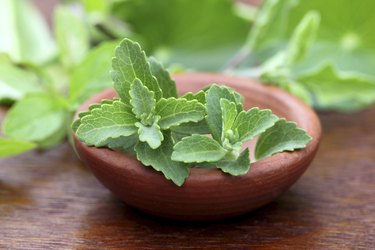
Whether you're on a diet or have diabetes and wish to enjoy something sweet without sugar, the natural sweetness of stevia provides a good alternative. With no calories and glycemic index of zero, stevia provides sweetness to baked goods without the negative aspects of refined sugar.
Stevia is naturally much sweeter than sugar, so a little goes a long way. Because of this, when you're substituting stevia for sugar, ingredient adjustments are often required in recipes to make up for the lost bulk. In addition, the amount of stevia that's necessary depends on the particular product's stevia-to-sugar ratio.
Video of the Day
Video of the Day
Tip
When you're baking with stevia instead of sugar, be sure to check the product label for proper sugar-to-stevia conversion. The stevia-to-sugar ratio depends on the type and brand of stevia being used.
Stevia has been used for hundreds of years in South America. It is now used in processed forms to help with weight management a May 2015 article in Nutrition Today explains that by eliminating the sugar calories from a variety of products and in home baking. Steviol glycosides are the components that cause the sweet taste in the plant and are 250 to 300 times sweeter than sucrose. High-purity forms of these glycosides are considered safe by the U.S. Food and Drug Administration.
Read more: Splenda vs. Stevia
Substitute Stevia for Sugar
When attempting to substitute stevia for sugar, it is recommended for best results to only remove half of the sugar in place of stevia. This is due to the moisture, browning and rising effects that sugar contributes to.
There are commercial sugar and stevia blends available as well. Follow the directions for sugar-to-stevia conversion stated on the package. Many of these are designed for a cup-for-cup stevia-to-sugar ratio making baking with stevia no different than when using regular sugar.
For stevia packets, the sweetness of one packet is similar to 2 teaspoons of sugar. Twenty-four packets equal 1 cup of sugar. If you are using a bag of baking stevia, then 1/3 cup plus 1 1/2 tablespoons are equal to 1 cup of sugar. For pure powdered stevia, the stevia-to-sugar ratio is much lower. Only 1 teaspoon of powdered stevia equals 1 cup of sugar. For baking purposes, the bags of baking stevia are more convenient and practical than individual packets.
Read more: Stevia is One Sweet Substitute for Sugar!
Tips for Baking With Stevia
There are a few adjustments that should be made to substitute stevia for sugar. When baking cookies, stevia is best used in recipes for crisp cookie types such as shortbread. If you are making chewy cookie types, it is best to add some bulk and moisture in the form of pumpkin, applesauce, uncooked oatmeal or nut and seed butter. Otherwise, your cookies could end up dry and crumbly.
In the case of cakes, separate the egg whites and whip them to stiff peaks to help maintain the volume of the cake batter. Be sure to invert the cake onto a cooling rack when finished baking in order to maintain volume and avoid the cake collapsing.
Yeast breads need sugar to rise. Replace only half of the sugar and increase the baking soda or baking powder to compensate for the lack of sugars available to feed the yeast. In all cases, preheat the oven to the correct temperature beforehand.
Read more: Erythritol vs. Stevia vs. Xylitol
Warning
Although stevia does not contain calories or cause fluctuations in blood sugar, the Mayo Clinic still recommends using it in moderation due to the excess calories in desserts. Other ingredients in the recipe can contribute to spikes in blood sugar.
- Nutrition Today: "Stevia, Nature’s Zero-Calorie Sustainable Sweetener"
- U.S Food & Drug Administration: "Has Stevia Been Approved by FDA to Be Used as a Sweetener?"
- Penn State Extension: "Sugar Substitutes"
- In The Raw: "Stevia in the Raw Packets"
- In the Raw: "Stevia in the Raw Baker's Bag"
- Missouri University Extension Center: "Baking With Sugar Substitutes"
- University of Nebraska Lincoln: "Satisfying Your Sweet Tooth"
- University of Nebraska Extension: "Stevia"
- Mayo Clinic Nutrition and Healthy Eating: "What Is Stevia? I've Heard It's Good for Weight Control"