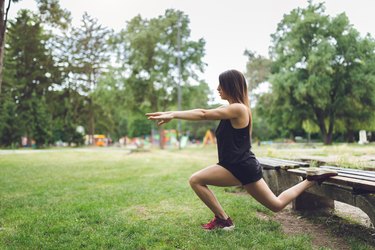
Exercise is like medicine — the right amount of the right kind can heal you, but too much of the wrong kind can be harmful. Case in point: Physical therapy exercises to relieve SI joint pain, formally known as sacroiliitis, will expedite recovery, but the wrong physical activity can make pain worse.
Tip
If you have SI joint pain, you should avoid running, stair climbing and anything that puts uneven weight on one side of your body.
Video of the Day
First, it's important to understand what sacroiliitis is and why certain exercises affect it the way they do. If you have sacroiliitis, your doctor or physical therapist will give you specific instructions on exercises to relieve SI joint pain, but there are a few basic movements and stretches you can try.
Video of the Day
Read more: How to Alleviate Back Pain in 11 Simple Moves
What Is Sacroiliitis?
Sacroiliitis is an inflammation of your sacroiliac (SI) joints, where your lower spine connects with your pelvis, according to the Mayo Clinic. This pain might be caused by traumatic injury, arthritis, chronic muscle weakness, pregnancy or infection, and depending on the cause, you could have sacroiliitis in one joint (either on your left or right side) or in both joints.
The Mayo Clinic further explains that sacroiliitis can be difficult to diagnose because it's easily mistaken for other causes of lower back pain. Doctors will usually need to rely on an X-ray or use of anesthetic injections to determine whether the pain is due to sacroiliitis or something else.
Those with sacroiliitis can undertake such home treatments as over-the-counter pain relievers, ice and heat — and, maybe most important, rest. Mount Sinai Health System emphasizes that patients should minimize physical activity so that a SI joint injury has the chance to get better. If you have to get up and move around, you should do so with a sacroiliac belt or lumbar brace to help support your back.
SI Joint Exercises to Avoid
Does this mean that people with sacroiliitis should avoid all physical activity? Not necessarily, unless your doctor tells you so. But there are certain movements that can make the pain worse.
If you have sacroiliac joint pain, exercises to avoid include anything that requires prolonged standing or taking large strides, specifically running and stair climbing, as these exercises can make sacroiliitis pain worse.
Back in 2011, Aurora Health Care provided information to its patients discouraging specific physical movements that exacerbate SI joint pain. These SI joint exercises to avoid included:
- Skipping down the stairs.
- Jumping on one leg.
- Taking long steps.
- Crossing your legs.
- Standing with weight on one side.
- Carrying heavy objects on one side (including on the hip or shoulder).
- Any sexual activity that involves a partner bearing weight on you or positions that put increased weight on one side more than another.
Instead, the Mayo Clinic recommends patients focus on range-of-motion and stretching exercises prescribed by a doctor or physical therapist that can help you maintain joint flexibility and make your muscles more stable.
Can You Still Exercise?
According to a September 2017 review published in the Journal of Physical Therapy Sciences, which looked at studies published between 2004 and 2014, physiotherapy can be helpful in reducing pain, reducing disability and even restoring pelvic position in patients with SI joint dysfunction.
Most effective among exercises are those that are categorized as manipulation, which the American Physical Therapy Association (APTA) defines as manual, or hands-on, skilled passive movement treatment techniques. Manipulation, per the APTA, is frequently used by physical therapists, physicians, osteopaths and chiropractors.
Additionally, strengthening certain muscles will help — namely, your gluteus maximus, the formal name for your butt muscle.
A February 2018 study published in International Journal of Sports Physical Therapy looked at a small group of eight subjects who had SI joint dysfunction along with lumbopelvic pain. The study found that five weeks of strengthening exercises for their gluteus maximus helped decrease pain, and subjects were able to leave physical therapy to return to their normal activities.
The study couldn't definitively say whether the exercises stabilized the SI joint, but rather that patients simply saw decreased pain and improved function, indicating that gluteus maximus strengthening exercises can help in recovery.
Exercises to Relieve SI Joint Pain
If you need exercises to relieve SI joint pain, a doctor or physical therapist can guide you on the movements that are right for you and your specific situation; more important, they can ensure you're doing the exercises properly. However, if you need a few starter suggestions on the kinds of exercises that will relieve SI joint pain, here's a sample stretch that Mount Sinai Health System recommends. Stretches such as these, along with rest and ice, will help your injury heal more quickly.
- Lie on your back with knees bent and your feet flat in front of you.
- Rotate your knees slowly to the side of your body until you feel pain or discomfort.
- Rotate back to the other side of your body until you feel pain or discomfort again.
- Bring your knees back to the starting position and rest briefly.
- Repeat the exercise 10 times on each side.
Kaiser Permanente recommends knee-to-chest stretches, bridging and hip extensions, among several others:
Move 1: Knee-to-Chest Stretch
- Lie on your back on the floor (place a small pillow under your head if this makes it more comfortable). Bend your knees so your feet are flat on the floor in front of you.
- Wrap your hands around one knee and draw it up toward your chest, keeping the other leg in starting position with your foot flat on the floor. Hold for 15 to 30 seconds.
- Return your leg to the starting position and repeat with the opposite leg.
- Repeat two to four times with each leg
Move 2: Bridging
- Lie on your back on the floor with your knees bent at approximately a 90-degree angle.
- Bracing your stomach muscles and keeping your feet firmly in place, lift your hips up off the floor until your knees, hips and shoulders are in a straight line.
- Hold this position for approximately six seconds, breathing normally as you do so.
- Return to the starting position by lowering your hips back down to the ground.
- Rest for 10 seconds before repeating.
- Repeat eight to 12 times.
Move 3: Hip Extensions
- Begin on your hands and knees. Hold your neck and back straight and keep your hands on the floor aligned with your shoulders.
- Lift one leg straight behind you, keeping your hips level as you do so. Avoid twisting your back or letting your opposite hip drop to the floor.
- When your lifted leg is straight, hold for six seconds.
- Return to the starting position and lift the other leg.
- Repeat eight to 12 times.
Tip
To increase the difficulty of this exercise, lift the opposite arm out in front of you simultaneously as you lift the leg.
- Mayo Clinic: “Sacroiliitis”
- Mount Sinai Health System: “Sacroiliac Joint Pain – Aftercare”
- Journal of Physical Therapy Sciences: “The Effectiveness of Physiotherapy Interventions for Sacroiliac Joint Dysfunction”
- Aurora Health Care: “Sacroiliac Joint Information and Home Exercise Program”
- International Journal of Sports Physical Therapy: “Strengthening the Gluteus Maximus in Subjects With Sacroiliac Dysfunction”
- Kaiser Permanente: “Sacroiliac Pain: Exercises”
- American Physical Therapy Association: "Manipulation Safety & Physical Therapist Practice"
Is this an emergency? If you are experiencing serious medical symptoms, please see the National Library of Medicine’s list of signs you need emergency medical attention or call 911.