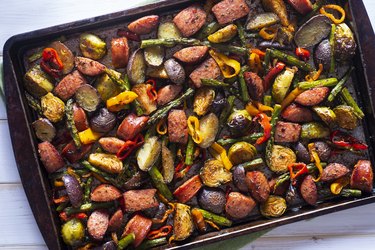
Vegetables are truly delicious when roasted. Their flavors are enhanced by the roasting process — even their textures, as they get soft on the inside and a crispy golden brown on the outside.
Using olive oil will keep the roasted vegetables from discoloring and maintain their lovely taste. And roasting vegetables ahead is a great way to save time and have a side dish ready for the rest of the week. After cooking and storing your vegetables, follow the directions to reheat roasted vegetables to enjoy all week long.
Video of the Day
Video of the Day
How to Roast Vegetables
Things You'll Need
Vegetables
Olive oil
Knife
Oven-safe dish
Parchment paper
Salt
Pepper
Favorite seasonings
Aluminum foil
1. Choose Your Veggies
The best vegetables to roast include the following:
- Eggplant
- Zucchini
- Peppers
- Mushrooms
- Potatoes
- Fennel
- Red onion
Note that eggplant absorbs oil like a sponge. If you've included it in your medley, add a little more olive oil to the vegetables before reheating. You can also add other varieties according to your taste.
2. Prep the Veggies
Rinse all vegetables under cold running water when preparing vegetables in advance for roasting. Scrub the potatoes and peel the onions.
Cut the cleaned vegetables into 1-inch cubes and spread the pieces in a casserole dish layered with parchment paper.
Tip
Do not overcrowd the dish — leaving space allows hot air to surround the veggies for even cooking. Leave a bit of space between the pieces, and use an additional pan if needed.
3. Preheat the Oven
Heat the oven to 425 degrees Fahrenheit. Although it takes longer, if you like softer veggies, try roasting them at lower temperatures, such as 350 degrees Fahrenheit, as recommended by the University of California, Berkeley.
4. Add Oil and Spices
Drizzle the vegetables generously with extra-virgin olive oil and season them to taste with salt and pepper. Around 3 tablespoons of olive oil should be enough for 4 pounds of cut vegetables.
If you like a more aromatic flavor, place the cubed vegetables in a bowl and toss them with one or two crushed or finely minced cloves of garlic before placing them on the baking dish.
You can also add the olive oil, salt and pepper at this stage and spread the seasonings on the dish ready to go. For a touch of spiciness, add 1/4 to 1/2 teaspoon of cayenne pepper.
5. Roast the Vegetables
Place the dish in the oven and bake the vegetables for about 45 minutes or until golden brown. Check on and toss the vegetables every 15 minutes with a spatula.
Note that cooking times will vary according to the vegetable type, so you may need to adjust.
6. Pack the Veggies
Remove the dish from the oven and allow the vegetables to cool to room temperature. Cover the dish with aluminum foil and refrigerate overnight.
How to Reheat Roasted Vegetables
If you're not careful, reheating roasted vegetables can leave you with a pile of tasteless mush. There are several ways you can reheat your vegetables so that they maintain their texture and delicious flavor.
"Having ingredients that are already cooked can make it so that you are that much closer to having a meal prepared," says Alicia Connor, RDN, a San Francisco-based dietitian and chef.
She recommends these four methods for reheating the perfect roasted vegetables to use as a side or in salads, soups or frittatas throughout the week.
In a Saute Pan
Things You'll Need
Stovetop
Non-stick pan with a lid
1. Preheat the Pan
Preheat a non-stick pan over medium-low heat. Do not add any oil to the pan.
2. Cook the Vegetables
Add the cold roasted vegetables to the pan in a single layer. Place a lid on top of the pan and heat for 2 to 3 minutes until heated through.
In the Oven
Things You'll Need
Oven
Sheet pan
Parchment paper
1. Preheat the Oven
Preheat the oven to 375 degrees Farenheight. If your oven has a convection setting, use this for faster reheating.
2. Bake Vegetables
Line a sheet pan with parchment paper and add the roasted vegetables to the pan in a single layer. Roast for 2 to 5 minutes or until heated through.
In the Air Fryer
Things You'll Need
Air fryer
Parchment paper
1. Preheat the Air Fryer
Preheat the air fryer to 375 degrees Farenheight.
2. Air Fry Vegetables
Place a sheet of parchment paper into the tray of the air fryer, leaving space along the outside rim for airflow. Place a single layer of roasted vegetables on the parchment paper. Air fry the vegetables for 1 to 3 minutes or until warm.
In the Microwave
Things You'll Need
Microwave
Microwave-safe container with a cover
or Microwavable steamer with a lid
1. Prepare Vegetables
Add roasted vegetables in a single layer to a microwave-safe container with a lid. Alternatively, you can use a microwavable steamer with a lid.
2. Microwave Vegetables
Heat for 30 seconds or until warmed through.
Tips for the Best Reheated Roasted Vegetables
If you're making extra vegetables and plan to reheat them to eat throughout the week, Connor recommends following these tips:
- Cut vegetables for roasting in similar-sized pieces for even cooking and place them in a single layer for even and quicker roasting.
- Avoid overcooking vegetables so that they retain their texture when they are reheated.
- Do not add too much oil. Use a spray oil for easy control.
- Reheat and roast veggies in a single layer for even cooking and to reduce the risk of overcooking, which will lead to a rubbery or mushy texture.