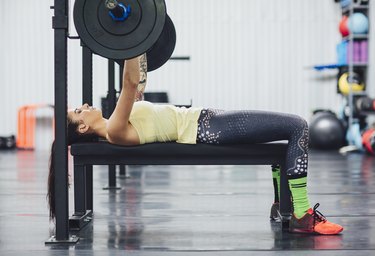
If you've waited (sometimes patiently, sometimes less so) for your turn on a bench in a crowded gym on Mondays, you know the unique pain of wanting to get a bigger chest.
The unofficial chest day for lifters all over, Mondays have become synonymous with the bench press — and the chiseled, defined pectorals that come with enough practice.
Video of the Day
But you'll only see those results you're craving with some smart training strategies and proper nutrition. We tapped top trainers to share everything you need to know about building a bigger chest. Plus, we highlight some of the best chest exercises to help you get started.
What Are the Chest Muscles?
While your chest muscles are a smaller muscle group than, say, your legs and back, they are still important. They provide stability and aid in daily functional movements, like pushing doors open, moving a grocery cart and sliding heavy furniture across the room.
"Like a hinge on a door, the chest muscles are responsible for movement of the arms and shoulders, such as flexion, adduction and rotation," Oscar Smith, a certified personal trainer and owner of O-D Studio in New York City, tells LIVESTRONG.com.
Your chest muscles span the entire front part of your upper torso, from your sternum (the breastbone) to your shoulders, so they are on both sides of your body. Your chest is comprised of two major muscles: the pectoralis major and the pectoralis minor.
- The pectoralis major is a two-headed muscle that includes the clavicular head and the sternocostal head, which starts from your breastbone and connects to the upper arm. According to the American Council on Exercise (ACE), the pectoralis major is at work when you lift your arms in front of you, like in a shoulder front raise, and when you perform pushing motions, like in a bench press.
- The pectoralis minor is the triangle-shaped muscle that lies beneath the pectoralis major and runs from some of your ribs to your shoulder blade in a diagonal. This smaller chest muscle is responsible for scapular protraction, bringing the shoulder blade forward and away from the spine.
While there are many upper-body exercises that also target the chest muscles, you want to focus on exercises that isolate the pectoralis major and minor to create the larger cuts and chiseled lines you desire.
Related Reading
The Benefits of Stronger, Bigger Chest Muscles
Other than filling out your T-shirts (and sports bras) nicely, there are functional perks that come with having a bigger chest.
You'll avoid injury. Stronger chest muscles can help ward off injuries, especially to your shoulders, because your pecs help stabilize the shoulder joint during a variety of movements.
"The shoulders tend to jump in during most chest exercises, if they are done improperly or if the individual can't handle the weight," says Chris Pabon, a NASM-certified personal trainer and fitness manager at Blink Fitness. "Strong chest muscles — and doing exercises with proper form — will keep the majority of the load where it belongs — in the pecs."
Plus, working your chest promotes symmetry, so you're less likely to have muscle imbalances in your upper body.
You'll have better posture. A more sedentary lifestyle can lead to a rounding of the back and tightness in the chest. But by strengthening all over, including your chest muscles, you'll naturally improve your posture and stand up taller and prouder, Pabon says.
Good posture isn't only a sign of confidence (hey, who wouldn't have a little more pep in their step with a bigger chest?), but it will also help you optimize your workouts because your chest works in tandem with your back, shoulders and arms.
You'll get more out of push movements. Whether you're doing an overhead press or a back squat, performing exercises with good form often involves keeping your chest tall and proud. By engaging your chest, you recruit other upper-body muscles, including your triceps and lats, to assist with the work, Pabon says.
"Every time you push or press something in front of you or overhead, your chest muscles are going to be a primary mover," Pabon says. "Even doing an overhead press, which is predominately a shoulder movement, will get some chest work in there as well."
Classic body-weight pushing movements, like push-ups and plank up-downs, get an extra boost from your chest muscles, too. Think about how much more powerful you feel doing a push-up when you focus on using your chest muscles to press yourself back up into a plank rather than relying solely on your arms.
Related Reading
How to Build a Workout for a Bigger Chest
To get a bigger chest, you're going to need to gain muscle mass. This is called hypertrophy, and it's most effectively achieved with a specific rep and set scheme in your chest workouts.
The ACE recommends completing 6 to 12 reps per set at 67 to 85 percent of your one-rep max, which is the heaviest weight you can lift at once for any given exercise. (You'll do fewer reps the closer you get to 85 percent of your one-rep max.) According to the ACE, you should aim for 3 to 4 sets at this weight to see a difference in the size of your pecs.
For example, if your max bench press is 200 pounds, you should press 134 to 170 pounds with a barbell. Note that the steel bar alone is 40 pounds, so you would add about 65 pounds worth of plates equally on both sides of the barbell. Alternatively, you can use a pair of dumbbells or kettebells.
"For hypertrophy, I would work your chest muscles until failure each time," Smith says. (A workout buddy who can spot you on your heavy lifts to failure can help keep you safe.) You'll know when you've reached muscle failure when you can't complete another rep of an exercise. By lifting heavy weights, you're engaging your slow- and fast-twitch muscle fibers, which helps promote muscle definition and growth.
"I rest only 60 to 75 seconds between sets and two to three minutes between exercises if I can help it," Pabon says. This generally falls in line with the ACE's recommendation of resting 30 to 90 seconds in between exercise intervals for hypertrophy.
Pabon recommends doing two chest workouts a week, but Smith says you can go up to three. According to a December 2012 study in Interventional Medicine and Applied Science, training three days a week with bench presses at 75 percent of your one-rep max for 3 sets of 10 repetitions can significantly increase pectoralis major muscle thickness and size after just one week.
During the other days of the week, you should focus on strengthening other muscle groups, as well as incorporating some cardio. "I would do a day of chest and then cardio later that day (two-a-day workouts are what the pros do). This can be helpful for the body to recover after," Smith says.
Here's a simple rule to follow: As long as you meet the U.S. Department of Health and Human Services guidelines for cardio activity to maintain good health, you can spend the rest of your time in the weight room if your goal is bigger muscles. That means getting at least 150 minutes of moderate-intensity cardio or 75 minutes of vigorous-intensity cardio per week.
Speaking of recovery, don't forget to also bake proper rest time into your schedule. After all, it's during rest that your muscles are able to repair and become bigger and stronger.
The ACE recommends 24 to 72 hours of recovery between working out the same muscle group. So, if you work out your chest every Monday, the next chest workout would be Wednesday or Thursday.
During recovery days, make sure to do some chest stretches to relieve tightness and soreness. They'll make your chest muscles feel brand-new for your next workout.
Increase the Intensity to Keep Making Progress
Hypertrophy truly happens when you practice progressive overload, which is the strength training principle of increasing load, reps, volume and intensity over time. After a few weeks, that 60-pound dumbbell chest press you've been doing isn't going to feel as challenging, so you need to up the ante.
One way to do this is to follow a pyramid set. "I would do what old-school bodybuilders would call a pyramid set, which includes light, heavy and then back to light weights," Smith says.
The benefit of following a pyramid set is that you reach muscle failure faster, and you train all muscle fibers to help with growth. It's also a great strategy if you don't have a ton of equipment at home. By increasing the rep range, you're able to work your muscles to failure without adding load.
Here's how it works: Choose the chest exercises you want to include in your workout. With the first set, you would use a pair of light weights and do 25 reps to warm up the chest muscles, Smith says. Then, you would pick up your heavy weights and complete 8 to 10 reps. Once you've finished the heavy set, go back to the light set of weights again and do 25 reps.
"You should do this for at least 5 sets per exercise. The weight that you use is up to you," Smith says. "I recommend that for your heavier weight, take what your max bench press weight is and then subtract 50 pounds."
Some research backs up this approach: According to a December 2019 study in the Journal of Strength and Conditioning Research, low-load resistance training to muscle failure promotes greater muscle hypertrophy than low-load resistance training without muscle failure. So, by doing higher reps at a lower weight, as you would in a pyramid set, you can achieve muscle hypertrophy even if you only have access to lower weights.
What to Eat for Bigger Chest Muscles
In addition to smart training strategies, building muscle mass requires proper nutrition. Nourishing your muscles with the right nutrients will help them grow stronger and bigger.
Protein and carbohydrates are the main macronutrients you want to center your diet around, but some healthy fats can help, too. That's because protein is broken down into essential and non-essential amino acids, which are the building blocks of muscle tissue. Both are critical for muscle growth, so it's important to vary your diet with different protein sources, including lean meats, fish, poultry, dairy, eggs and beans and legumes.
To promote muscle growth, you want to have a small calorie surplus instead of a deficit. The extra calories will field additional nutrients to your muscles for repair. Smith recommends increasing your protein intake by at least 15 percent. FYI, the normal recommended protein intake is 0.8 grams of protein per kilogram of body weight, according to Harvard Health Publishing.
So, if you normally consume about 30 grams of protein per meal, then you would need to increase your intake to 34.5 grams.
Some studies suggest getting an even higher amount of protein to build muscle. According to a February 2017 review in Nutrients, you might want to aim to eat 1.6 to 2.2 grams of protein per kilogram of body weight for hypertrophy. Beyond that limit, protein supplementation doesn't lead to additional muscle gains.
For example, if you weigh 155 pounds, then you would convert your weight into kilograms by dividing it by 2.2, and then multiplying that number by 1.6 and 2.2. You would aim to take in 113 to 155 grams of protein daily.
Carbohydrates are also essential for muscle growth. When you work out, you use glycogen stored in your liver and muscles, which primarily comes from carbs. After a tough sweat session, you need to replenish those glycogen stores so your muscles have fuel for your next workout.
Complex carbs, such as whole grains, beans, starchy vegetables and fruits, are good sources of vitamins and nutrients. Carbs also promote muscle protein synthesis, aka muscle repair, by stimulating insulin release.
"What's worked best for me is a 40/35/25 split for macros: 40 percent of calories of protein, 35 percent from carbs and 25 percent from fat," Pabon says.
5 of the Best Chest Exercises
In terms of the best chest exercises for hypertrophy, Pabon recommends the incline and decline dumbbell bench press, flat dumbbell bench press and chest fly. Smith also suggests doing dumbbell pullovers, cable cross-overs and close-grip bench presses.
According to October 2012 research from the ACE, three of the most effective chest exercises include the barbell bench press, the chest press and the incline dumbbell fly.
While these chest exercises are similar, changing the grip and incline of your bench can activate different parts of the muscles. It's best to use all types of grips and inclines to ensure you're working your chest in a variety of ways. "When you change your grip, you're looking to specifically target a muscle group or to grow the muscles and get stronger," Smith says.
Tip
- A close grip works more of your inner chest muscles, giving you more nice lines on your upper and lower pecs.
- A reverse grip, or supinated grip, works more of your triceps and upper pecs.
- A normal grip, or neutral grip, works all three upper and lower pecks and triceps.
- Incline bench presses work your upper pecs, while decline bench presses work your lower pecs.
If you have limited fitness equipment at home (i.e. you don't have access to a bench and barbell), Pabon suggests using dumbbells or incorporating some body-weight chest moves, like push-ups, into your workouts every day.
Fill your chest-building workouts with the exercises below to work your pectoralis major and minor at different angles.
Move 1: Barbell Bench Press
- Lie face up on a flat bench with your eyes in line with the barbell. Your feet should be flat on the floor.
- Grip the barbell with your hands shoulder-width apart and lift it off the rack to position it directly over your shoulders. Pull your abs into your spine to avoid arching the lower back.
- Lower the barbell as far as you can with control or until it touches your chest and you feel a stretch in your chest muscles. Pause for a second in this position.
- Press the weight back to the top until your arms are fully extended.
Move 2: Barbell Decline Bench Press
- Lie face up on a decline bench adjusted to about 30 degrees below the flat bench, so your head is lower than your hips. The barbell should be right above your chest and your feet should be flat on the floor.
- Grip the barbell with your hands shoulder-width apart and lift it off the rack. Pull your abs into your spine to avoid arching the lower back.
- Lower the bar with control until it touches your chest. Pause in this position for a second.
- Press the bar back up until your arms are fully extended.
Tip
As you lower the weight in a bench press, you should feel your chest muscles stretch. When you push the weight back up, you want your elbows almost locked out but not completely. "Locking them out will take some tension off the chest, and we want to hit it as hard as possible," Pabon says.
Move 3: Reverse Grip Dumbbell Bench Press
- Lie face up on a flat bench, holding a dumbbell in each hand right above your chest, palms facing in. Your feet should be flat on the floor.
- Lower the dumbbells with control until the heads of the weights are just outside of your torso. Pull your abs into your spine to avoid arching the lower back. Pause here for a second.
- Press the weights back up to the top until your arms are fully extended.
Tip
With any bench press, you want to keep your shoulder blades retracted throughout the movement to keep the shoulders safe, Pabon says.
Move 4: Incline Dumbbell Fly
- Lie face up on an incline bench adjusted to about 45 degrees, holding a dumbbell in each hand above your shoulders, palms facing each other.
- With a slight bend in your elbows, slowly lower the weights down toward the sides of your chest. Your elbows should come to about shoulder level.
- Lift your arms back up to the starting position, squeezing your chest at the top.
Move 5: Stability Ball Bench Press
- Rest your back on a stability ball, knees bent, feet planted on the ground hip-distance apart. Hold a dumbbell in each hand right above your shoulders, palms facing your feet.
- Pull your abs toward your spine and squeeze your glutes to keep your hips from sagging as you lift your hips to form a straight line from your shoulders to your knees.
- Lower the weights with control until the heads of the weights are just outside of your shoulders.
- Keep your hips lifted as you press the weights back up to the top.
- Bend your elbows to 90 degrees as you lower the weights toward your chest and repeat.
- American Council on Exercise: "ACE-Sponsored Research: Top 3 Most Effective Chest Exercises"
- Journal of the International Society of Sports Nutrition: "Evidence-Based Recommendations for Natural Bodybuilding Contest Preparation: Nutrition and Supplementation"
- Health.gov: "Dietary Guidelines for Americans, 2015-2020: Appendix 1. Physical Activity Guidelines for Americans"
- Journal of Strength and Conditioning Research: "Muscle Failure Promotes Greater Muscle Hypertrophy in Low-Load but Not in High-Load Resistance Training"
- Journal of Sports Sciences: "Dose-Response Relationship Between Weekly Resistance Training Volume and Increases in Muscle Mass: A Systematic Review and Meta-Analysis"
- ACE: "Weight Lifting Tempo & Sets: How to Select the Right Sets for Your Clients"
- American Council on Exercise: "Muscles That Move the Arm"
- American Council on Exercise: "How to Select the Right Intensity and Repetitions for Your Clients"
- American Council on Exercise: "How to Select the Right Rest Intervals and Post-Training Recovery for Your Clients"
- Interventional Medicine and Applied Science: "Time Course for Arm and Chest Muscle Thickness Changes Following Bench Press Training"
- Harvard Health: "How Much Protein Do You Need Every Day?"
- Nutrients: "Recent Perspectives Regarding the Role of Dietary Protein for the Promotion of Muscle Hypertrophy With Resistance Exercise Training"