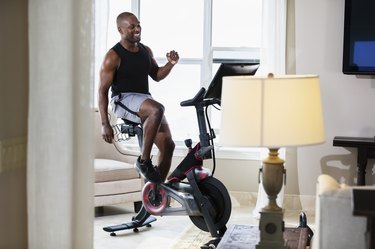
Outdoor cycling is a great low-impact exercise, but not everyone is comfortable riding a bike and the weather doesn't always cooperate with your workout schedule.
Fortunately, you can reap the same health-boosting benefits with indoor cycling, thanks to a plethora of stationary bikes and cycling apps. And if this is your first time hopping in the saddle, many indoor bikes and cycling machines provide on-demand workouts and tutorials to help you get started.
Video of the Day
Video of the Day
Here are some of the greatest benefits of stationary bike workouts. Plus, exactly how indoor cycling can help you burn calories, build endurance and much more — without leaving the comfort of your home.
8 Stationary Bike Benefits
1. It's Gentle on Your Joints
Climbing aboard a cycling machine is a low-impact cardio workout that tends to be comfortable on sensitive joints. In fact, cycling is often used in rehab for joint-related issues because it eliminates some of the impact in other forms of exercise like running.
"Cycling is easy on your body because it's a closed chain exercise, which means it's connected to a fixed object — in this case, the pedals — creating less stress on the body," explains Dyan Tsiumis, CPT, a personal trainer with MYX Fitness and Openfit. "This closed chain makes it a gentle option for people who want an intense workout without stressing their joints."
2. It Strengthens Your Lower-Body Muscles
It's important to keep your joints healthy as you age in to prevent stiffness and muscle imbalances. Joints that are able to move through their full range of motion help their surrounding muscles gain more strength during exercise, making your workouts more effective.
Thankfully, joint-friendliness is one of the main benefits of riding a stationary bike.
"The movement [of cycling] helps lubricate the joints, thus helping the bones. And by adding resistance, you can build lower-body muscles and strength," says Tiffany Berenberg, CPT, a certified personal trainer and studio manager for Life Time in Minnesota.
In fact, regular cycling can help reduce stiffness and joint pain commonly associated with exercise in people living with osteoarthritis, according to a March 2016 study in the Journal of Rheumatology.
And because indoor bike machines simulate outdoor terrain, you'll ride in and out of the saddle targeting your quads, hamstrings, calves and glutes.
"While seated, you will build the gluteus and hamstring muscles, and when you lift to ride out of the saddle, you build the quadriceps as well as the gluteus muscles," Tsiumis says.
3. It Burns Lots of Calories
If you're looking to lose weight, indoor cycling can help, says Todd Buckingham, PhD, an exercise physiologist with the Mary Free Bed Sports Rehabilitation Performance Lab. "Be consistent with your biking workouts. Try to ride every day for at least 30 minutes each day." Beginners should aim to do one to two indoor cycling workouts per week.
Your caloric expenditure largely depends on your exercise intensity. The harder you work, the more stationary bike calories you burn.
For example, a 155-pound person who cycles for 30 minutes on a stationary bike can burn around 252 calories at a moderate pace and 278 calories at a vigorous pace, according to Harvard Health Publishing.
However, the same 155-pound person, who cycles 30 minutes at a competitive pace of 16 to 19 miles per hour, can burn around 421 calories, according to the American Council on Exercise.
Keep in mind that these numbers are just estimates and that your calorie burn depends on your biological sex, age, weight, body composition and resting metabolic rate, among other factors, according to the Mayo Clinic.
Here's another calorie-burning benefit of cycling machine: You're able to adjust the level of resistance. That way, you can increase your exercise intensity without having to pedal faster.
4. It's Convenient and Customizable
One of the most common workout excuses? "I just don't have the time." Meanwhile, one of the advantages of cycling indoors is that you can do it for as little or as much time as you want — all in the comfort of your own home.
"Stationary biking is a great alternative to outdoor cycling for many individuals due to the convenience," says Emily Booth, the education manager for cycle at Life Time fitness centers.
One of the biggest benefits of stationary cycling is that the weather doesn't impact your workout, and you can control the intensity by adjusting the speed and resistance, so you can design a workout that fits your specific training program.
"The terrain is dictated by your resistance, so you can create your own experience each time you get on the bike. You can add hills and flat roads, or do recovery or endurance rides. The cycling world is your oyster," Tsiumis says.
5. It Builds Endurance
Just like many other forms of cardio, indoor cycling benefits your heart health while strengthening your muscular endurance. The amount of time you spend in the saddle at different resistance levels, along with your cadence (revolutions per minute) trains your lower-body muscles to be efficient and keeps your heart rate up, Berenberg says.
Stationary bikes benefit cardiovascular fitness just like outdoor cycling, with the added perk that there is no 'coasting' on a stationary bike. You have to work continuously," Booth says.
As you get stronger over time, you'll want to increase the resistance and time you spend on the bicycle machine to continue challenging your muscles.
6. It's Safer Than Riding on the Road
According to cycling statistics, 25 percent of cyclist deaths are the result of drivers trying to overtake bike lanes between intersections.
Biking indoors avoids cycling-related dangers from vehicle traffic or dangerous roads, making it a helpful alternative for anyone living in an area that isn't favorable for outdoor cyclists.
7. It Can Boost Your Mood
Generally, doing any form of regular exercise and physical activity, including indoor cycling, is associated with reduced stress and anxiety, according to a July 2018 review in Current Psychiatry Reports.
And the good news is that you don't have to ride for very long to feel the mood-boosting benefits of indoor cycling machines. Just 15 minutes of riding a stationary bike can help decrease cortisol levels among people living with major depression, according to a small December 2013 study in BioPsychoSocial Medicine.
8. It Provides Community Support
Cycling can be an intimidating sport to break into. If you're nervous about exercising around other people, an indoor cycling routine can help you reach your goals from the comfort and security of your own home.
And of course, it can also be social. If you have a cycling app or own an indoor bike that offers live group cycling classes, they allow you to enjoy these indoor cycling benefits in a team atmosphere. "If you're riding with a friend with a different fitness level than you, [stationary cycling] lets you ride together, but at your own individual pace," Booth says.
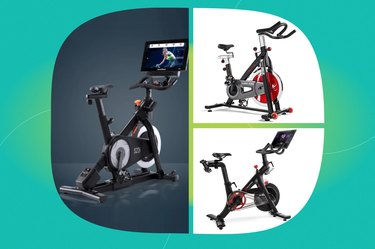
The Best Stationary Bikes for At-Home Workouts
- Peloton Bike (OnePeloton.com, $2,245)
- Echelon EX-3 Connect Bike (EchelonFit.com, $799.99)
- Sunny Health and Fitness Belt Drive Indoor Cycling Bike (Amazon.com, $557.00 )
Try This 30-Minute Stationary Bike Workout
Ready to hop in the saddle for your first indoor ride? Try this indoor cycling workout designed by Berenberg.
"It lets you build up to a threshold, hold steady to work on a smooth cadence with resistance and ends strong with a quick 3-minute push," she says.
For the greatest cycling machine benefits, be sure to use the RPE (rate of perceived exertion) scale to help you adjust the resistance in your workout. Consider 1 a soft pedal and 10 an all-out effort. All you have to do is grab your cycling shoes and start pedaling.
Time | Rate of Perceived Exertion | |
|---|---|---|
Warm-Up | 2 to 3 minutes | RPE 2 to 3 |
Build Up Resistance Each Minute | 7 minutes | Start with RPE 4 and end with RPE 7 to 8 |
Recover (soft pedal) | 1 minute | RPE 2 to 3 |
Hold Steady | 5 minutes | RPE 4 to 6 |
Recover (soft pedal) | 1 minute | RPE 2 to 3 |
Build Up Resistance Each Minute | 7 minutes | Start with RPE 4 and end with RPE 7 to 8 |
Recover (soft pedal) | 1 minute | RPE 2 to 3 |
Threshold | 3 minutes | RPE 7 to 8 |
Cool-Down | 2 to 3 minutes | RPE 0 to 1 |

- BioPsychoSocial Medicine: "A clinical study of the efficacy of a single session of individual exercise for depressive patients, assessed by the change in saliva free cortisol level"
- Journal of Rheumatology: "Improved Function and Reduced Pain after Swimming and Cycling Training in Patients with Osteoarthritis"
- Current Psychiatry Reports: "Moving to Beat Anxiety: Epidemiology and Therapeutic Issues with Physical Activity for Anxiety"
- Harvard Health Publishing: "Calories Burned in 30 Minutes for People of Three Different Weights"
- American Council on Exercise: "Tools & Calculators: Physical Activity Calorie Counter"
- Mayo Clinic: "Metabolism and Weight Loss: How You Burn Calories"