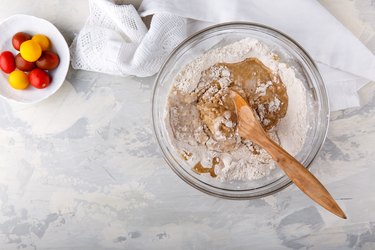
Baking soda is a salt that makes food light and fluffy. If you don't have this ingredient at hand, use a baking soda substitute. Without it, your cake won't rise and can turn out flat.
Tip
Leaving baking soda out of the cake prevents it from rising, but you can use baking powder as a substitute.
Video of the Day
Uses for Baking Soda
Baking soda is often used in dessert recipes like cookies and cake, but it has many uses outside of the kitchen too. In fact, you can use it to clean your countertops and even your clothes. According to Michigan State University Extension, this product is good for brushing your teeth, settling your stomach or unclogging a drain.
Video of the Day
Read more: Baking Soda for Sore Muscles
The U.S. National Library of Medicine states that baking soda may help relieve heartburn and indigestion. That's because it neutralizes the excess acid that may cause digestive issues. Baking soda is often sold in tablet form as an antacid to take after meals.
The proper name for baking soda is sodium bicarbonate. That's the chemical name, which means that there is a sodium molecule with two carbons. There are no additives in baking soda. Baking powder, on the other hand, has two additional acids, which changes the way it affects food texture and consistency.
Read more: Keto Blueberry Muffins
Baking Soda vs. Baking Powder
One of the acids in baking powder is monocalcium phosphate, according to North Carolina State University. The other one is either sodium acid pyrophosphate or sodium aluminum sulfate. The two additional chemicals in this ingredient make it release slowly during the baking process compared to baking soda, which reacts quickly when it meets an acid.
When you bake a cake, you want it to rise gradually as it cooks rather than all at once. Not only can baking powder be used as a baking soda substitute, but it might also actually be better to use in cakes because of its gradual release.
Sodium bicarbonate makes your food rise by producing carbon dioxide. On the acid-base scale in chemistry, it's on the basic side. You need some type of acid in your cake recipe to act as a catalyst and interact with the baking soda, according to the American Chemical Society. Buttermilk is an example of an acid used in baking.
The reaction with an acidic compound makes sodium bicarbonate release carbon dioxide. As your cake is cooking, this reaction is taking place. When carbon dioxide is released, it creates little gas bubbles that make the dough of your cake rise. That's why it expands as it cooks and becomes light and fluffy.
Read more: Pumpkin Chocolate Chip Bundt Cake
Alternatives to Baking Soda
The only drawback of this process is that the chemical reaction starts immediately, so you'll want to have your oven heated to the proper temperature by the time you're done mixing your cake batter. Yeast creates carbon dioxide, which can make your baked goods rise — this makes it a possible baking soda substitute.
Yeast isn't a chemical, but a living organism, explains an article from K-State Research and Extension. It's commonly added to bread to make the dough rise, but it has a shorter shelf life than baking soda.
This microorganism feeds on sugar and produces carbon dioxide to make the dough rise with the gas bubbles. If you forgot baking soda, you can use yeast in your cake recipe, but it will add a flavor that you might not enjoy.
It's difficult to replace both baking soda and baking powder in cake recipe. Both compounds help neutralize the acidic ingredients in your cake, which enhances the flavor. That's why you can't easily replace them with something that makes the dough rise, like yeast. The flavor they create is part of their appeal.
- K-State Research and Extension: "3 Key Chemical Leavening Agents in Baking"
- American Chemical Society: "The Science of Baking Soda"
- North Carolina State University: "The Difference Between Baking Soda and Baking Powder"
- U.S. National Library of Medicine: "Sodium Bicarbonate"
- Michigan State University: "Endless Uses of Baking Soda"
- Epicurious: Basic Cake Balls
- Epicurious: Yeasted Sugar Cake