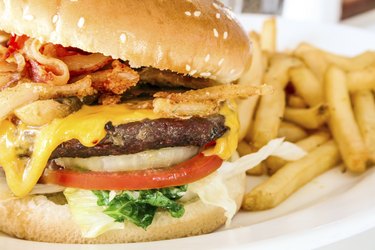
You've been disciplined and focused when it comes to your eating plan -- sticking to the calorie recommendations and resisting treats. But one night -- be it a holiday event, a stress-induced feast in front of the television or a party where the drinks left you uninhibited as to what you ate -- has left you feeling guilty and defeated. But, even if you went all out and downed an entire carton of ice cream or gorged on happy hour snacks, it's nearly impossible to eat enough in one evening to gain substantial weight. The number on the scale may rise as a result of water retention, but it should normalize after you return to a healthy eating routine and exercise regimen.
How a Binge Affects Your Weight
Video of the Day
Substantial weight gain is a result of a consistently eating more calories than you burn. A 3,500-calorie surplus will cause you to gain 1 pound -- but it's quite hard to eat that much on top of what you need for daily maintenance to gain 1 pound in one night. Even if you had a pint of vanilla ice cream, five large chocolate chip cookies and half a 17-ounce family bag of nacho-cheese corn chips, you'd have had 3,230 calories. To gain weight, you'd need to eat more like 5,000 to 6,000 calories in one day.
Video of the Day
Of course, if you keep up these binge sessions daily, or even once per week, you could undo any calorie deficit you create during the week and inhibit weight loss or even gain weight. But, a one-night affair is unlikely to do any permanent harm.
Don't Stress About the Scale
After a one-night binge episode, the scale may fluctuate. The scale reflects not only the weight of fat on your body but also any urine, feces and water -- as well as bone, muscle and organ mass. When you eat a high-carb and sodium-rich meal -- as a binge is likely to be -- your body holds onto extra fluids. These should shed after a few days back on your healthy plan.
Sometimes, the scale fluctuates even if you haven't binged. A woman's hormones, constipation or a tough workout can also cause shifts in the scale. Measure weight-loss progress over a week or a month -- not over the course of a few days.
Examine Why You Binged
More importantly than the binge itself are the reasons behind it. If your diet is too restrictive, you may rebound and overeat in response. Your body and mind perceive severe calorie cutting and meal skipping as deprivation, driving you to overeat and give in to cravings. You only have so much willpower, and if challenged too much, at some point it cracks.
Your diet should not leave you ravenous. How you perceive the action of refusing pizza and cupcakes also affects your willpower. If you believe it's a choice you are making, rather than one dictated by doctors or a diet book, you are more likely to accept the dietary changes. If, however, you perceive the dietary restrictions as being forced upon you, you may have a much harder time accepting them.
Any time you limit calories, though, your mind and body feel some stress. A study published in a 2010 issue of Psychosomatic Medicine showed that restricting and counting calories causes increased release of the stress hormone cortisol. Increased cortisol production actually encourages your body to gain weight.
Also observe if you binge in response to life stress or anxiety. Take nonfood-related action the next time you feel overwhelmed by work, peers or family. Head to a yoga class, call a close friend or go for a mind-clearing walk. If binging is your way of dealing with stress, it may take a concerted effort to overcome the habit -- but it can be done with time.
A Nutritionally Sound Diet Plan
Biologically, make sure you're getting the nutrients you need when you do eat. Cutting out an entire food group, subsisting on extremely small portions or drinking all your meals can make you feel deprived and lead to a binge.
Include vegetables, whole grains and protein at every meal. If you are hungry after you finish your plate, load up on extra watery, fibrous vegetables, such as broccoli and salad, as the fiber and volume of the food helps fill you up. Adequate protein also makes you feel satisfied. A 2012 study published in the British Journal of Medicine found that consuming about 0.55 gram of protein per pound of body weight daily leads to improved feelings of satisfaction and preservation of lean muscle as you lose weight. Go for 2 to 4 ounces of skinless poultry, lean beef, pork tenderloin, tofu or fish at meals and snacks. The fiber in whole grains, such as quinoa and brown rice, makes them digest more slowly than refined grains. This keeps you feeling fuller and more satisfied for longer, so you're less likely to feel hungry and deprived, leading to binge eating.
- Shape: When Your Weight Fluctuates: What’s Normal and What’s Not
- Healthaliciousness: Ice Cream, Cookies, Chips
- Psychology Today: Must Cutting Calories Lead to Binge Eating?
- Psychosomatic Medicine: Low Calorie Dieting Increases Cortisol
- British Journal of Nutrition: Dietary Protein - Its Role in Satiety, Energetics, Weight Loss and Health