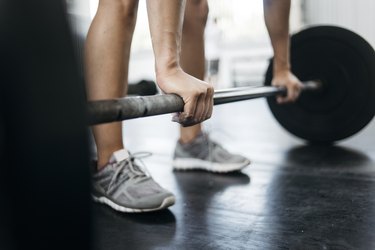
Your success when you're pumping iron often depends on the eight tiny bones and connecting ligaments that make up the wrist joints of each hand.
Weight lifters of every age and ability depend on their wrists, from beginners hoisting rubber dumbbells to Olympians under heavy metal. Your wrists link the load in your hands with the larger muscles in your arms, torso and legs, helping transfer the physical force needed to complete many resistance-training moves.
Video of the Day
Video of the Day
Weak wrists can quickly become inflamed (or worse) if you attempt to lift too much weight or let your form falter. Even seasoned lifters may encounter chronic pain or injury on occasion.
The good news, though, is that wrist injuries among weight lifters are relatively rare: A six-year study of weight lifting-related injuries published in 2018 in the Journal of Long-Term Effects of Medical Implants found that less than 5 percent of sprains and strains involved the wrists. (Exercisers were much more likely to complain of shoulder, lower-trunk and upper-trunk pain.)
Types of Wrist Pain From Lifting
While not common, injuries do occur among weight lifters. Newbies in particular are likely to report wrist pain, according to Sanjeev Kakar, MD, an orthopedic surgeon at the Mayo Clinic. "We often see wrist pain at the start of the new year, when inexperienced lifters hit the gym," Dr. Kakar says. "They reach for heavy weights and their muscle tissues aren't used to taking that load."
In some cases, the cause of wrist pain is clear — an overly heavy weight may cause a sudden sharp pain. In other cases, the condition may be chronic, developing with time from overuse. Medical experts often classify wrist pain by where it hurts, separating conditions that affect the back of the hand (knuckles up) from those that affect the front (palms up).
According to Dr. Kakar, causes of wrist pain among weight lifters include:
- De Quervain's tenosynovitis, which affects tendons on the back of the thumb-side of the wrist and causes difficulty moving the thumb and wrist when pinching or grasping.
- Intersection syndrome, an overuse injury characterized by pain or swelling on the back of the wrist in line with the index or pointer finger. Intersection syndrome is also known as "oarsmen's wrist" because of its prevalence among rowers.
- ECU pain, or inflammation of the extensor carpi ulnaris forearm muscle. ECU pain hurts on the pinky side of the back of the wrist and can be treated with ice and anti-inflammatory medication.
- TFC injury, a tear of the triangular fibrocartilage complex tissue on the back of your wrist near your pinky finger, which can limit your range of motion.
- FCR tendinitis, inflammation of the flexor carpi radialis forearm muscles that flex the wrist on the inside near the thumb.
- Stress fractures of the wrist bones.
- Injuries to wrist ligaments (including sprains and strains).
- Carpel tunnel syndrome, which is caused by pressure on a nerve in your palm that can lead to numbness, weakness and tingling in the fingers.
When to Talk to Your Doctor About Wrist Pain
If you do develop mild to moderate wrist pain that has no clear cause or injury and feels like overuse, reach out to your doctor or a physical therapist.
How to Prevent and Treat Wrist Pain From Lifting
If your wrists don't already hurt, let's keep it that way! Before you lift, try flexing, extending and massaging your wrists gently against the floor or a wall, Dr. Kakar says.
Then, before doing exercises that place a lot of pressure on your wrists, warm up with practice repetitions at a lighter weight before you attempt to go heavy. "Leave your ego at home if you've never lifted before," Dr. Kakar says. "Consider doing lifting with a partner who can spot you, especially while doing heavy lifts."
Lifting with good form and technique can also help you avoid wrist pain. "With most lifts, the load of the weight is transferred through the wrist, so it's important to keep the weight in alignment," says Eric Paur, a board-certified sports physical therapy specialist with TRIA Orthopedics in Minneapolis.
He also recommends grip-strengthening exercises to condition your wrists to handle larger loads. "Grab a bar and hang from it," he says. "You might not be able to do a full chin-up, but if you hang there as long as you can, you'll develop more wrist and grip strength. It's underrated, but it really works."
If hanging from a bar is too difficult, try doing farmer's carries, where you hold a weight in each hand by your sides and walk from one end of the room to the other with good posture and a braced core.
Was this article helpful?
150 Characters Max
0/150
Thank you for sharing!
Thank you for your feedback!