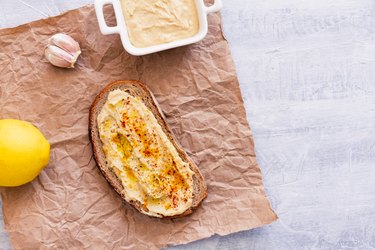
If you love hummus, here's good news: The fat in hummus is generally good for you, and hummus itself is not fattening — as long as you make it part of a balanced diet. But snackers, beware. If your love for hummus leads you to eat more calories than your body needs, you'll start to put on weight.
Tip
Although hummus does contain some fat, that doesn't necessarily make it a fattening food. Instead, your calorie balance — whether you're eating more calories than you need, fewer calories than you need or just as many as you need — determines whether this kind of food goes to your waistline.
Video of the Day
A Look at Hummus Nutrition
Hummus — a flavorful paste typically made of garbanzo beans, tahini, garlic, olive oil and lemon juice — is a staple in Middle Eastern and Mediterranean diets.
Video of the Day
As the USDA notes, hummus does have plenty of fat content. Here's the general breakdown of hummus calories and nutrition for a typical 1-tablespoon serving:
- 39 calories
- 1.23 grams protein
- 2.67 grams fat
- 2.98 grams carbohydrate
Just because there's fat in hummus doesn't mean it'll go straight to your hips. For most people, it's your overall calorie intake that determines whether you put on weight, lose weight or hold steady.
In general, if you aren't eating too many calories, you won't gain weight. The Department of Health and Human Services (HHS) has a handy chart you can use to estimate how many calories you should eat to maintain your weight, judging by your age, sex and physical activity level. If you track your daily calorie intake, you judge how often, and how much, hummus can fit into your daily diet without it being a fattening food.
However, watch your serving sizes. When you eat something as a dip or a spread, it's very easy to accidentally exceed a modest 1-tablespoon serving. Using an actual measuring spoon and/or dishing out portioned servings are great ways to avoid that trap.
Is Eating Fat Fattening?
If hummus is rich in fat, why doesn't it make you fat? A couple of studies shed light on the relationship between macronutrient intake and its effect on your waistline. Their ultimate verdict: As long as you're eating a calorie-appropriate diet with reasonably balanced representation from all three macronutrients (fat, protein and carbohydrate), the specific macronutrient balance doesn't seem to matter that much.
That's confirmed by a study published in the February 2009 issue of the New England Journal of Medicine. Although it's been a while since this study was published, it remains particularly noteworthy because of its large sample size (more than 800 participants), its long study period (two years) and its design, which allowed researchers to directly compare results from a diet that included 40 percent calories from fat versus a diet that included 20 percent calories from fat.
Ultimately, both of those groups achieved similar weight loss at the end of the two-year study period.
Interestingly, a data review published in the May 2015 issue of Advances in Nutrition found that increasing your fat intake might actually make it easier to stick with a diet — and that long-term compliance is ultimately what it takes to reach or maintain a healthy weight.
Read more: Is Hummus Bad for Weight Loss?
Back to Hummus
While eating fat on its own isn't necessarily a bad thing, the types of fat that you consume can make a big difference in your health.
According to the USDA, the vast majority of the fat in hummus — 2.16 grams — comes from unsaturated fats. And that's a good thing. As the American Heart Association points out, replacing saturated fats with unsaturated fats can have positive health effects, such as lowering your levels of triglycerides and "bad" LDL cholesterol, while also providing essential nutrients.
Saturated fats are the unhealthy fats that can cause cardiovascular disease and other health problems, and the HHS recommends restricting them to less than 10 percent of your total calorie intake.
But because of its unsaturated fat content, hummus is generally a healthy, nonfattening choice — as long as you pay attention to those serving sizes and keep your overall intake of hummus calories to reasonable levels.
- USDA: "Hummus, Plain"
- New England Journal of Medicine: "Comparison of Weight-Loss Diets With Different Compositions of Fat, Protein, and Carbohydrates"
- Advances in Nutrition: "Effect of Macronutrient Composition on Short-Term Food Intake and Weight Loss"
- American Heart Association: "Dietary Fats"
- HHS: "Dietary Guidelines for Americans, 2015-2020: Chapter 1. Key Elements of Healthy Eating Patterns"
- HHS: "Dietary Guidelines for Americans, 2015-2020: Appendix 2. Estimated Calorie Needs Per Day, by Age, Sex, and Physical Activity Level"
Was this article helpful?
150 Characters Max
0/150
Thank you for sharing!
Thank you for your feedback!