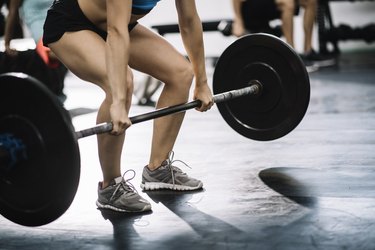
Becoming super-buff doesn't have to be a pipe dream; there are foolproof ways to pack on muscle and get the body you've always dreamed of. If you're on a mission to get a buff body, it's important to find the right workout routine (hint: It's not running!), eat high-quality protein and other foods that maximize muscle growth, get good sleep and live a healthy lifestyle.
Go From Bones to Buff
Video of the Day
Always remember that quality trumps quantity when it comes to your workout. If you're truly looking to go from bones to buff, running for three hours isn't going to do the trick. Rather, your workouts should be short, sweaty and intense; think heavy lifting (but always use a spotter) and multijoint exercises like chinups and pullups.
Video of the Day
Men's Journal also states that, for those who really want to build muscles quickly, volume training is key. Try doing five or more exercises per body part (four sets of eight to 12 reps) to bulk up fast. In addition, mix in some high-intensity interval training and cardio to change things up a bit; variety can help you avoid training plateaus.
Read more: Can You Get in Shape in a Week?
Eat the Right Foods
Go from skinny to buff when you eat the right foods. First, don't stress too much about calorie cutting as this can make you lose muscle. The trick to getting buff muscles is to eat more protein and cut down on carbs.
According to Men's Health, you should only eat carbs right before and after you train, since carbs give you energy to exercise and also replace the energy you lose during a workout. In terms of protein intake, Men's Journal says that a good rule of thumb is to get 1 to 1.5 grams of protein per lean pound of body weight.
Quality food sources are just as important as exercise, according to the U.S. Department of Health & Human Services. Some of the best foods that can help you maximize muscle growth and minimize fat gain include quinoa, salmon, avocado, sprouted-grain bread and rolled oats, all of which are fantastic at keeping your metabolism functioning at tiptop speed.
Read more: Fastest Ways to Get in Shape in 2 Weeks
Get Healthy in Every Way
On your journey to getting buff, diet and exercise are a big piece of the puzzle, but it's also crucial to get healthy in every other aspect of your life. Sleep is one of the most important indicators of overall health, and getting seven to nine hours of shut-eye per night is vital for post-workout recovery.
On that note, according to John Underwood, author of Sleep and Recovery: An Applicable Approach to a Lifestyle of Recovery and Rest for Athletes, during sleep is when muscle growth actually occurs. Plus, particularly intensive workouts can cause micro-damage within muscle tissue. So getting a good night's sleep on days when you work out hard is the best way to give your body a chance to recuperate.
If you're serious about your goal to get buff fast, it's also a good idea to cut out or severely reduce your alcohol intake, since, according to an article published in Shape by the Diet Doctor, Mike Roussell, Ph.D., alcohol produces a metabolic environment that's the exact opposite of the environment your body creates post-exercise. That is to say, it creates an environment of inhibited fat burning coupled with high circulating levels of fat. This isn't optimal when you're trying to get big fast, to say the least.
Read more: Alcohol & Fat Burning
- Men's Journal: 25 Ways to Get Bigger
- Men's Health: Eat to Get Ripped Fast With This Smart Meal Plan
- U.S. Department of Health & Human Services: How to Eat Healthy
- National Sleep Foundation: How Much Sleep Do We Really Need?
- Shape: Does Alcohol Make You Gain Weight?
- Life of an Athlete: Sleep and Recovery