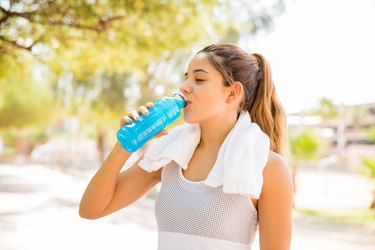
When you're thirsty and need a quick boost of energy, what do you grab? If you're trying to decide which side of the Gatorade vs. soda debate you're on, you might want to examine the nutrition label of each beverage to see how much sugar and other ingredients are hiding in your favorite go-to drink.
Gatorade vs. Soda
Video of the Day
Gatorade is a sports-drink that contains sugar and electrolytes like sodium and potassium. The drink is advertised as a way to rehydrate when performing endurance activities such as running and cycling. According to the Gatorade website, a 20-ounce serving of Gatorade contains 140 calories and 36 grams of carbohydrates, with 34 grams of carbohydrates coming straight from sugar. It also has 270 milligrams of sodium and 75 milligrams of potassium.
Video of the Day
A 12-ounce can of soda, cola style, has 156 calories and 38.5 grams of carbohydrates with 37 grams of carbohydrates coming from sugar, according to MyFoodData. The sodium and potassium in cola is much lower than Gatorade, with only 11.2 milligrams of sodium and 18.6 milligrams of potassium. It's important to note that the serving sizes when comparing Gatorade vs. soda are different, with Gatorade being 20 ounces and the soda 12 ounces. Ounce per ounce, the soda is more concentrated with sugar and calories.
And finally, if you're looking for a beverage with caffeine, you're probably weighing the pros and cons of Coke vs. Gatorade. In addition to the high sugar content, Coke also has 33.5 milligrams of caffeine, whereas, the original Gatorade does not contain caffeine.
Keep in mind that the Federal Food and Drug Administration (FDA) has cited 400 milligrams a day as the maximum amount of caffeine a healthy adult should consume. So, if you're a cola drinker, and you consume other caffeinated beverages or food items, consider keeping track of the amount of caffeine you consume in a day.
What Should You Drink?
The question of what you should drink really comes down to the sport or fitness event you're participating in and the duration of the activity. For most people, deciding between Gatorade vs. water is an easy choice: Go with water. That said, since athletes often need sugar and electrolytes, Gatorade is preferred over soda as its easily digested and replenishes electrolytes while supplying energy.
However, for most people that are not performing endurance activities for an extended period of time, the Academy of Nutrition and Dietetics says most, if not all, of your hydration needs, will be satisfied with water. They point out that sports drinks should only be consumed by athletes that are engaged in a moderate-to high-intensity exercise that lasts longer than an hour.
Water is also a better choice when it comes to calories and sugar content. Even if you're not trying to lose weight, consuming excess sugar and calories from sports drinks and soda can lead to an increase in obesity, type 2 diabetes, heart disease and gout, according to Harvard T.H. Chan School of Public Health.
But just how much sugar is too much? The American Heart Association says most women should not exceed 100 calories or 25 grams of added sugar per day and men should not exceed 150 calories or about 38 grams of sugar per day. When compared to the 34 grams of sugar in Gatorade and 37 grams of sugar in a cola, it's easy to see why water is the clear winner when it comes to hydration.
Determining Your Hydration Needs
Staying hydrated throughout the day is a key component to overall health. There are several theories as to how much water you should drink in a day, but the actual amount really comes down to your individual needs such as your health, activity level and where you live, explains the Mayo Clinic. That said, they do cite the National Academies of Sciences, Engineering, and Medicine's recommendations which state that men should get about 15.5 cups or 3.7 liters of fluids per day and women about 11.5 cups or 2.7 liters per day.
When it comes to hydration, a good rule of thumb is as long as you're drinking water throughout the day, with a focus on a few extra glasses before you exercise and hydrating while working out, you should be able to keep your body hydrated and running at peak performance.
To get a better idea if you're adequately hydrated, pay attention to the color of your urine and thirst level. If your urine is colorless or light yellow, you're consuming enough fluids, but if it is dark-colored, you may be dehydrated. And if you rarely feel thirsty, there's a good chance you're keeping up with your hydration needs.
- Harvard T.H. Chan School of Public Health: "Sugary Drinks"
- U.S. Department of Agriculture, MyFoodData: "Soft Drink, Cola, Fruit or Vanilla Flavored"
- Academy of Nutrition and Dietetics: "Hydrate Right"
- Federal Food and Drug Administration: "Spilling the Beans: How Much Caffeine is Too Much?"
- American Heart Association: "Sugar 101"
- The Mayo Clinic: "Water: How Much Should You Drink Every Day?"
- Gatorade Official Website: "Thirst Quencher: Nutrition Information"