



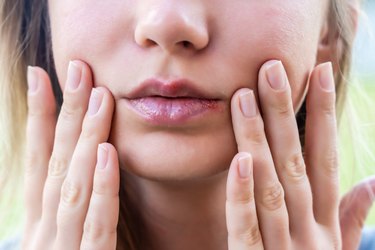






















Cold sores are tiny blisters on the skin, usually around the mouth. According to the Mayo Clinic, herpes simplex virus type 1 (HSV-1) is usually the cause of cold sores on the face; however, herpes simplex virus type 2 (HSV-2), which causes genital herpes, can also cause facial cold sores. After an outbreak, which can last up to two weeks, the virus lies dormant in nerve cells until triggered by stress, illness, fever or fatigue. Doctors prescribe topical anesthetics to relieve the pain and antiviral medications to shorten the healing time, but these drugs can have unpleasant side effects. Many herbs have antiviral actions and specifically target both types of the herpes simplex virus.
Star anise
Star anise (Illicium verum) is a star-shaped spice from the star anise tree, a small evergreen native to China. The essential oil contains antiviral compounds known as phenylpropanoids and sesquiterpenes. An in vitro (test-tube) study by German researchers, published in the December 2009 issue of "Evidence-based Complementary and Alternative Medicine," found that star anise oil had potent antiviral activity against herpes simplex virus type 1. The oil was 99 percent effective in reducing herpes viral infection in the test tube. The phenylpropanoids and the sesquiterpenes worked by directly inactivating the herpes virus. The herb's most active antiviral constituent was the sesquiterpene known as beta-caryophyllene. The research supports treating recurrent cold sores with a topical application of star anise oil containing beta-caryophyllene.
Licorice
Licorice root (Glycyrrhiza glabra) is effective against a number of viruses, including the HSV-1 that causes cold sores. Licorice contains the potent antivirals glycyrrhizin and glycyrrhetic acid. Herbalist David Hoffmann, in his 2003 book, "Medical Herbalism: the Science and Practice of Herbal Medicine," states that glycyrrhizin inactivates herpes simplex virus particles. A study published in the September 2005 issue of "Biological and Pharmaceutical Bulletin" found that glycyrrhetic acid showed even greater anti-herpes action than glycyrrhizin.
Peppermint
Peppermint (Mentha piperita) is an aromatic herb that contains a potent essential oil. A study published in the July 2003 issue of "Phytomedicine: International Journal of Phytotherapy and Phytopharmacology" found that peppermint oil was effective against both herpes simplex virus types 1 and 2. Peppermint oil was also active against strains of HSV-1 that are resistant to acyclovir, a drug prescribed for herpes infections. The researchers recommend peppermint oil as a topical treatment for herpes infections.
Japanese cypress
Japanese cypress (Chamaecyparis obtusa) is an evergreen that contains a lignan known as yatein. Yatein inhibits the herpes simplex virus type 1 at the DNA level. A study reported in the July 2006 issue of "Antiviral Research" found that yatein blocks the alpha gene expression of HSV-1 and prevents the virus from replicating.
Lemon balm
Lemon balm (Melissa officinalis) is an aromatic herb that contains potent antiviral compounds in the leaves and the essential oil. A study published in the 2008 issue of "Natural Product Research" found that rosmarinic acid was the main ingredient in lemon balm extract that was effective against herpes simplex virus 2. Herbalist David Hoffmann recommends applying a lotion of lemon balm extract to cold sores.
References
- Mayo Clinic
- "Evidence-based Complementary and Alternative Medicine"; Screening for Antiviral Activities of Isolated Compounds from Essential Oils; Astani A, Reichling J, Schnitzler P; December 15, 2009
- "Medical Herbalism: the Science and Practice of Herbal Medicine"; David Hoffmann; 2003
- "Biological and Pharmaceutical Bulletin"; Anti-herpes virus type 1 activity of oleanane-type triterpenoids; Ikeda T, Yokomizo K, Okawa M, Tsuchihashi R, Kinjo J, Nohara T, Uyeda M; September 2005
- "Phytomedicine: International Journal of Phytotherapy and Phytopharmacology"; Virucidal effect of peppermint oil on the enveloped viruses herpes simplex virus type 1 and type 2 in vitro; Schuhmacher, A.; Reichling, J.; Schnitzler, P; July 2003


