
You squat to train your glutes, you lunge to train your quads and you deadlift to train your hamstrings. But where do calves fit into your leg-day routine?
Doing endless calf raises isn't the best (or most exciting) way to lift and sculpt these muscles. Instead, target your calves by adding a resistance band and standing on your toes during some familiar lower-body exercises.
Video of the Day
Video of the Day
On your next leg day, give your calves some much-deserved TLC with these five resistance band exercises, courtesy of Samuel Chan, physical therapist at Bespoke Treatments in New York.
Tip
Thinner resistance bands offer the least resistance — and are therefore easier to use — while thicker resistance bands offer the most resistance. Resistance bands come in different colors to signify their resistance levels.
Move 1: Banded Ankle Pumps
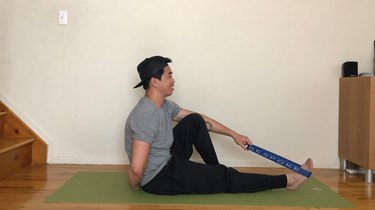
- Begin seated on the ground with your right knee bent, foot on the floor and left leg extended straight. Loop a band around the ball of your left foot.
- Holding the other end of the band in your hands, press your left toes away from you as if you're pumping a gas pedal.
- Pause for a few moments.
- Then bring the toes back to face the ceiling.
- Make sure to do the same number of reps on each side.
Move 2: Standing Calf Raise With Ankle Band
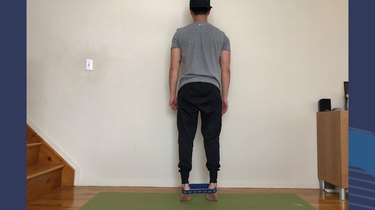
- Begin standing with feet hip-width apart, back flat and core braced.
- Wrap a resistance band around your ankles, looping around the bottom of your heels.
- Lift up on the balls of your feet.
- Pause here for a few moments.
- Return to the starting position.
Move 3: Banded Soleus Raise
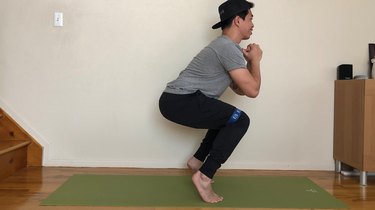
- Stand with your feet at hip-width apart, back flat and core braced.
- Loop a resistance band above your knees.
- Push your hips back and squat down until your thighs are parallel to the ground.
- Holding this squat, come up onto the balls of your feet.
- Pause here for a moment.
- Bring your heels back to the floor.
- Repeat these calf raises while holding a squat.
Tip
If you're struggling to keep your balance, hold onto the back of a chair or counter for extra stability.
Move 4: Banded Marches With Calf Raise
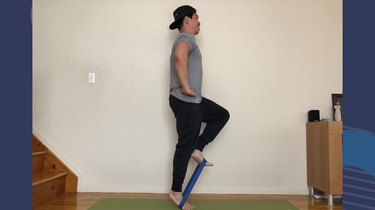
- Start standing tall with feet hip-width apart.
- Loop a resistance band around the balls of your feet.
- Raise your right knee up toward the ceiling.
- Simultaneously, come up onto the balls of your left foot.
- Return to the starting position and then switch sides, alternating back and forth.
Move 5: Banded Side Steps With Calf Raise
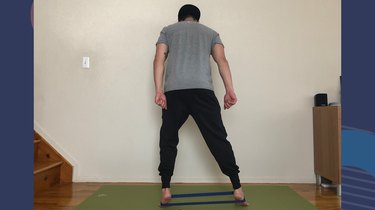
- Stand tall with a band looped around the arches of your feet.
- Come up onto the balls of your feet in a calf raise.
- Step your right foot to the right a few steps.
- Repeat this motion, stepping to the left, keeping your feet at least hip-width apart.